This compound belongs to the class of organic compounds known as styrenes. These are organic compounds containing an ethenylbenzene moiety.
External Descriptors
Not available
1. Djoumbou Feunang Y, Eisner R, Knox C, Chepelev L, Hastings J, Owen G, Fahy E, Steinbeck C, Subramanian S, Bolton E, Greiner R, and Wishart DS. ClassyFire: Automated Chemical Classification With A Comprehensive, Computable Taxonomy. Journal of Cheminformatics, 2016, 8:61.
Determine the necessary mass, volume, or concentration for preparing a solution.
Dilution Calculator
Determine the dilution needed to prepare a stock solution.
Reconstitution Calculator
Bewertungen
Kundenbewertungen
Application Protocols
No assay protocols (e.g., WB, IHC, IF, FC) apply to this material. For materials handling, consider the following practical workflows (general guidance):
3D printing filament use: Dry at ~80 °C for 2–4 h; nozzle 230–250 °C; bed 90–110 °C; enclosure recommended to reduce warping. Tune per filament grade.
Solvent welding: Use MEK or ethyl acetate sparingly; apply by brush or syringe; fixture for 10–30 min; allow ≥24 h for full strength.
Surface activation: Oxygen plasma 1–3 min prior to coating/adhesion; proceed immediately with primer/coating to minimize hydrophobic recovery.
Refer to your process documentation and the specific resin grade’s technical data for exact settings.
Biological Roles
ABS is a synthetic engineering thermoplastic with no intrinsic biological function. It is not a metabolite, cofactor, or biological macromolecule.
Relevance to bio-labs (general/literature)
Can serve as a structural material for lab fixtures, instrument housings, or disposable prototypes. For biointerfaces, surface activation (e.g., oxygen plasma, UV‑ozone) may be used to increase hydrophilicity and support coating with biomolecules or extracellular matrix proteins.
Chemical leachables are formulation-dependent; for any contact with biologics, assess extractables/leachables and perform compatibility testing with the exact grade.
No biological pathways or physiological roles apply to this material.
Buffer Applications
Not typically applicable. ABS is a solid polymer, not a buffering reagent. It does not participate in acid–base equilibria relevant to buffer preparation. For lab use with buffers, consider:
Compatibility testing of ABS components with your buffer (pH, salts, surfactants) to avoid stress cracking or swelling.
Using surface treatments or barrier coatings if prolonged buffer contact is required.
Green Alternatives
Context: ABS offers excellent performance but relies on petrochemical monomers and often requires aggressive solvents for surface finishing. Greener choices depend on performance needs.
Material alternatives (literature)
PLA (polylactic acid): Bio-based, compostable in industrial settings; lower heat deflection and impact than ABS; suitable for low-load housings and 3D prints.
PC–ABS blends with halogen-free FR systems: Improved heat/impact; can be specified with RoHS-compliant additives; still petrochemical-based.
Bio-ABS or recycled ABS: Incorporates bio-attributed styrene/acrylonitrile or high-recycled content; maintains similar processing.
PA11/PA1010 (bio-based polyamides): Higher heat/chemical resistance; may replace ABS in demanding parts; different processing/solvent behavior.
Process/solvent choices (literature)
Prefer mechanical finishes over solvent smoothing; if solvent is needed, use ethyl acetate or acetone over methylene chloride/THF where performance allows, and implement capture/ventilation.
Waterborne primers/inks and plasma activation can replace chromic acid etches or solvent-based adhesion promoters in some workflows.
Comparison snapshot (indicative)
ABS vs PLA: ABS higher impact/heat; PLA lower VOCs in printing but brittle and heat-sensitive.
ABS vs Recycled ABS: Similar properties if controlled feedstocks; recycled reduces footprint but may widen property variation.
ABS + green processing: Plasma activation + waterborne coatings reduce hazardous waste versus solvent etch/prime.
Select alternatives based on required Tg/impact, environmental stress cracking resistance, and regulatory constraints.
Pharmaceutical Uses
ABS is not an active pharmaceutical ingredient and is not used as a buffer or excipient in formulations.
Context (general/literature)
In the broader manufacturing landscape, ABS may be used for non-product-contact housings, fixtures, or prototype tooling. Any use in regulated environments requires grade-specific regulatory documentation (e.g., REACH, RoHS) and extractables/leachables assessments; such documentation is not provided here.
For this SKU, no pharmacopeial status or formulation role is specified. Refer to the CoA/Spec Sheet if regulatory notes are available for the particular lot/grade.
Physical Properties
Item-specific specs
Appearance: Not specified for this item; refer to CoA/Spec Sheet.
Grade/Purity: Not specified for this item; refer to CoA/Spec Sheet.
Polymer characteristics (general/literature; indicative, not item-specific)
Physical state: Amorphous thermoplastic; typically pellets or granules.
Color: Natural grades off‑white to light beige; colorable with masterbatch.
Density: ~1.03–1.07 g/cm³ (23 °C) depending on rubber content and fillers (literature).
Glass transition: SAN phase Tg typically ~100–107 °C; rubber phase Tg < −50 °C (literature).
Softening: Vicat (A50) commonly ~95–110 °C (grade-dependent; literature).
Thermal decomposition: Onset often >300 °C under inert; processing window usually 200–260 °C (literature).
Solubility: Insoluble in water; soluble/swells in ketones (e.g., MEK, acetone), esters (ethyl acetate), chlorinated solvents (methylene chloride), and aromatic hydrocarbons (toluene) to varying degrees (literature).
Surface energy: ~36–40 mN/m; adhesion often improved via etch or plasma (literature).
Refractive index: SAN phase nD ~1.57; bulk ABS often reported around ~1.53–1.55 (literature).
Electrical: Volume resistivity typically >10^14 Ω·cm (dry; literature).
Notes
ABS is amorphous; no true melting point. Reported Tg/Vicat values vary by grade, rubber content, and additives.
Always consult the item’s CoA/Spec Sheet for definitive properties applicable to this specific lot.
Quality and Grades
Item-specific status
Grade/Purity: Not specified for this item; refer to CoA/Spec Sheet.
Stabilizers/Additives: Not specified for this item; refer to CoA/Spec Sheet.
How ABS grades differ (general/literature)
Processing grades: Injection molding, extrusion/sheet, thermoforming, and 3D-printing filament grades differ in melt flow index (MFR/MFI), molecular-weight distribution, and rubber particle morphology.
Performance variants: High-impact (higher butadiene), high-heat (increased Tg via SAN composition), high-flow (lower MW/tailored distribution), electroplating grades (surface-etchable for metallization), flame‑retardant grades (with FR systems), UV-stabilized/heat‑stabilized, antistatic, and glass/mineral‑filled formulations.
Color and optics: Natural, pre-colored, and opaque/transparent SAN‑rich variants exist; gloss and haze controlled by particle size and SAN formulation.
Implications of stabilizers (typical)
Antioxidants and heat stabilizers suppress thermal oxidation during processing.
Lubricants and mold-release agents influence surface energy and downstream adhesion/printing.
Quality documentation
For this specific SKU, consult the CoA/Spec Sheet for: melt flow rate, ash/filler content, volatiles, thermal properties (Tg/Vicat), color metrics (b*, L*), moisture limits, and any regulatory notes (e.g., RoHS/REACH statements) if applicable.
Reaction and Applications
ABS as a research material (general/literature)
Materials science and prototyping
Widely used for injection-molded housings, fixtures, and 3D-printing filament due to balanced toughness, rigidity, and machinability. Stable dimensions and easy solvent bonding make it suitable for lab jigs and microfluidic prototypes.
Surface modification and metallization
Electroplating-on-plastics (POP): Butadiene-rich domains are selectively etched (e.g., chromic acid/sulfuric) to create a micro-porous surface for catalyst seeding (Sn/Pd) and subsequent electroless Ni/Cu deposition; enables conductive tracks and RF shields.
Plasma/UV-ozone treatments raise surface energy for improved adhesion and biofunctional coatings.
Chemical functionalization
Nitrile groups in SAN matrix enable limited post-functionalization (e.g., surface hydrolysis to amide/carboxylate under strong conditions), while allylic sites in butadiene phase allow ozonolysis or grafting.
Graft-from polymerizations (e.g., SI-ATRP/RAFT) on pre-activated ABS surfaces can create brush coatings.
Solvent processing
ABS dissolves in ketone/ester/chlorinated systems to prepare conductive composites (carbon black, Ag flakes), adhesion promoters, or patterned resists via spin/spray coating.
Practical tips
Dry resin before melt processing (typical: 80 °C, 2–4 h; literature) to minimize splay and hydrolysis.
Avoid residence times >5–7 min at >260 °C; monitor for yellowing/fume evolution.
Manage residual stresses (anneal near 80–90 °C when dimensional stability is critical).
Reaction Conditions
Guidance below reflects general processing/functionalization conditions reported in the literature; they are not specifications for this item.
Drying (prior to melt processing)
70–85 °C under dry air or vacuum, 2–4 h, to reduce moisture (<0.1% typical target) and prevent splay/voids.
Extrusion/injection molding
Barrel temps commonly 200–250 °C (feed to nozzle gradient); mold 50–80 °C; residence time minimized (<5–7 min) to prevent degradation. Screw speeds moderate to limit shear heating.
Annealing to relieve stress
75–90 °C for 1–3 h depending on section thickness; cool slowly to room temperature.
Solvent bonding
MEK or ethyl acetate applied by capillary action or vapor exposure seconds to minutes; clamp until green strength achieved; full strength after 12–24 h as solvent dissipates. Ensure robust ventilation.
Surface etch for metallization (POP)
Typical etch bath: chromic acid/sulfuric acid mixture at ~60–70 °C for minutes (grade-dependent), followed by thorough rinsing, neutralization, Sn/Pd activation, and electroless Cu/Ni deposition. Note: hexavalent chromium processes are hazardous; consider Cr(VI)-free alternatives where possible.
Plasma/UV‑ozone treatment
Oxygen plasma at 50–200 mTorr, 10–200 W RF, 0.5–5 min increases surface energy; effects may age—coat promptly.
Always optimize on coupons from the exact grade; monitor color, gloss, and mechanical changes as indicators of overprocessing.
Safety and Handling
Item-specific hazard data
GHS classification, pictograms, signal word, H-statements: Not specified for this item; refer to SDS.
General safety considerations for ABS resins (literature/guidance)
Hazards
Combustible polymeric solid; burning/melting can release irritating vapors and decomposition products (e.g., styrene, acrylonitrile traces, butadiene fragments, hydrogen cyanide and NOx in under-ventilated fires).
Dust from machining/filament grinding may create a nuisance dust and, if finely dispersed, a combustible dust hazard.
PPE and hygiene
Wear safety glasses with side shields, lab coat or protective garments, and suitable gloves when handling pellets, solutions, or machining swarf.
Use local exhaust ventilation during thermal processing (e.g., extrusion, 3D printing) and solvent-based operations to control vapors and particulates.
Storage incompatibilities and precautions
Store away from strong oxidizers and strong acids. Avoid prolonged UV exposure and heat to limit yellowing/embrittlement.
Prevent contact with chlorinated solvents at elevated temperature; can cause environmental stress cracking.
First-aid overview (guidance only; see SDS)
Inhalation of fumes/dust: Move to fresh air; seek medical attention if symptoms persist.
Skin contact: Wash with soap and water. For hot melt burns, cool with water—do not attempt to remove solidified polymer; seek medical care.
Eye contact: Rinse cautiously with water; remove contact lenses if easy; seek medical attention if irritation continues.
Fire-fighting
Water spray, foam, dry chemical, or CO2; fire can produce toxic gases—self-contained breathing apparatus recommended.
Always consult the specific SDS for authoritative hazard classification and emergency measures for this item.
Solvent Selection
Applicability: ABS is a solid polymer; this section addresses solvent interactions for dissolution, cleaning, bonding, or surface treatments rather than selecting a reaction solvent.
Polarity/miscibility (literature)
Water: Insoluble; negligible swelling.
Good solvents: MEK, methyl isobutyl ketone (MIBK), cyclohexanone, ethyl acetate, tetrahydrofuran (THF), dimethylformamide (DMF), methylene chloride; toluene/xylene swell and can partially dissolve SAN-rich ABS.
Poor solvents: Aliphatic hydrocarbons (hexane, heptane) and alcohols cause minimal swelling; acetone can be a borderline/partial solvent for some grades.
Practical selection
Bonding/Finishing: MEK or a ketone/ester blend offers controlled surface softening for adhesive bonding or vapor smoothing (use with strict ventilation and safety controls).
Cleaning: Isopropanol for benign wipe-downs (low attack); stronger cleanup with ethyl acetate or MEK if residue compatibility allows.
Coatings/inks: Ketone/ester/aromatic blends tune dry time and film formation; test for stress-cracking.
Compatibility and stress cracking
Polar aprotic and chlorinated solvents can induce environmental stress cracking, especially under load. Use lowest effective solvent strength and brief contact times.
Comparison (literature, indicative)
MEK: Fast, strong solvent; good for welding—higher ESCR risk.
Ethyl acetate: Moderate strength; more forgiving; slower dry.
IPA: Minimal attack; preferred for gentle cleaning.
Always verify solvent interactions on scrap coupons of the exact grade/finish before production use.
Storage and Reconstitution
Item-specific instruction (from Product Data)
Storage Conditions: Room temperature.
Shipped In: Normal.
General guidance for ABS resins (literature)
Keep sealed in original packaging to prevent dust uptake and minimize moisture absorption. While ABS is less hygroscopic than polyamides, drying prior to melt processing is beneficial to avoid cosmetic defects and reduce volatile evolution.
Protect from direct sunlight and sources of heat to limit yellowing and oxidative embrittlement.
If supplied as pellets/granules, no reconstitution is required. For solution preparation (e.g., coatings), dissolve in an appropriate solvent (e.g., MEK/ethyl acetate blend) under stirring; add solids/fillers incrementally to avoid agglomeration; filter to desired fineness.
After opening, reseal liners with desiccant where feasible. First‑in/first‑out (FIFO) inventory practice is recommended.
Note: For exact drying targets, allowable storage humidity/temperature ranges, and any shelf‑life statements, consult the CoA/Spec Sheet for this specific SKU.
Research Use Note: For research use only.
Structure and Identity
Overview: ABS (acrylonitrile–butadiene–styrene) is a multiphase engineering thermoplastic copolymer composed of a rubbery polybutadiene dispersed phase within a rigid styrene–acrylonitrile (SAN) matrix.
Item-specific identifiers (from Product Data)
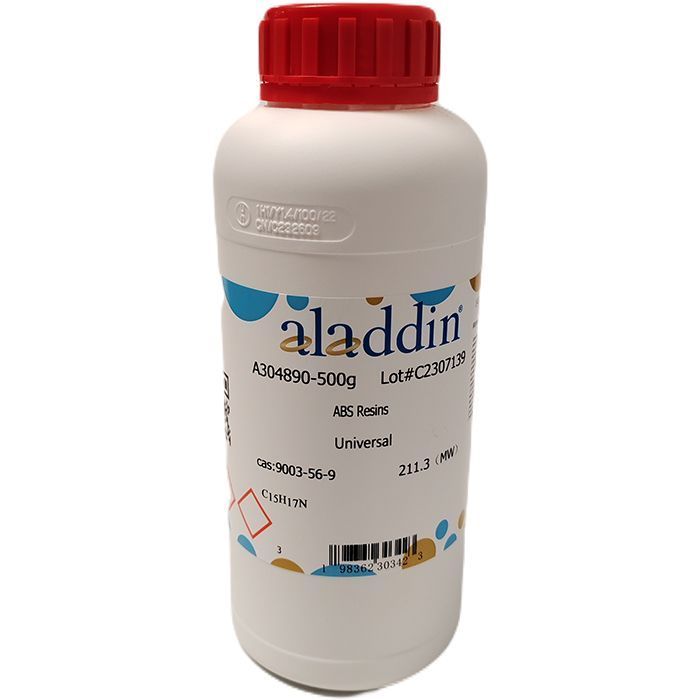
Product Name: ABS Resins (SKU: A304890)
CAS: 9003-56-9 (polymeric substance)
CID: 24756 (polymer class entry)
InChIKey: 415575 (polymer class placeholder)
SMILES: Not specified for this item; refer to CoA/Spec Sheet. (Note: polymers typically lack a single definitive SMILES.)
Molecular Formula: Not applicable to macromolecules with variable composition.
Molecular Weight: Not specified for this item; refer to CoA/Spec Sheet. (ABS has broad molecular-weight distributions.)
Structural features (general/literature)
Copolymer of three monomers: acrylonitrile (–CH2–CH(CN)–), 1,3-butadiene rubber segments (–CH2–CH=CH–CH2–)n, and styrene (–CH2–CH(Ph)–).
Morphology: Two-phase system—polybutadiene rubber particles (often grafted with SAN) dispersed in a continuous SAN matrix; particle size and grafting strongly influence impact strength and gloss.
Functional groups: Aromatic phenyl rings (styrene), polar nitrile groups (acrylonitrile), and unsaturated/allylic sites retained within the butadiene rubber (extent depends on hydrogenation/stabilization).
Stereochemistry: Atactic SAN sequences; rubber phase contains cis/trans-1,4 and 1,2-vinyl microstructures depending on feed/processing.
Typical composition (literature): ~15–35% acrylonitrile, ~5–30% butadiene, ~40–60% styrene by mass, tuned for toughness vs. rigidity.
Synthetic Utility
As a polymeric material, ABS is not a classic small-molecule building block; however, it has utility as a substrate/support in synthetic and materials workflows (literature):
Surface-initiated polymerizations
After surface activation (e.g., plasma, peroxide initiators), ATRP/RAFT “graft-from” strategies can grow functional polymer brushes from ABS surfaces, enabling tailored wettability, antifouling, or sensor interfaces.
Metallization and microfabrication
Standard POP workflows create adherent Cu/Ni layers on ABS for prototyping conductive circuits and EMI shielding. Subsequent patterning via subtractive etch allows rapid device iteration without PCBs.
Chemical post-modification
Limited hydrolysis or aminolysis near nitrile-bearing SAN domains (under strong conditions) provides polar functionality for coupling. Ozonolysis of residual unsaturation in the butadiene phase can introduce carbonyl groups for further derivatization.
Composite formation
ABS readily forms dispersions with carbon black, CNTs, metal flakes, or ceramic fillers to adjust electrical/thermal/mechanical properties for functional components or fixtures.
These utilities are grade- and process-dependent; verify adhesion/compatibility and thermal history for your specific ABS lot.
Target Specificity
Not applicable. This product is a polymeric resin, not a biological affinity reagent or antibody. No antigen, epitope, species reactivity, clone, or isotype information applies.
Wir verwenden Cookies, um die ordnungsgemäße Funktion der Website sicherzustellen und, soweit zulässig, Ihr Nutzererlebnis zu verbessern. Sie können Ihre Einstellungen jederzeit unter „Einstellungen“ verwalten. Weitere Informationen finden Sie in unserer Cookie-Richtlinie.
Shall we send you a message when we have discounts available?
Remind me later
Thank you! Please check your email inbox to confirm.
Products are supplied to verified businesses, institutions, and qualified professionals for research and development use only. Not for use in humans, animals, diagnosis, or therapy.

 C2627318