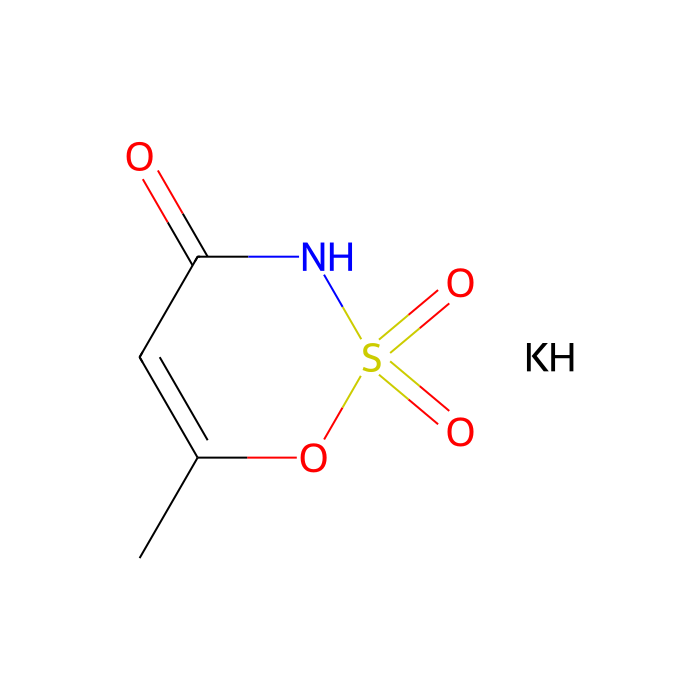
Acesulfame Potassium - 10mM in DMSO , CAS No.55589-62-3

CAS: 55589-62-3 Cat. No.: A407850 Molecular Weight: 201.24 Beilstein Registry Number: 3637857 EC Number: 259-715-3
AVAILABLE TO ORDER
GRADE & PURITY 10mM in DMSO
Storage
Store at -80°C
Shipped In
Dry ice packs + Cold packs
 ·  off list, applied to all prices below.
Size
Status
Price
Qty
1ml
A407850-1ml
2

$47.90

$55.90
Save $8.00 (14.31%)
Enter a quantity for the sizes you want to add.
🧪

Why this grade

10mM in DMSO for sensitive chromatographic and analytical workflows requiring minimal baseline interference.

🌡

Storage & shipping

Store at -80°C Ships Dry ice packs + Cold packs Check lot-specific COA for exact specifications.

📋

Quality documents

SDS, COA, datasheet, and spec sheet available for download. Lot-specific COA accessible via lot number lookup.

📚

Literature proof

Cited in 13 peer-reviewed publications across chromatography, organic synthesis, and cross-coupling reactions.

Overview

Information

Acesulfame potassium is a non-nutritive sweetener.
In vitro

Acesulfame potassium activates two members of the human TAS2R family (hTAS2R43 and hTAS2R44) to stimulate bitter taste. Acesulfame potassium elicited robust elevation of cytosolic Ca2+ in hTAS2R44-expressing cells, with a threshold value of activation of 0.25 mM and an EC50 value of 2.5 mM. Acesulfame potassium elicited response of hTAS2R43-expressing cells with a threshold value of 3.1 mM and an estimated EC50 value ﹥10 mM [1]\nAcesulfame potassium acts directly on the pancreatic islets and potentiates glucose-induced insulin release. Acesulfame potassium (1.0-15.0 mM) augmented insulin release from islets incubated in the presence of 7.0 mM d-glucose. [2]\nAcesulfame Potassium enhanced glucose absorption via activating sweet taste receptors in the enterocyte to translocate GLUT2 to the apical membrane through the PLC βII. In Caco-2 and RIE-1 cells, Acesulfame potassium (10 mM) increased glucose uptake by 20-30 % when incubated for 10 min with glucose >25 mM. [3]\nAcesulfame potassium increased the contractile response of isolated rat detrusor muscle strips via increased extracellular Ca2+ influx. Acesulfame potassium (10-7 M to 10-2 M) enhanced the contractile response to 10 Hz EFS compared to control. The atropine-resistant response to EFS is marginally increased by Acesulfame potassium (10-6 M). Acesulfame potassium (10-6 M) increased the maximum contractile response to α, β methylene ATP by 35% and to KCl by 12%. Acesulfame potassium (10-6 M) increased the log EC50 from -2.7 to -3.03. [4]

In vivo

Acesulfame potassium acts on two members of the TAS1R family of G-protein-coupled receptors (TAS1R2 and TAS1R3) to stimulate sweet taste. Selective elimination of T1R-subunits differentially abolishes de tection and perception of these two taste modalities. [5]\nAcesulfame potassium can also induce insulin secretion in rats. Injection of Acesulfame potassium (150 mg/kg body weight) increased the plasma insulin concentration at 5 min from 27.3 mU/mL to 58.6 mU/mL. Infusion of Acesulfame potassium (20 mg/kg body weight/min) for one hour maintained the insulin concentration at a high level (about 85-100 mU/mL). When using different amounts of Acesulfame potassium, the insulin secretion is stimulated in a dose-dependent fashion. [6]\nOral administration of Acesulfame potassium (60, 450, 1500 and 2250 mg/kg body weight) induced a significant increase in the frequency of cellular damage and chromosome aberrations in the Bone marrow cells isolated from mice femora. [7] Oral administration of Acesulfame potassium at the concentration of 150, 300, and 600 mg/kg body weight is found to induce DNA damage in bone marrow cells of mice with a minimum effective concentration (MEC) value of 150 mg/kg in the comet assay. [8]\n
Cell Data

cell lines:

Concentrations:

Incubation Time:

Powder Purity:

Specifications

Specifications & Purity
10mM in DMSO
Storage
Store at -80°C
Shipped In
Dry ice packs + Cold packs
This product requires cold chain shipping. Ground and other economy services are not available.
Names and Identifiers
Isomeric SMILES CC1=CC(=O)[N-]S(=O)(=O)O1.[K+]
WGK Germany 1
Alternate CAS 33665-90-6
Molecular Weight 201.24
Beilstein 3637857
Reaxy-Rn 3637857
Reaxys-RN_link_address https://www.reaxys.com/reaxys/secured/hopinto.do?context=S&query=IDE.XRN=3637857&ln=

Documentation

📋 Safety Data Sheet (SDS)

Comprehensive hazard, handling, storage, and regulatory compliance document.

Download SDS →

✅ Certificate of Analysis (COA)

Lot-specific quality data. Enter your lot number to retrieve the exact COA.

Look up COA →

📊 Datasheet

Quick-reference summary of product specifications and applications.

View datasheet →

🔬 Specification Sheet

Full quality attributes and acceptance criteria for this grade.

View spec sheet →

Advanced Data

Certificates(CoA,COO,BSE/TSE and Analysis Chart)
C of A & Other Certificates(BSE/TSE, COO):
Analytical Chart:
Chemical and Physical Properties
Melt Point(°C)229-232°C
Citations of This Product
References
1. Sun Xiao-Dong, Wu Hai-Long, Liu Zhi, Chen Yue, Liu Qian, Ding Yu-Jie, Yu Ru-Qin.  (2018)  Rapid and Sensitive Detection of Multi-Class Food Additives in Beverages for Quality Control by Using HPLC-DAD and Chemometrics Methods.  Food Analytical Methods,  12  (2): (381-393).  [PMID:] [10.1007/s12161-018-1370-3]
2. Hongmei Zhang, Shixin Sun, Yanqing Wang, Zhenghao Fei, Jian Cao.  (2018)  Binding mechanism of five typical sweeteners with bovine serum albumin.  SPECTROCHIMICA ACTA PART A-MOLECULAR AND BIOMOLECULAR SPECTROSCOPY,      [PMID:30015031] [10.1016/j.saa.2018.07.013]
3. Yuan-Liang Hu, Zeng-Ping Chen, Yao Chen, Cai-Xia Shi, Ru-Qin Yu.  (2016)  Generalized multiple internal standard method for quantitative liquid chromatography mass spectrometry.  JOURNAL OF CHROMATOGRAPHY A,      [PMID:27072522] [10.1016/j.chroma.2016.04.008]
4. Jing Xiao, Dali Zhuo, Jiayuan Tang, Jihong Chen, Chao Tan, Shu Zhang, Shichao Li, Zhirong Zou.  (2024)  Selective and sensitive detection of cyclamate in beverages using a portable pressure meter: A specific reaction-based analytical kit.  MICROCHEMICAL JOURNAL,      [PMID:] [10.1016/j.microc.2024.110959]
5. Yingying Yao, Kun Cui, Bingyu Tian, Hongxin He, Ping Wen, Rui Dong, Mingjin Fan.  (2025)  Anti-wear protection for titanium alloy interface based on “soft-hard” molecular design strategy and viscosity-lubrication effect of ionic liquids.  TRIBOLOGY INTERNATIONAL,      [PMID:] [10.1016/j.triboint.2025.111193]
6. Zihui Li, Wenxue Chen, Qiongya Wan, Haoliang Li, Xuefeng Wang, Pengcheng Xu, Yuan Zhang, Yongheng Zhu, Xinxin Li.  (2025)  A Carbon Black-Based Non-Enzymatic Electrochemical Sensor for the Detection of Sunset Yellow in Beverages.  Chemosensors,  13  (9): (330).  [PMID:] [10.3390/chemosensors13090330]
7. Guoting Li, Panpan Yu, Yujie Guo, Xiao Mi, Mingyu Liu, Yunlong Ran, Zhongkun He, Baogui Wang, Yingxu Liu, Tannaz Pak.  (2025)  Implications of confined Mn species on reinforcing adsorption capability of activated coke for a sweetener acesulfame removal.  Environmental Progress & Sustainable Energy,      [PMID:] [10.1002/ep.70092]
8. Ferry Saputra, Yu-Heng Lai, Rey Arturo T. Fernandez, Allan Patrick G. Macabeo, Hong-Thih Lai, Jong-Chin Huang, Chung-Der Hsiao.  (2021)  Acute and Sub-Chronic Exposure to Artificial Sweeteners at the Highest Environmentally Relevant Concentration Induce Less Cardiovascular Physiology Alterations in Zebrafish Larvae.  Biology-Basel,  10  (6): (548).  [PMID:34207293] [10.3390/biology10060548]
9. Shixian Chen, Gaohui Du, Yan Cheng, Di Han, Jiahao Deng, Yunting Wang, Huayu Li, Libing Yao, Dong Wang, Qingmei Su, Bingshe Xu.  (2025)  Dry-processing of VN quantum dots/N, O, S-doped hierarchical porous carbon electrodes with high sulfur-loading for practical lithium-sulfur batteries.  CHEMICAL ENGINEERING JOURNAL,      [PMID:] [10.1016/j.cej.2025.161440]
10. Wenjiao Liu, Han wang, Qi Mu, Ting Gong.  (2024)  Taste receptor T1R3 regulates testosterone synthesis via the cAMP-PKA-SP1 pathway in testicular Leydig cells.  THERIOGENOLOGY,      [PMID:39476553] [10.1016/j.theriogenology.2024.10.019]
11. Zeyu Hou, Bingxin Yan, Yuhan Zhao, Shengbo Zhang, Bo Su, Kai Li, Cunlin Zhang.  (2025)  Spectral investigation of aspartame and acesulfame utilizing PXRD, Raman, FTIR, and THz technologies.  CHEMOMETRICS AND INTELLIGENT LABORATORY SYSTEMS,      [PMID:] [10.1016/j.chemolab.2025.105408]
12. Siting Peng, Wendi Xiao, Liwei Gao, Junyuan Shi, Dingfeng Wang, Junjie Pan, Houwen Hu, Da Chen.  (2026)  A versatile dual-excitation carbon dots for simultaneous detection and discrimination of flavonoids in dietary and herbal sources.  MICROCHEMICAL JOURNAL,      [PMID:] [10.1016/j.microc.2026.117273]
13. Peng-Yao Lin, Jia-Rong Xie, Tian-Chen Qian, Shi-Song Wang, Si-Yi Yu, Wen-Bo Shi, Ying Wang, Lu-Ze Cen, Qing-Jing Zhu, Yi-Yang Zheng, Hui Gao, Rong Fang, Zhao-Xia Xia, Ai-Ming Liu, Lei Xu.  (2026)  Peroxisome proliferator‑activated receptor α regulates acesulfame‑K‑induced NAFLD via hepatic PLCβ: Foe and friend.  INTERNATIONAL JOURNAL OF MOLECULAR MEDICINE,  57  (4): (1-13).  [PMID:41789618] [10.3892/ijmm.2026.5773]
Solution Calculators
Reviews

Customer Reviews

Shall we send you a message when we have discounts available?

Remind me later

Thank you! Please check your email inbox to confirm.

Oops! Notifications are disabled.