
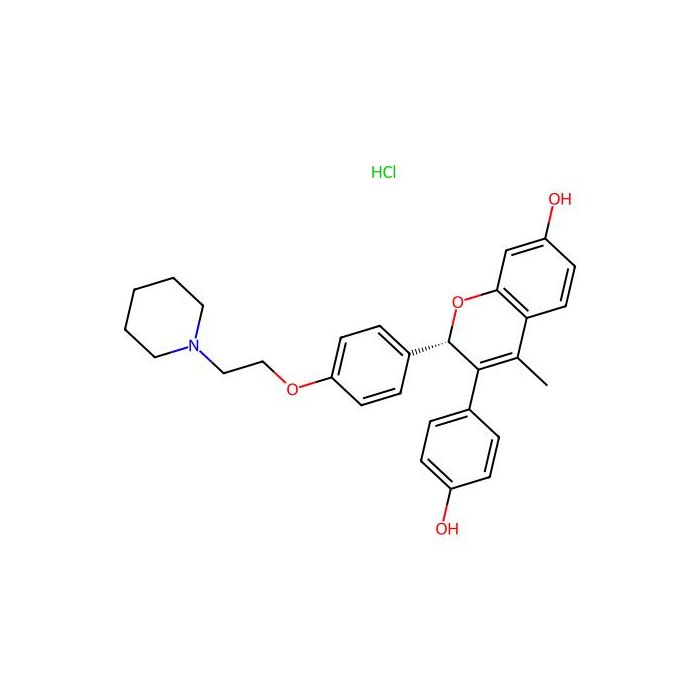
Acolbifene hydrochloride - ≥98% , CAS No.252555-01-4
Auf Lager
SKU
A647196
Acolbifene (EM-652) hydrochloride, an active metabolite of EM800, is an orally active, cancer-preventing selective estrogen receptor modulator (SERM). Acolbifene (EM-652) hydrochloride inhibits estradiol (E2)-induced transcriptional activity of ERα (IC 50 =2 nM) and ERβ (IC 50 =0.4 nM). Acolbifene (EM-652) hydrochloride exerts a potent and pure antiestrogenic action in the mammary gland and uterus. Anticarcinogenic properties.
In Vitro
Acolbifene (ACOL) does not affect pathways of cholesterol synthesis, supporting the involvement of the clearance-related receptors in its hypocholesterolemic action. Acolbifene (EM-652) shows no agonistic activity on ERα and ERβ transcriptional function and blocks the estradiol (E2)-mediated activation of both ERα and ERβ. Acolbifene (EM-652) shows the most potent inhibition of estradiol-stimulated cell proliferation in human breast cancer cells (ZR-75-1, MCF-7, T-47D) and is devoid of any intrinsic estrogenic activity . MCE has not independently confirmed the accuracy of these methods. They are for reference only.
In Vivo
Acolbifene (ACOL) reduces food intake and strongly decreases cholesterolemia in rats fed a cholesterol-free diet. Acolbifene (ACOL) reduces food intake (16%) and weight gain (45%, mainly fat) similarly in both dietary cohorts. MCE has not independently confirmed the accuracy of these methods. They are for reference only. Animal Model: Female Sprague-Dawley rats (n = 42) initially weighing 175-200 g. Dosage: 2.5 mg/kg. Administration: Oral gavage, once daily for 21 d. Result: Prevents tumor growth in rats.
Form:Solid
| CAS | 252555-01-4 |
|---|---|
| Synonyme | (2S)-3-(4-HYDROXYPHENYL)-4-METHYL-2-(4-(2-PIPERIDIN-1-YLETHOXY)PHENYL)-2H-CHROMEN-7-OL, HYDROCHLORIDE | AKOS040745472 | 2H-1-Benzopyran-7-ol,3-(4-hydroxyphenyl)-4-methyl-2-[4-[2-(1-piperidinyl)ethoxy]phenyl]-,hydrochloride (1:1), (2S)- | Q27282480 | SCH57 |
| Spezifikationen & Reinheit | ≥98% |
| Storage | Store at 2-8°C,Desiccated |
| Verschickt in | Wet ice |
| Product Description | Acolbifene (EM-652) hydrochloride, an active metabolite of EM800, is an orally active, cancer-preventing selective estrogen receptor modulator (SERM). Acolbifene (EM-652) hydrochloride inhibits estradiol (E2)-induced transcriptional activity of ERα (IC 50 =2 nM) and ERβ (IC 50 =0.4 nM). Acolbifene (EM-652) hydrochloride exerts a potent and pure antiestrogenic action in the mammary gland and uterus. Anticarcinogenic properties. In Vitro Acolbifene (ACOL) does not affect pathways of cholesterol synthesis, supporting the involvement of the clearance-related receptors in its hypocholesterolemic action. Acolbifene (EM-652) shows no agonistic activity on ERα and ERβ transcriptional function and blocks the estradiol (E2)-mediated activation of both ERα and ERβ. Acolbifene (EM-652) shows the most potent inhibition of estradiol-stimulated cell proliferation in human breast cancer cells (ZR-75-1, MCF-7, T-47D) and is devoid of any intrinsic estrogenic activity . MCE has not independently confirmed the accuracy of these methods. They are for reference only. In Vivo Acolbifene (ACOL) reduces food intake and strongly decreases cholesterolemia in rats fed a cholesterol-free diet. Acolbifene (ACOL) reduces food intake (16%) and weight gain (45%, mainly fat) similarly in both dietary cohorts. MCE has not independently confirmed the accuracy of these methods. They are for reference only. Animal Model: Female Sprague-Dawley rats (n = 42) initially weighing 175-200 g. Dosage: 2.5 mg/kg. Administration: Oral gavage, once daily for 21 d. Result: Prevents tumor growth in rats. Form:Solid |
| Löslichkeit | DMSO : 180 mg/mL (364.36 mM; Need ultrasonic) |
| PubChem CID | 155436 |