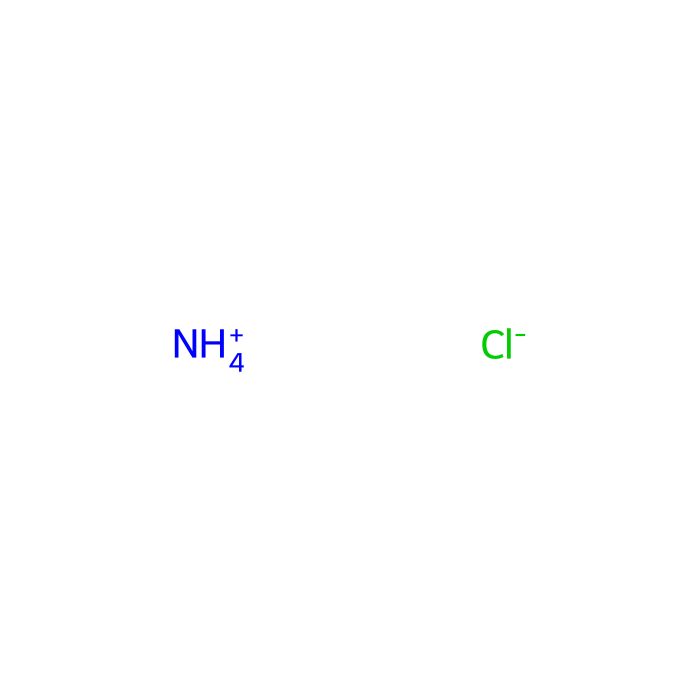
Ammonium chloride - Suitable for molecular biology, ≥99.5% , CAS No.12125-02-9

CAS: 12125-02-9 Cat. No.: A116372 Summenformel: NH4Cl Molekulargewicht: 53.49 EG-Nummer: 235-186-4
Zu bestellen verfügbar
QUALITÄT & REINHEIT Suitable for molecular biology ? Molecular-biology grade — free of nucleases and contaminants that degrade DNA/RNA. Use in cloning, PCR, and nucleic-acid work needing clean reagents. ≥99.5%
Synonyms
Ammonium Chloratum|ammonium chloride salt|Ammoniumchlorid [German]|ammonium chlorid|AMMONIUM CHLORIDE (MART.)|Ammonium chloride, biochemical grade|AMMONIUM CHLORIDE (USP-RS)|Pesticide Code: 129014.|Chlorammonic|Conclyte-A (TN)|Ammoniac, Sal|azanium chloride|Dytuss|AMMONIUM CHLORIDE [VANDF]|Conclyte-A|Ins no.510|AMMONIUM CHLORIDE (II)|Chloride, Ammonium|ammonia hydrochloride|ammonia hydrochloride-|Ammonium chloride fume|Ammonium chloride (JAN/USP)|Ammonium chloride - $-beta|AMMONIUM CHLORIDE [WHO-DD]|Chlorid amonny [Czech]|Ammonium chloride ((NH4)Cl)|AMMONIUM CHLORIDE [II]|AMMONIUM CHLORIDE [ORANGE BOOK]|Ammonium-15N chloride|AMMONIUM CHLORIDE (EP MONOGRAPH)|AMMONIUM CHLORIDE [EP MONOGRAPH]|Amoklor|AMMONIUM CHLORIDE [FCC]|AMMONIUM CHLORIDE [JAN]|Chlorammonic [France]|AMMONIUM CHLORIDE [HSDB]|AMMONIUM MURIATICUM [HPUS]|Darammon|AMMONIUM CHLORIDE [USP MONOGRAPH]|ammonium cloride|ammoniurn chloride|Chlorid amonny|AMMONIUM CHLORIDE (NH4CL)|AMMONIUM CHLORIDE [MI]|Ammoniumklorid|Ammonium chloride (USP:JAN)|AMMONIUM CHLORIDE [MART.]|Ammonium chloride in plastic container|ammonium choride|Chloramon|Elektrolyt|AMCHLORIDE|Ammon Chlor|COLDS COUGHS|Sal ammonia|Sal ammoniac|AMMONIUM CHLORIDE [GREEN BOOK]|Ammonium muriaticum|ammoniumchloride|Ammoniumchlorid|Ammoneric|AMMONIUM CHLORIDE (USP MONOGRAPH)|Ammonium Chloride Injection|Ammonium muriate|Ammonium-15N,d4 chloride|Chlorid ammonia|Cloruro de Amonio|FUS-SOL|Salammonite|Ammonii Chloridum|AMMONIUM CHLORIDE [USP-RS]|Salmiac|Quelidrine|amrnonium chloride|arnmonium chloride|Ammonchlor|Muriate of Ammonia|Salammoniacus|AMMONIUM CHLORIDE|Ammonium chloride [USP:JAN]|AMMONIUM CHLORIDE [INCI]|Pectomed|Ammonium chloride (NH4)(HCl2))|Ammonium Chloride Tablets|amonium chloride|Catalyst rd
Storage
Room temperature,Desiccated
Shipped In
Normal
★
Größe
Deutschland (EU)
USA*
Preis
Menge
500g
A116372-500g
—
3 Auf Lager
69,33€
Enter a quantity for the sizes you want to add.

Spezifikationen

Synonyme
Ammonium Chloratum | ammonium chloride salt | Ammoniumchlorid [German] | ammonium chlorid | AMMONIUM CHLORIDE (MART.) | Ammonium chloride, biochemical grade | AMMONIUM CHLORIDE (USP-RS) | Pesticide Code: 129014. | Chlorammonic | Conclyte-A (TN) | Ammoniac, Sal | azanium chloride | Dytuss | AMMONIUM CHLORIDE [VANDF] | Conclyte-A | Ins no.5 Show more
Spezifikationen & Reinheit
Suitable for molecular biology, ≥99.5%
Storage
Room temperature,Desiccated
Verschickt in
Normal
Note
Suitable for molecular biology
Reinheit
≥99.5%
Namen und Kennungen
Pubchem Sid
Pubchem Sid Url
https://pubchem.ncbi.nlm.nih.gov/substance/508814323
SMILES
[NH4+].[Cl-]
IUPAC Name
azanium;chloride
InChIKey
NLXLAEXVIDQMFP-UHFFFAOYSA-N
InChI
1S/ClH.H3N/h1H;1H3
Isomere SMILES
[NH4+].[Cl-]
WGK Deutschland
1
Molekulargewicht
53.49
Reaxys
3547232
Reaxys-RN_link_address
https://www.reaxys.com/reaxys/secured/hopinto.do?context=S&query=IDE.XRN=3547232&ln=

Erweiterte Daten

Taxonomic Classification

Taxonomy Tree

KingdomInorganic compounds
SuperclassHomogeneous non-metal compounds
KlasseOther non-metal halides
SubclassNot available
Intermediate Tree Nodes Not available
Direct ParentOther non-metal halides
Alternative Parents Inorganic chloride salts  
Molecular FrameworkNot available
Substituents Other non-metal halide - Inorganic chloride salt - Inorganic salt
BeschreibungThis compound belongs to the class of inorganic compounds known as other non-metal halides. These are inorganic compounds containing 'other non-metals' and halogen.
External Descriptors ammonium salt - inorganic chloride
3D-Struktur
Interaktives chemisches Strukturmodell


Zugehörige Ziele (menschlich)
TRPA1 Tclin Transient receptor potential cation channel subfamily A member 1 (0 Activities)
Activity TypeActivity Value -log(M)Mechanism of ActionActivity ReferencePublications (PubMed IDs)
Zertifikate (CoA, COO, BSE/TSE und Analyse-Diagramm)
C of A & Other Certificates(BSE/TSE, COO):
Analytical Chart:

Find and download the COA for your product by matching the lot number on the packaging.

4 results found

Lot NumberCertificate TypeDatumArtikel
B2302608B2302608Certificate of AnalysisJul 30, 2026 A116372
C2626203C2626203Certificate of AnalysisApr 02, 2026 A116372
F2228046F2228046Certificate of AnalysisJan 19, 2026 A116372
I2110061I2110061Certificate of AnalysisMar 04, 2025 A116372
Chemische und physikalische Eigenschaften
EmpfindlichkeitHygroscopic
Siedepunkt (°C)520 °C
Schmelzpunkt (°C)338°C(dec.)(lit.)
Molekulargewicht53.49
XLogP3
Hydrogen Bond Donor Count1
Hydrogen Bond Acceptor Count1
Rotatable Bond Count0
Exact Mass53.0032 Da
Monoisotopic Mass53.0032 Da
Topological Polar Surface Area1.000 Ų
Heavy Atom Count2
Formal Charge0
Complexity0.000
Isotope Atom Count0
Defined Atom Stereocenter Count0
Undefined Atom Stereocenter Count0
Defined Bond Stereocenter Count0
Undefined Bond Stereocenter Count0
The total count of all stereochemical bonds0
Covalently-Bonded Unit Count2
Sicherheit und Gefahren (GHS)
Piktogramm(e)
Signal
Warning
Gefahrenhinweise

H302:Harmful if swallowed

H319:Causes serious eye irritation

Sicherheitshinweise

P264:Wash hands [and …] thoroughly after handling.

P270:Do not eat, drink or smoke when using this product.

P280:Wear protective gloves/protective clothing/eye protection/face protection.

P330:Rinse mouth.

P305+P351+P338:IF IN EYES: Rinse cautiously with water for several minutes. Remove contact lenses if present and easy to do - continue rinsing.

P501:Dispose of contents/container to an approved waste disposal plant.

P264+P265:Wash hands [and …] thoroughly after handling. Do not touch eyes.

P301+P317:IF SWALLOWED: Get medical help.

P337+P317:If eye irritation persists: Get medical help.

WGK Deutschland
1
Reaxys
3547232
Reaxys-RN_link_address
https://www.reaxys.com/reaxys/secured/hopinto.do?context=S&query=IDE.XRN=3547232&ln=
Merck-Index
509
FAQs und Artikel
Molecular Biology Grade
Eight Common Lysis Buffers
General Principles of Antibody Labeling with NHS-Activated Esters, F/P Calculation, and Troubleshooting Guide
Fundamentals and Applications of Etching Solutions: Using Metallic Copper / PCB Etching as an Example
Installing a Redox Switch on Biomolecules: Principles, Conjugation Essentials, and an Application Guide for ATTO MB2 NHS ester
Calcium Gluconate: Physicochemical Properties, Pharmacopoeial Quality Control, and Application Guidelines
A Practical Guide to Organozinc Reagents for Synthesis (Organozinc Reagents): Structural Features, Key Reactions, and a Practical Selection Navigation (Including Aladdin Product Tables)
Furin: A Review of Its Structural Features, Substrate Recognition, and Research Applications
Tissue Dissociation for Single-Cell Preparation: Sample Handling and Quality Control Strategies
Coupling Mechanisms Between Terminal Reducing-Power Allocation in Photosynthetic Electron Transport and Metabolic Demand
Application Differences Among Glutaraldehyde, Paraformaldehyde, and Formalin in Tissue and Cell Sample Fixation
Capable of Swelling, Adsorption, and Cation Exchange: What Makes Montmorillonite Clay Different?
Comparison of Urea Detection Methods: Reaction Mechanisms, Interference Factors, and Application Scenarios of the Urease Method and Diacetyl Monoxime Method
Types of Inorganic Salts That Can Undergo Reduction Reactions: Nitrates, Sulfur-Containing Salts, Halogen Oxyanion Salts, and Metal Salts
Autophagy Signaling Pathways and Selective Autophagy Research
Membrane Transporters and Ion Channels: How Transmembrane Substance Flux Drives Cellular Signaling and Functional Regulation
Thietanes: Promising Small-Ring Building Blocks with Tunable Physicochemical Properties through Sulfur Oxidation-State Control
Discovery and Structural Optimization of the Noncovalent 3CL Protease Inhibitor S-217622
Citations of This Product
Lösungsrechner
Bewertungen

Kundenbewertungen

Benötigen Sie Hilfe bei der Auswahl der Qualität?

Unser Leitfaden zur Qualitätsauswahl behandelt Reinheit, Stabilisatorstatus und Anwendungseignung für alle Varianten in unserem Katalog.

Suitable for molecular biology Qualitätsleitfaden ansehen →

Dürfen wir Sie über Rabattaktionen informieren?

Später erinnern

Vielen Dank! Bitte überprüfen Sie Ihren E-Mail-Posteingang, um zu bestätigen.

Hoppla! Benachrichtigungen sind deaktiviert.