≥99% for sensitive chromatographic and analytical workflows requiring minimal baseline interference.
🌡
Storage & shipping
Store at 2-8°C,Desiccated Ships Wet ice Check lot-specific COA for exact specifications.
📋
Quality documents
SDS, COA, datasheet, and spec sheet available for download. Lot-specific COA accessible via lot number lookup.
📚
Literature proof
Cited in 0 peer-reviewed publications across chromatography, organic synthesis, and cross-coupling reactions.
Übersicht
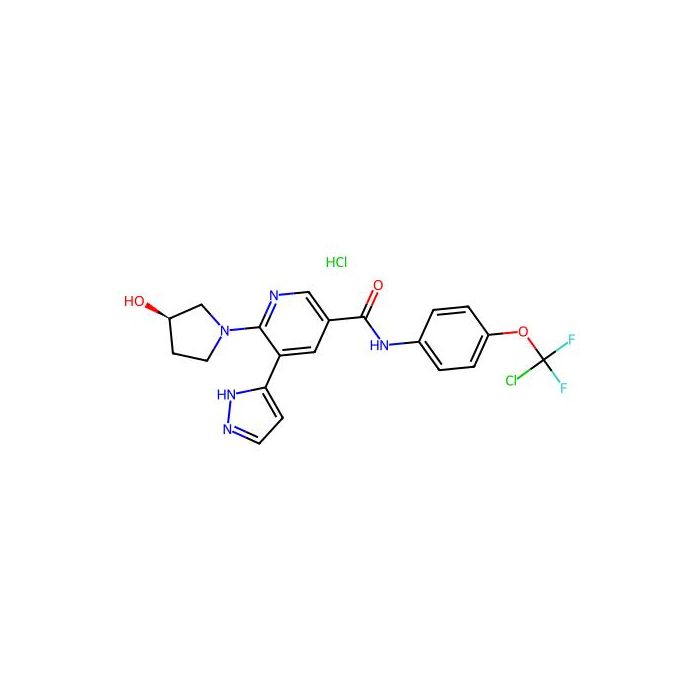
Asciminib (ABL001) hydrochloride is a potent and selective allosteric BCR-ABL1 inhibitor, which inhibits Ba/F3 cells grown with an IC 50 of 0.25 nM.
In Vitro
Asciminib (ABL001) hydrochloride binds to the myristoyl pocket of ABL1 and induces the formation of an inactive kinase conformation. Asciminib hydrochloride binds potently (dissociation constant=0.5-0.8 nM) and selectively to the myristoyl pocket of ABL1 and induces the inactive C-terminal helix conformation. Asciminib hydrochloride exhibits the same non-ATP-competitive biochemical kinetics as the BCR–ABL inhibitor GNF-2 but with approximately 100-fold greater potency. Asciminib hydrochloride lacks activity against more than 60 kinases, including SRC, and is similarly inactive against G-protein-coupled receptors, ion channels, nuclear receptors and transporters. In BCR–ABL1-transformed Ba/F3 cells grown without IL-3, Asciminib hydrochloride has an anti-proliferative with IC 50 value of 0.25 nM. In the CML blast-phase cell line KCL-22, Asciminib hydrochloride inhibits phosphorylation of both STAT5 (Tyr694; pSTAT5) and BCR–ABL1 (Tyr245; pBCR–ABL1) after 1 h using concentrations that correlate with those required for inhibition of cell proliferation. Asciminib hydrochloride is selectively active against all BCR–ABL1 lines (IC 50 value of 1–20 nM), irrespective of the presence of either the p210 or the p190 BCR–ABL1 isoform. MCE has not independently confirmed the accuracy of these methods. They are for reference only.
In Vivo
Single doses of 7.5, 15 and 30 mg/kg Asciminib, administered to mice bearing KCL- 22 xenografts, inhibits pSTAT5 (Tyr694), which return to baseline at 10, 12 and 16-20 h after administration of the dose, respectively. In mice implanted with KCL-22 tumors, the minimum dose of Asciminib required for complete regression is 7.5 mg/kg twice a day (BID) or 30 mg/kg once a day (QD), and is tolerated at doses up to 250 mg/kg BID . MCE has not independently confirmed the accuracy of these methods. They are for reference only.
This compound belongs to the class of organic compounds known as aromatic anilides. These are aromatic compounds containing an anilide group in which the carboxamide group is substituted with an aromatic group. They have the general structure RNC(=O)R', where R= benzene, and R = aryl group.
External Descriptors
Not available
1. Djoumbou Feunang Y, Eisner R, Knox C, Chepelev L, Hastings J, Owen G, Fahy E, Steinbeck C, Subramanian S, Bolton E, Greiner R, and Wishart DS. ClassyFire: Automated Chemical Classification With A Comprehensive, Computable Taxonomy. Journal of Cheminformatics, 2016, 8:61.
Determine the necessary mass, volume, or concentration for preparing a solution.
Dilution Calculator
Determine the dilution needed to prepare a stock solution.
Reconstitution Calculator
Bewertungen
Kundenbewertungen
Häufig gestellte Fragen
What is the purity of this product?
This product is supplied at ≥99% purity (chemical assay). Lot-specific values are stated on the Certificate of Analysis.
How should this product be stored?
Store at 2–8 °C, desiccated. Keep the container tightly closed with desiccant — the material is moisture-sensitive.
How is this product shipped?
This product ships chilled on wet ice. Unpack on arrival and transfer it to the storage condition stated above.
What are the CAS number, molecular formula and molecular weight?
The CAS Number is 2119669-71-3, the molecular formula is C20H19Cl2F2N5O3, and the molecular weight is 486.30 g/mol. InChIKey HGCOOPLEWPBLOY-PFEQFJNWSA-N.
What documentation is provided?
Available product documentation, including Certificates of Analysis (COA), Safety Data Sheets (SDS), and specification sheets, is shown in the product document area. Document availability and access follow the current site policy.
Wir verwenden Cookies, um die ordnungsgemäße Funktion der Website sicherzustellen und, soweit zulässig, Ihr Nutzererlebnis zu verbessern. Sie können Ihre Einstellungen jederzeit unter „Einstellungen“ verwalten. Weitere Informationen finden Sie in unserer Cookie-Richtlinie.
Shall we send you a message when we have discounts available?
Remind me later
Thank you! Please check your email inbox to confirm.
Products are supplied to verified businesses, institutions, and qualified professionals for research and development use only. Not for use in humans, animals, diagnosis, or therapy.