Determine the necessary mass, volume, or concentration for preparing a solution.
| Activity Type | Activity Value -log(M) | Mechanism of Action | Activity Reference | Publications (PubMed IDs) |
|---|

Moligand™, 10mM in DMSO Moligand™ for sensitive chromatographic and analytical workflows requiring minimal baseline interference.
Store at -80°C Ships Dry ice packs + Cold packs Check lot-specific COA for exact specifications.
SDS, COA, datasheet, and spec sheet available for download. Lot-specific COA accessible via lot number lookup.
Cited in 0 peer-reviewed publications across chromatography, organic synthesis, and cross-coupling reactions.
Information
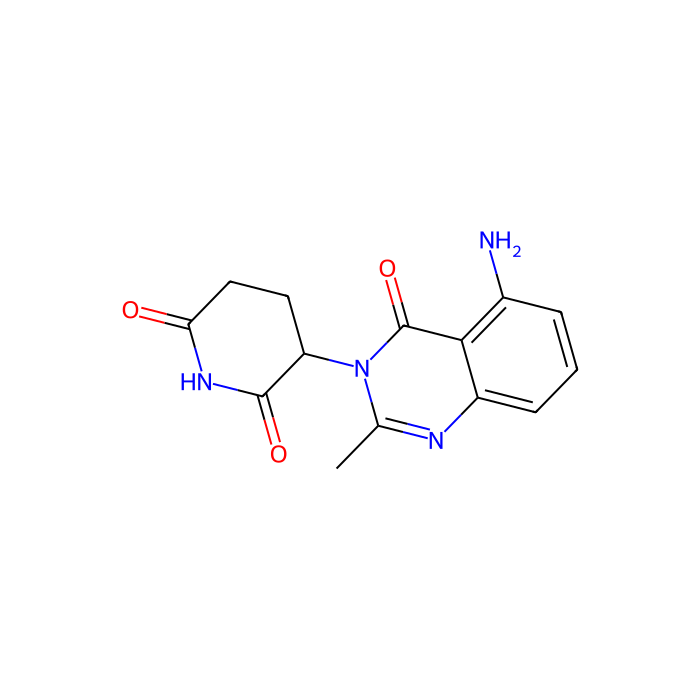
Avadomide (CC-122) Avadomide (CC-122), a new chemical entity termed pleiotropic pathway modifier, is a novel agent for Diffuse large B-cell lymphoma(DLBCL) with antitumor and immunomodulatory activity. Its molecular target is the protein cereblon (CRBN), a substrate receptor of the cullin ring E3 ubiquitin ligase complex CRL4 CRBN .
Targets
CRBN
In vitro
CC-122 is a novel agent for DLBCL with antitumor and immunomodulatory activity. In DLBCL cell lines, It binds CRBN and induces degradation or short hairpin RNA-mediated knockdown of Aiolos and Ikaros which correlates with increased transcription of interferon (IFN)-stimulated genes independent of IFN-α, -β, and -γ production and/or secretion and results in apoptosis in both activated B-cell (ABC) and germinal center B-cell DLBCL cell lines. CRBN is the molecular target of CC-122, CC-122 binding to CRBN recruits Aiolos/Ikaros to CRL4CRBN, and E3 ligase enzymatic activity is necessary for ubiquitination of Aiolos and Ikaros and thus their proteasomal degradation induced by CC-122. CC-122 induces IFN-regulated proteins and its mediated effects on the IFN pathway is independent of autocrine type I and II IFN secretion and signaling.
In vivo
CC-122 reduces tumor growth in xenograft models established from ABC- and GCB-DLBCL cell lines, and stimulates IL-2 production in primary T cells. Also, in a single-arm CC-122 clinical trial, exposure to CC-122 reduced expression levels of Aiolos and Ikaros in each patient by 25% to 50% demonstrating the utility of these 2 proteins as pharmacodynamic markers of CC-122.
Cell Research(from reference)
Cell lines:DLBCL cell lines(TMD8, U2932, Riva, and OCI-LY10) and GCB-DLBCL lines (Karpas 422, WSU-DLCL2, SUDHL-4, OCI-LY19, and Pfeiffer)
Concentrations:0.01 to 10\u2009000 nM
Incubation Time:5 days
| ALogP | -0.477 |
|---|---|
| hba_count | 4 |
| HBD-Zahl | 2 |
| Rotationsfähige Bindung | 1 |
| Pubchem Sid | 528776320 |
|---|---|
| Kanonisches Lächeln | CC1=NC2=CC=CC(=C2C(=O)N1C3CCC(=O)NC3=O)N |
| IUPAC Name | 3-(5-amino-2-methyl-4-oxoquinazolin-3-yl)piperidine-2,6-dione |
| InChIKey | RSNPAKAFCAAMBH-UHFFFAOYSA-N |
| INCHI | 1S/C14H14N4O3/c1-7-16-9-4-2-3-8(15)12(9)14(21)18(7)10-5-6-11(19)17-13(10)20/h2-4,10H,5-6,15H2,1H3,(H,17,19,20) |
| Isomere SMILES | CC1=NC2=CC=CC(=C2C(=O)N1C3CCC(=O)NC3=O)N |
| Molekulargewicht | 286.29 |
| Reaxy-Rn | 13123447 |
| Reaxys-RN_link_address | https://www.reaxys.com/reaxys/secured/hopinto.do?context=S&query=IDE.XRN=13123447&ln= |
Comprehensive hazard, handling, storage, and regulatory compliance document.
Download SDS →Lot-specific quality data. Enter your lot number to retrieve the exact COA.
Look up COA →Full quality attributes and acceptance criteria for this grade.
View spec sheet →Taxonomy Tree
| Kingdom | Organic compounds |
|---|---|
| Superclass | Organoheterocyclic compounds |
| Klasse | Diazanaphthalenes |
| Subclass | Benzodiazines |
| Intermediate Tree Nodes | Quinazolines |
| Direct Parent | Quinazolinamines |
| Alternative Parents | Piperidinediones Pyrimidones Delta lactams Benzenoids Vinylogous amides N-unsubstituted carboxylic acid imides Heteroaromatic compounds Dicarboximides Amino acids and derivatives Azacyclic compounds Primary amines Organic oxides Hydrocarbon derivatives Carbonyl compounds |
| Molecular Framework | Aromatic heteropolycyclic compounds |
| Substituents | Quinazolinamine - Piperidinedione - Delta-lactam - Piperidinone - Pyrimidone - Piperidine - Pyrimidine - Benzenoid - Heteroaromatic compound - Vinylogous amide - Carboxylic acid imide - Dicarboximide - Carboxylic acid imide, n-unsubstituted - Amino acid or derivatives - Lactam - Azacycle - Carboxylic acid derivative - Organic oxygen compound - Amine - Organic oxide - Organic nitrogen compound - Primary amine - Hydrocarbon derivative - Carbonyl group - Organonitrogen compound - Organooxygen compound - Aromatic heteropolycyclic compound |
| Beschreibung | This compound belongs to the class of organic compounds known as quinazolinamines. These are heterocyclic aromatic compounds containing a quianazoline moiety substituted by one or more amine groups. |
| External Descriptors | Not available |
| Activity Type | Activity Value -log(M) | Mechanism of Action | Activity Reference | Publications (PubMed IDs) |
|---|
| Activity Type | Relation | Activity value | Units | Action Type | Journal | PubMed Id | doi | Assay Aladdin ID |
|---|
| DMSO (mg/ml) Maximale Löslichkeit | 57 |
|---|---|
| DMSO (mM) Maximale Löslichkeit | 199.0988159 |
| Wasser (mg/ml) Maximale Löslichkeit | <1 |
| Molekulargewicht | 286.290 g/mol |
| XLogP3 | 0.000 |
| Hydrogen Bond Donor Count | 2 |
| Hydrogen Bond Acceptor Count | 5 |
| Rotatable Bond Count | 1 |
| Exact Mass | 286.107 Da |
| Monoisotopic Mass | 286.107 Da |
| Topological Polar Surface Area | 105.000 Ų |
| Heavy Atom Count | 21 |
| Formal Charge | 0 |
| Complexity | 530.000 |
| Isotope Atom Count | 0 |
| Defined Atom Stereocenter Count | 0 |
| Undefined Atom Stereocenter Count | 1 |
| Defined Bond Stereocenter Count | 0 |
| Undefined Bond Stereocenter Count | 0 |
| The total count of all stereochemical bonds | 0 |
| Covalently-Bonded Unit Count | 1 |
Our grade selection guide covers purity, stabilizer status, and application suitability for all variants in our catalog.
View Moligand™ grade guide →