Determine the necessary mass, volume, or concentration for preparing a solution.
| Activity Type | Activity Value -log(M) | Mechanism of Action | Activity Reference | Publications (PubMed IDs) |
|---|

≥99% for sensitive chromatographic and analytical workflows requiring minimal baseline interference.
Store at -20°C Ships Ice chest + Ice pads Check lot-specific COA for exact specifications.
SDS, COA, datasheet, and spec sheet available for download. Lot-specific COA accessible via lot number lookup.
Cited in 0 peer-reviewed publications across chromatography, organic synthesis, and cross-coupling reactions.
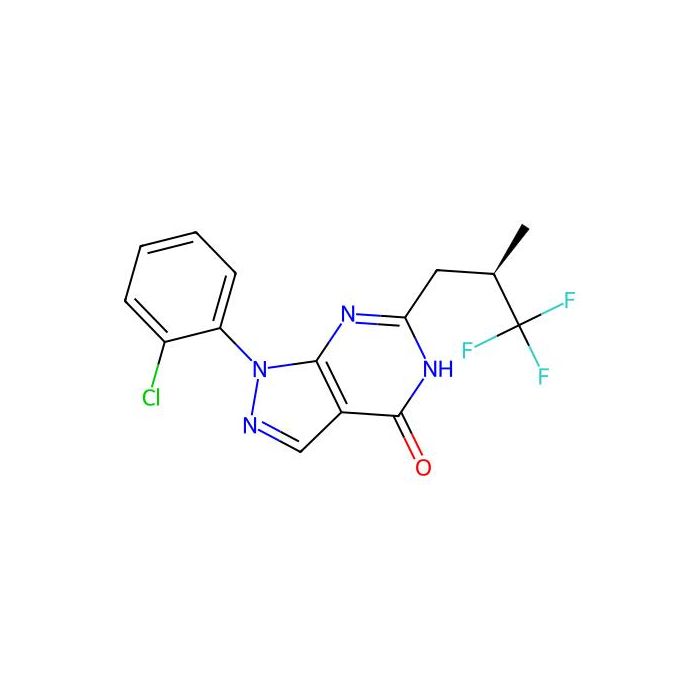
BAY 73-6691 ((R)-BAY 73-6691) is a potent, brain penetrant, and selective PDE9A inhibitor
In Vitro
The BAY 73-6691 dose-dependently alleviates cell viability loss due to Aβ 25-35 treatment. It is found that when SH-SY5Y cells are cultured by Aβ 25-35 , a high degree of cell apoptosis is observed, while additional stimulation with BAY 73-6691 causes attenuation of cell apoptosis.? BAY 73-6691 dose-dependently attenuates oxidative stress induced by Aβ 25-35 , and BAY 73-6691 at 200 μg/mL almost neutralizes Aβ 25-35 -induced oxidative damage. The BAY 73-6691 attenuates Aβ 25-35 -induced increase of apoptosis cells. MCE has not independently confirmed the accuracy of these methods. They are for reference only.
In Vivo
BAY 73-6691 dose-dependently improves the acquisition performance in the Aβ 25-35 -injected mice on days 7 to 10 (day 7, F (5,54) =65.153; day 8, F (5,54) =62.340; day 9, F (5,54) =37.529; day 10, F (5,54) =38.624; P<0.001). BAY 73-6691 at 3 mg/kg can almost completely abolish the prolongation of escape-latency on days 9 to 10.? BAY 73-6691 dose-dependently elevates the Aβ 25-35 -induced decrease of the dwell time on the 10th day post Aβ 25-35 injection (day 10, F (5,54) =27.360, P<0.001). Results reveal that the Aβ 25-35 injection and BAY 73-6691 treatment cause no influence on the swimming speed. Treatment with BAY 73-6691 does not cause detectable alteration of spatial memory in sham mice. BAY 73-6691 alleviates Aβ 25-35 -induced abnormalities of the above indices. The BAY 73-6691 causes no influence on the four indices mentioned above in sham mice. The BAY 73-6691 has no significant effect on the apoptosis of hippocampal neurons in sham mice . MCE has not independently confirmed the accuracy of these methods. They are for reference only.
Form:Solid
IC50& Target:PDE9
Comprehensive hazard, handling, storage, and regulatory compliance document.
Download SDS →Lot-specific quality data. Enter your lot number to retrieve the exact COA.
Look up COA →Full quality attributes and acceptance criteria for this grade.
View spec sheet →Taxonomy Tree
| Kingdom | Organic compounds |
|---|---|
| Superclass | Organoheterocyclic compounds |
| Klasse | Azoles |
| Subclass | Pyrazoles |
| Intermediate Tree Nodes | Not available |
| Direct Parent | Phenylpyrazoles |
| Alternative Parents | Pyrazolo[3,4-d]pyrimidines Pyrimidones Chlorobenzenes Aryl chlorides Vinylogous amides Heteroaromatic compounds Lactams Azacyclic compounds Alkyl fluorides Organic oxides Hydrocarbon derivatives Organochlorides Organofluorides Organonitrogen compounds Organooxygen compounds Organic anions |
| Molecular Framework | Aromatic heteropolycyclic compounds |
| Substituents | Phenylpyrazole - Pyrazolopyrimidine - Pyrazolo[3,4-d]pyrimidine - Chlorobenzene - Halobenzene - Pyrimidone - Aryl chloride - Aryl halide - Monocyclic benzene moiety - Pyrimidine - Benzenoid - Vinylogous amide - Heteroaromatic compound - Lactam - Azacycle - Organic oxide - Organic oxygen compound - Organonitrogen compound - Organofluoride - Organochloride - Organohalogen compound - Organooxygen compound - Alkyl halide - Alkyl fluoride - Organic nitrogen compound - Hydrocarbon derivative - Organic anion - Aromatic heteropolycyclic compound |
| Beschreibung | This compound belongs to the class of organic compounds known as phenylpyrazoles. These are compounds containing a phenylpyrazole skeleton, which consists of a pyrazole bound to a phenyl group. |
| External Descriptors | Not available |
| Activity Type | Activity Value -log(M) | Mechanism of Action | Activity Reference | Publications (PubMed IDs) |
|---|
| Activity Type | Activity Value -log(M) | Mechanism of Action | Activity Reference | Publications (PubMed IDs) |
|---|
| Löslichkeit | DMSO : 160 mg/mL (448.52 mM; Need ultrasonic and warming) |
|---|---|
| Molekulargewicht | 356.730 g/mol |
| XLogP3 | 3.500 |
| Hydrogen Bond Donor Count | 1 |
| Hydrogen Bond Acceptor Count | 6 |
| Rotatable Bond Count | 3 |
| Exact Mass | 356.065 Da |
| Monoisotopic Mass | 356.065 Da |
| Topological Polar Surface Area | 59.300 Ų |
| Heavy Atom Count | 24 |
| Formal Charge | 0 |
| Complexity | 527.000 |
| Isotope Atom Count | 0 |
| Defined Atom Stereocenter Count | 1 |
| Undefined Atom Stereocenter Count | 0 |
| Defined Bond Stereocenter Count | 0 |
| Undefined Bond Stereocenter Count | 0 |
| The total count of all stereochemical bonds | 0 |
| Covalently-Bonded Unit Count | 1 |