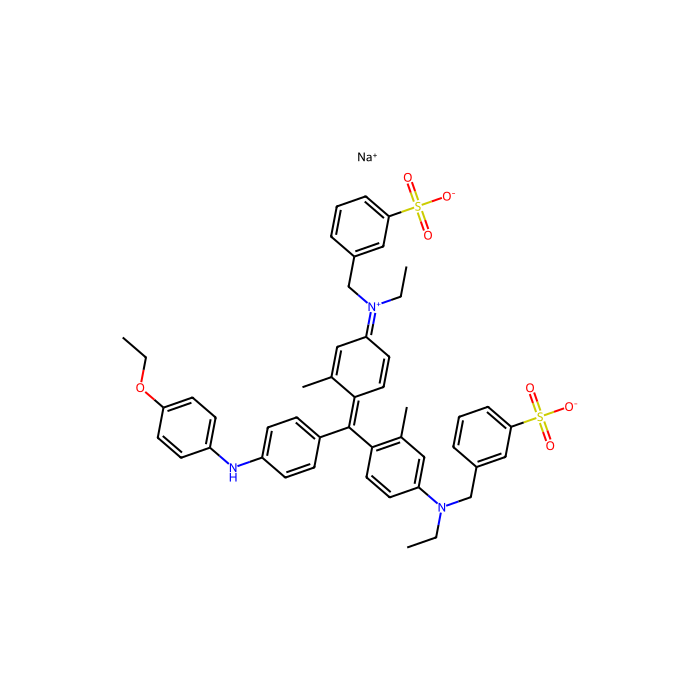
Brilliant Blue G - for electrophoresis, ≥70% , CAS No.6104-58-1

CAS: 6104-58-1 Cat. No.: B104241 Summenformel: C47H48N3NaO7S2 Molekulargewicht: 854.02 Beilstein Registry Number: 5230822 EG-Nummer: 228-058-4
Zu bestellen verfügbar
QUALITÄT & REINHEIT Suitable for electrophoresis ? Electrophoresis grade — low ionic/UV impurities for clean gel runs. Use in agarose/PAGE electrophoresis where impurities distort bands. ≥70%
Synonyms
Blu brillante G|(2S,5R)-5-methyl-2-propan-2-ylcyclohexan-1-one|Brilliant Blue G, pure|Coomassie Brilliant Blue G|Brillant blue G|bril-lant blue g|Bleu brillant G|C.I. Acid Blue 90|Acid Blue 90|Azul brillante G|CBB G-250|Brilliant Blue G, 250, for microscopy|1-Propanone,4-dimethoxyphenyl)-2-methyl-|Brilliant Blue G|Coomassie Brilliant Blue G (CBBG)|Coomassie Brilliant Blue G-250|SKF 6270|Azul Brilhante G|sodium 3-(((4-((E)-(4-(4-ethoxyphenylamino)phenyl)((E)-4-(ethyl(3-sulfonatobenzyl)iminio)-2-methylcyclohexa-2,5-dienylidene)methyl)-3-methylphenyl)(ethyl)amino)methyl)benzenesulfonate|BBG;Brilliant blue G-250|COOMASSIE BRILLIANT BLUE
Storage
Desiccated,Room temperature
Shipped In
Normal
★
Größe
Deutschland (EU)
USA*
Preis
Menge
5g
B104241-5g
—
3 Auf Lager
19,87€
10g
B104241-10g
—
3 Auf Lager
34,62€
50g
B104241-50g
—
7 Auf Lager
124,87€
250g
B104241-250g
1 Auf Lager
1 Auf Lager
541,38€
Enter a quantity for the sizes you want to add.

Spezifikationen

Synonyme
Blu brillante G | (2S,5R)-5-methyl-2-propan-2-ylcyclohexan-1-one | Brilliant Blue G, pure | Coomassie Brilliant Blue G | Brillant blue G | bril-lant blue g | Bleu brillant G | C.I. Acid Blue 90 | Acid Blue 90 | Azul brillante G | CBB G-250 | Brilliant Blue G, 250, for microscopy | 1-Propanone,4-dimethoxyphenyl)-2-methyl- | Brilliant Blue Show more
Spezifikationen & Reinheit
for electrophoresis, ≥70%
Biochemische und physiologische Mechanismen
Potent, non-competitive antagonist of rat and human P2X 7 receptors (IC 50 values are 10 and 200 nM, respectively). Displays >1000-fold selectivity over P2X 4 . IC 50 values for inhibition of the other P2X receptors range from 2 to >30 µM. Rat and human P
Storage
Desiccated,Room temperature
Verschickt in
Normal
Note
Für die Elektrophorese geeignet
Hinweis
Wherever possible, you should prepare and use solutions on the same day. However, if you need to make up stock solutions in advance, we recommend that you store the solution as aliquots in tightly sealed vials at -20°C. Generally, these will be useable for up to one month. Before use, and prior to opening the vial we recommend that you allow your product to equilibrate to room temperature for at least 1 hour. Need more advice on solubility, usage and handling? Please visit our frequently asked questions (FAQ) page for more details.
Reinheit
≥70%
Namen und Kennungen
Pubchem Sid
SMILES
CCN(CC1=CC(=CC=C1)S(=O)(=O)[O-])C2=CC(=C(C=C2)C(=C3C=CC(=[N+](CC)CC4=CC(=CC=C4)S(=O)(=O)[O-])C=C3C)C5=CC=C(C=C5)NC6=CC=C(C=C6)OCC)C.[Na+]
IUPAC Name
sodium;3-[[4-[(E)-[4-(4-ethoxyanilino)phenyl]-[4-[ethyl-[(3-sulfonatophenyl)methyl]azaniumylidene]-2-methylcyclohexa-2,5-dien-1-ylidene]methyl]-N-ethyl-3-methylanilino]methyl]benzenesulfonate
InChIKey
RWVGQQGBQSJDQV-UHFFFAOYSA-M
InChI
1S/C47H49N3O7S2.Na/c1-6-49(31-35-11-9-13-43(29-35)58(51,52)53)40-21-25-45(33(4)27-40)47(37-15-17-38(18-16-37)48-39-19-23-42(24-20-39)57-8-3)46-26-22-41(28-34(46)5)50(7-2)32-36-12-10-14-44(30-36)59(54,55)56;/h9-30H,6-8,31-32H2,1-5H3,(H2,51,52,53,54,55,56);/q;+1/p-1
Isomere SMILES
CCN(CC1=CC(=CC=C1)S(=O)(=O)[O-])C2=CC(=C(C=C2)/C(=C/3\C=CC(=[N+](CC)CC4=CC(=CC=C4)S(=O)(=O)[O-])C=C3C)/C5=CC=C(C=C5)NC6=CC=C(C=C6)OCC)C.[Na+]
WGK Deutschland
3
Molekulargewicht
854.02
Beilstein
5230822
Reaxys
9468447
Reaxys-RN_link_address
https://www.reaxys.com/reaxys/secured/hopinto.do?context=S&query=IDE.XRN=9468447&ln=

Erweiterte Daten

Taxonomic Classification

Taxonomy Tree

KingdomOrganic compounds
SuperclassBenzenoids
KlasseBenzene and substituted derivatives
SubclassPhenylmethylamines
Intermediate Tree Nodes Not available
Direct ParentPhenylbenzamines
Alternative Parents Diphenylmethanes  Aromatic monoterpenoids  Benzenesulfonic acids and derivatives  Monocyclic monoterpenoids  1-sulfo,2-unsubstituted aromatic compounds  Benzenesulfonyl compounds  Aminophenyl ethers  Phenoxy compounds  Aminotoluenes  Aniline and substituted anilines  Benzylamines  Dialkylarylamines  Aralkylamines  Alkyl aryl ethers  Azomethines  Secondary ketimines  Organosulfonic acids  Sulfonyls  Secondary amines  Propargyl-type 1,3-dipolar organic compounds  Organic oxides  Organic sodium salts  Organic zwitterions  Organopnictogen compounds  Hydrocarbon derivatives  
Molecular FrameworkAromatic homomonocyclic compounds
Substituents Phenylbenzamine - Diphenylmethane - Monoterpenoid - Benzenesulfonate - Aromatic monoterpenoid - Monocyclic monoterpenoid - Aminophenyl ether - Arylsulfonic acid or derivatives - 1-sulfo,2-unsubstituted aromatic compound - Benzenesulfonyl group - Phenol ether - Tertiary aliphatic/aromatic amine - Phenoxy compound - Benzylamine - Dialkylarylamine - Aniline or substituted anilines - Aminotoluene - Toluene - Alkyl aryl ether - Aralkylamine - Secondary ketimine - Azomethine - Sulfonyl - Organic sulfonic acid or derivatives - Organosulfonic acid or derivatives - Organosulfonic acid - Tertiary amine - Propargyl-type 1,3-dipolar organic compound - Secondary amine - Organic 1,3-dipolar compound - Ether - Organic alkali metal salt - Organic nitrogen compound - Organooxygen compound - Organonitrogen compound - Organosulfur compound - Organic zwitterion - Organic salt - Organic sodium salt - Hydrocarbon derivative - Organic oxide - Organopnictogen compound - Organic oxygen compound - Amine - Aromatic homomonocyclic compound
BeschreibungThis compound belongs to the class of organic compounds known as phenylbenzamines. These are aromatic compounds consisting of a benzyl group that is N-linked to a benzamine.
External Descriptors Not available
3D-Struktur
Interaktives chemisches Strukturmodell


Zertifikate (CoA, COO, BSE/TSE und Analyse-Diagramm)
C of A & Other Certificates(BSE/TSE, COO):
Analytical Chart:

Find and download the COA for your product by matching the lot number on the packaging.

10 results found

Lot NumberCertificate TypeDatumArtikel
F2616099F2616099Certificate of AnalysisJun 30, 2026 B104241
L2529362L2529362Certificate of AnalysisDec 30, 2025 B104241
B2221213B2221213Certificate of AnalysisDec 10, 2025 B104241
B2221257B2221257Certificate of AnalysisDec 10, 2025 B104241
B2221264B2221264Certificate of AnalysisDec 10, 2025 B104241
G2530053G2530053Certificate of AnalysisAug 08, 2025 B104241
L2023039L2023039Certificate of AnalysisOct 09, 2024 B104241
B2221352B2221352Certificate of AnalysisJan 24, 2022 B104241
K2329277K2329277Certificate of AnalysisJan 24, 2022 B104241
K2329279K2329279Certificate of AnalysisJan 24, 2022 B104241
Chemische und physikalische Eigenschaften
Schmelzpunkt (°C)100°C
Molekulargewicht854
XLogP3
Hydrogen Bond Donor Count1
Hydrogen Bond Acceptor Count9
Rotatable Bond Count13
Exact Mass853.283 Da
Monoisotopic Mass853.283 Da
Topological Polar Surface Area159.000 Ų
Heavy Atom Count60
Formal Charge0
Complexity1610.000
Isotope Atom Count0
Defined Atom Stereocenter Count0
Undefined Atom Stereocenter Count0
Defined Bond Stereocenter Count1
Undefined Bond Stereocenter Count0
The total count of all stereochemical bonds1
Covalently-Bonded Unit Count2
Sicherheit und Gefahren (GHS)
WGK Deutschland
3
Reaxys
9468447
Reaxys-RN_link_address
https://www.reaxys.com/reaxys/secured/hopinto.do?context=S&query=IDE.XRN=9468447&ln=
FAQs und Artikel
Aladdin@Guidelines for the formulation of commonly used buffers for biological experiments
GST Pull-Down Protocol
General Protocol for Western Blotting
Methods of Lysate Preparation for Western Blotting
Western Blotting with Fluorescently Labeled Antibodies
BN-PAGE Protocol
Peptide Mapping for Protein Structure Identification
Standard Operating Procedure (SOP) for Bis-Tris Polyacrylamide Gel Electrophoresis (SDS-PAGE)
Protein Tris-Acetate Electrophoresis System Standard Operating Procedure
Protein Tris-Tricine Electrophoresis System Standard Operating Procedure
Common Protein Gel Staining Methods
11 Common Methods for Protein Concentration Determination
Quick Reference Guide to “Blue” Reagents in Biological Experiments: Use Cases, Critical Control Points, and Selection Guidance
Recent Advances in Methods for Measuring Plant Protein-Related Indices and Application-Oriented Selection
Procyanidins: Structural Features and Key Points for Research and Application
Chymosin: A Review of Molecular Features, Coagulation Kinetics, and Activity Evaluation
Whey Protein: Composition Profile, Manufacturing Routes, and Key Product-Type Essentials
Review of the Principles, Methods, and Application Considerations for Superoxide Dismutase Activity Determination
Invertebrate Oxygen Carrier Proteins in Immunology and Vaccine Research
Applications and Comparison of Histological Counterstaining, Collagen Evaluation, and Protein Staining Methods
Enzymatic Hydroxylation Mechanism of Salicylate Conversion to Catechol
Structural Characteristics, Color-Change Mechanisms, and Application Selection of Triphenylmethane Dye-Type Indicators
Moisturizing Mechanisms of Tremella fuciformis Polysaccharides: From Polysaccharide Structure and Hydration Rheology to Dynamic Film Formation on the Skin Surface
What Is “Plant Collagen”? Distinguishing Ingredient Types, Structural Differences, Production Methods, and Skincare Effects
Differences Between Animal-Derived Collagen and Recombinant Collagen in Skincare: Sequence and Structure, Safety, Skin Effects, and Evidence Evaluation
Inflammasomes: Core Signaling Platforms and Targeted Research in Immunoinflammation
Citations of This Product
Lösungsrechner
Bewertungen

Kundenbewertungen

Dürfen wir Sie über Rabattaktionen informieren?

Später erinnern

Vielen Dank! Bitte überprüfen Sie Ihren E-Mail-Posteingang, um zu bestätigen.

Hoppla! Benachrichtigungen sind deaktiviert.