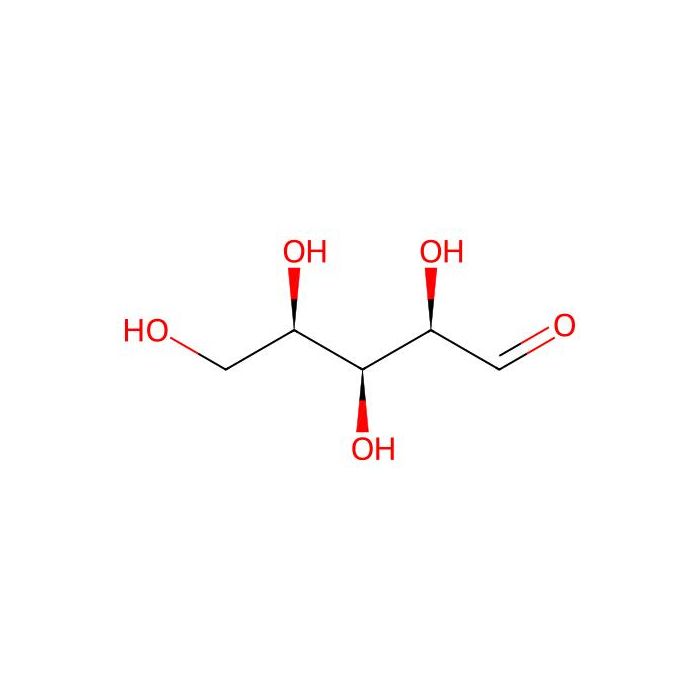
D-(+)-Xylose - analytical standard, Moligand™, ≥99% , CAS No.58-86-6

CAS: 58-86-6 Cat. No.: X101010 Summenformel: C5H10O5 Molekulargewicht: 150.13 Beilstein Registry Number: 1562108 EG-Nummer: 200-400-7 PubChem CID: 644160
Zu bestellen verfügbar
QUALITÄT & REINHEIT Analytical standard ? Analytical standard — certified-purity material for quantitative calibration. Use to prepare calibration standards and validate analytical methods. Moligand™ ? Moligand™ — Aladdin's line of ligands and bioactive small molecules. Use for receptor, pathway, and binding studies needing defined small-molecule tools. ≥99%
Synonyms
XYLOSE [WHO-DD]|X-7910|XYLOSE [HSDB]|D-xylo-pentose|( inverted exclamation markA)-Xylos|X-7950|XYLOSE [MI]|D-Xylose,(S)|Xylose, D-|DL-Xylose|XYLOSE [VANDF]|(+-)-Xylose|(+)-Xylose|(2R,3S,4R)-2,3,4,5-tetrahydroxypentanal|Pharmakon1600-01300048|XYLOSE [ORANGE BOOK]|(D)-XYLOSE|D-(+)-Xylose;(+)-Xylose;Wood sugar|XYLOSE [INCI]|(2R,4R,5R)-tetrahydropyran-2,3,4,5-tetrol|aldehydo-D-xylose|(2R,3S,4R)-2,3,4,5-tetrahydroxypentana|D-xylose (open structure, complete stereochemistry)|( inverted exclamation markA)-Xylose
Storage
Room temperature,Argon charged,Desiccated
Shipped In
Normal
★
Größe
Deutschland (EU)
USA*
Preis
Menge
250mg
X101010-250mg
—
5 Auf Lager

50,24€

59,79€
Speichern 9,55 € (15.97%)
Enter a quantity for the sizes you want to add.

Übersicht

D-(+)-Xylose is classified as a monosaccharide of the aldopentose type, which means that it contains five carbon atoms and includes a formyl functional group.

Spezifikationen

Synonyme
XYLOSE [WHO-DD] | X-7910 | XYLOSE [HSDB] | D-xylo-pentose | ( inverted exclamation markA)-Xylos | X-7950 | XYLOSE [MI] | D-Xylose,(S) | Xylose, D- | DL-Xylose | XYLOSE [VANDF] | (+-)-Xylose | (+)-Xylose | (2R,3S,4R)-2,3,4,5-tetrahydroxypentanal | Pharmakon1600-01300048 | XYLOSE [ORANGE BOOK] | (D)-XYLOSE | D-(+)-Xylose;(+)-Xylose;Wood sug Show more
Spezifikationen & Reinheit
analytical standard, Moligand™, ≥99%
Storage
Room temperature,Argon charged,Desiccated
Verschickt in
Normal
Note
Analytischer Standard, Moligand™
Reinheit
≥99%
Namen und Kennungen
Pubchem Sid
Pubchem Sid Url
https://pubchem.ncbi.nlm.nih.gov/substance/508810436
Isomere SMILES
C([C@H]([C@@H]([C@H](C=O)O)O)O)O
WGK Deutschland
2
PubChem CID
644160
Molekulargewicht
150.13
Beilstein
1562108

Erweiterte Daten

Zugehörige Ziele (nicht menschlich)
Hdac6 Histone deacetylase 6 (222 Activities)
Activity TypeRelationActivity valueUnitsAction TypeJournalPubMed IddoiAssay Aladdin ID
rep Replicase polyprotein 1ab (378 Activities)
Activity TypeRelationActivity valueUnitsAction TypeJournalPubMed IddoiAssay Aladdin ID
Wirkungsmechanismen
Zertifikate (CoA, COO, BSE/TSE und Analyse-Diagramm)
C of A & Other Certificates(BSE/TSE, COO):
Analytical Chart:

Find and download the COA for your product by matching the lot number on the packaging.

5 results found

Lot NumberCertificate TypeDatumArtikel
E2306036E2306036Certificate of AnalysisOct 13, 2026 X101010
E2611116E2611116Certificate of AnalysisMay 19, 2026 X101010
G2409321G2409321Certificate of AnalysisMar 13, 2026 X101010
K2012177K2012177Certificate of AnalysisSep 12, 2022 X101010
B2218573B2218573Certificate of AnalysisAug 25, 2022 X101010
Chemische und physikalische Eigenschaften
EmpfindlichkeitHygroscopic
Spezifische Drehung [α]20 ° (C=10, H2O)
Schmelzpunkt (°C)154-158°C
Molekulargewicht150.13
XLogP3-2.300
Hydrogen Bond Donor Count4
Hydrogen Bond Acceptor Count5
Rotatable Bond Count4
Exact Mass150.053 Da
Monoisotopic Mass150.053 Da
Topological Polar Surface Area98.000 Ų
Heavy Atom Count10
Formal Charge0
Complexity104.000
Isotope Atom Count0
Defined Atom Stereocenter Count3
Undefined Atom Stereocenter Count0
Defined Bond Stereocenter Count0
Undefined Bond Stereocenter Count0
The total count of all stereochemical bonds0
Covalently-Bonded Unit Count1
Sicherheit und Gefahren (GHS)
WGK Deutschland
2
Merck-Index
10087
FAQs und Artikel
An Introduction to Research-Grade Carbohydrates: Decoding the “Glycan Language” and a Product-Selection Guide (with Tables 1–3)
Isomerases: Overview and Recommended Application Technical Guide
Hemicellulases: A Review of Substrate Specificity, Catalytic Systems, and Research and Industrial Applications
Physicochemical Properties of Diphenylamine, Analytical Applications, and a Review of Its DNA Colorimetric Reaction
Pyran and the “Pyran Family” Research Selection Guide: Key Structural Points, a Classification Roadmap, and Experimental Selection Navigation
Formation of Nucleotide-Sugar Precursors and Regulatory Mechanisms in Plant Growth and Development
Synergy of Enzymes in Plant Cell Wall Hemicellulose Degradation: Xylanase, β-Xylosidase, and Debranching Enzymes
Comparison of Reducing Sugar Detection Methods: Selection of Fehling’s Reagent, Benedict’s Method, DNS Method, and HPLC
Moisturizing Mechanisms of Tremella fuciformis Polysaccharides: From Polysaccharide Structure and Hydration Rheology to Dynamic Film Formation on the Skin Surface
Skin Mechanism of Action of Pro-Xylane: From C-Xyloside Priming and CS/DS Chain Remodeling to the Dermal–Epidermal Junction
Sources, Host-Regulatory Mechanisms, and Tumor-Immune Effects of Gut Microbiota-Derived Metabolites
Effect of Glycosylation on the Hydrophilic–Lipophilic Partitioning and Solubility Behavior of Natural Products—Quercetin, Isoquercitrin, and Rutin as Examples
Glycosidic Bond Structure and Cleavage Mechanisms—Chemical and Enzymatic Cleavage of O-, N-, S-, and C-Glycosides
Citations of This Product
Lösungsrechner
Bewertungen

Kundenbewertungen

Dürfen wir Sie über Rabattaktionen informieren?

Später erinnern

Vielen Dank! Bitte überprüfen Sie Ihren E-Mail-Posteingang, um zu bestätigen.

Hoppla! Benachrichtigungen sind deaktiviert.