DY131 - Moligand™, ≥98% , Agonist of Estrogen-related receptor-β;Agonist of Estrogen-related receptor-γ, CAS No.95167-41-2, Agonist of Estrogen-related receptor-β;Agonist of Estrogen-related receptor-γ
DY131 - Moligand™, ≥98% , Agonist of Estrogen-related receptor-β;Agonist of Estrogen-related receptor-γ, CAS No.95167-41-2, Agonist of Estrogen-related receptor-β;Agonist of Estrogen-related receptor-γ
QUALITÄT & REINHEITMoligand™?Moligand™ — Aladdin's line of ligands and bioactive small molecules. Use for receptor, pathway, and binding studies needing defined small-molecule tools.≥98%
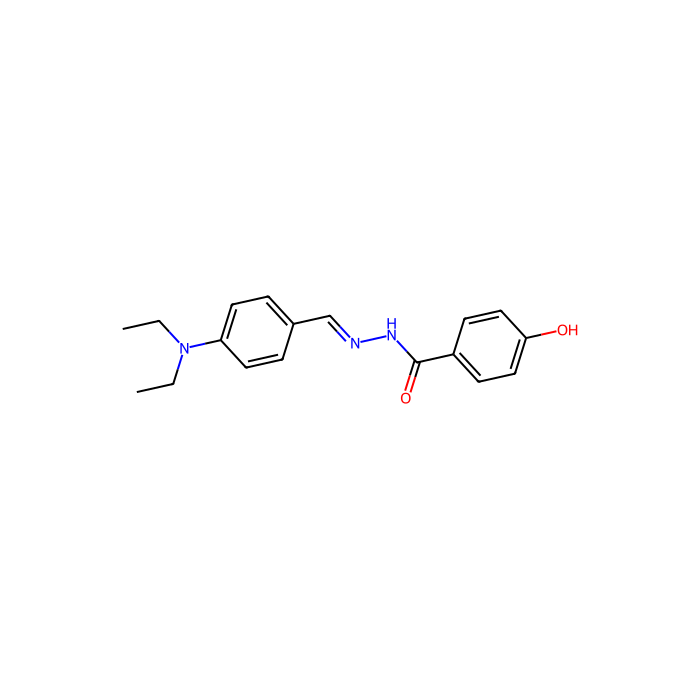
DY131(GSK 9089) is a novel selective agonist of ERRβ and ERRγ; displays minimal activity at ERRα, ERα and ERβ at concentrations up to 30 μM. A novel selective agonist at ERRβ and ERRγ
Spezifikationen
Synonyme
N'-((1E)-(4-(diethylamino)phenyl)methylene)-4-hydroxybenzohydrazide | DY131 | N'-{[4-(diethylamino)phenyl]methylidene}-4-hydroxybenzohydrazide | Aminotris(methylenephoshonic acid) pentasodium salt | (e)-N'-(4-(diethylamino) benzylidene)-4-hydroxybenzohydrazide | (E)-N'-[4-(Diethylamino)benzylidene]-4-hydroxybenzohydrazide | Benzoic acid, Show more
Spezifikationen & Reinheit
Moligand™, ≥98%
Biochemische und physiologische Mechanismen
Novel selective agonist at estrogen-related receptors ERRβand ERRγ. Displays minimal activity at ERRα, ERαand ERβat concentrations up to 30μM.
Storage
Store at 2-8°C
Verschickt in
Wet ice
Dieses Produkt erfordert Kühlkettenversand. Grundversand und andere Economy-Optionen sind nicht verfügbar.
Note
Moligand™
Aktionsart
AGONIST
Mechanismus der Wirkung
Agonist of Estrogen-related receptor-β;Agonist of Estrogen-related receptor-γ
This compound belongs to the class of organic compounds known as benzoic acids and derivatives. These are organic compounds containing a carboxylic acid substituent attached to a benzene ring.
External Descriptors
Not available
1. Djoumbou Feunang Y, Eisner R, Knox C, Chepelev L, Hastings J, Owen G, Fahy E, Steinbeck C, Subramanian S, Bolton E, Greiner R, and Wishart DS. ClassyFire: Automated Chemical Classification With A Comprehensive, Computable Taxonomy. Journal of Cheminformatics, 2016, 8:61.
Wir verwenden Cookies, um die ordnungsgemäße Funktion der Website sicherzustellen und, soweit zulässig, Ihr Nutzererlebnis zu verbessern. Sie können Ihre Einstellungen jederzeit unter „Einstellungen“ verwalten. Weitere Informationen finden Sie in unserer Cookie-Richtlinie.
Dürfen wir Sie über Rabattaktionen informieren?
Später erinnern
Vielen Dank! Bitte überprüfen Sie Ihren E-Mail-Posteingang, um zu bestätigen.
Products are supplied to verified businesses, institutions, and qualified professionals for research and development use only. Not for use in humans, animals, diagnosis, or therapy.

 D1727042