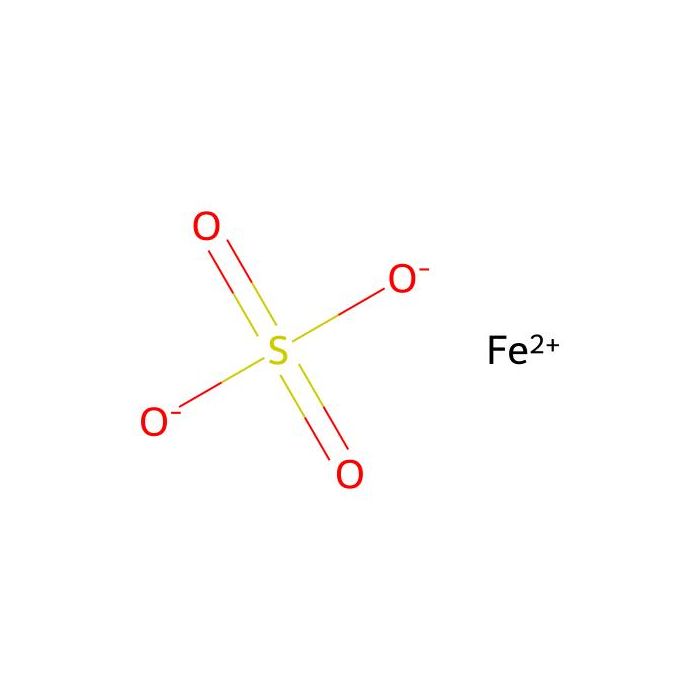
FERROUS SULFATE standard solution - 0.25mol/L in H2O , CAS No.7720-78-7

CAS: 7720-78-7 Cat. No.: F709863 Summenformel: FeSO4 Molekulargewicht: 151.91 EG-Nummer: 231-753-5
Zu bestellen verfügbar
QUALITÄT & REINHEIT 0.25mol/L in H2O
Storage
Room temperature
★
Größe
Deutschland (EU)
USA*
Preis
Menge
500ml
F709863-500ml
Auf Bestellung · 8–12 Wochen

100,57€

117,93€
Speichern 17,35 € (14.72%)
Enter a quantity for the sizes you want to add.
🧪
Warum diese Qualität

0.25mol/L in H2O für empfindliche chromatographische und analytische Workflows, die minimale Basislinieninterferenzen erfordern.

🌡

Lagerung & Versand

Room temperature Versand . Genaue Spezifikationen finden Sie im chargenspezifischen COA.

📋

Qualitätsdokumente

SDS, COA, Datenblatt und Spezifikationsblatt stehen zum Download bereit. Chargenspezifische COA über Chargennummernsuche abrufbar.

📚

Literaturbeleg

In 291 peer-reviewten Publikationen zu Chromatographie, organischer Synthese und Kreuzkupplungsreaktionen zitiert.

Spezifikationen

Spezifikationen & Reinheit
0.25mol/L in H2O
Storage
Room temperature
Namen und Kennungen
Kanonisches Lächeln
[O-]S(=O)(=O)[O-].[Fe+2]
IUPAC Name
iron(2+);sulfate
InChIKey
BAUYGSIQEAFULO-UHFFFAOYSA-L
INCHI
1S/Fe.H2O4S/c;1-5(2,3)4/h;(H2,1,2,3,4)/q+2;/p-2
Isomere SMILES
[O-]S(=O)(=O)[O-].[Fe+2]
Alternative CAS-Nummer
7720-78-7; 7782-63-0(heptahydrate),15438-31-0 (Parent)
MeSH-Eintrag
Aktiferrin;Apo-Ferrous Sulfate;biofer;Ceferro;Conferon;Eisendragees-ratiopharm;Eisensulfat Stada;Feospan;Fer-Gen-Sol;Fer-in-Sol;Feratab;Fero-Gradumet;Ferodan;Ferogradumet;Ferro-Gradumet;Ferrogamma;Ferrograd;FERROinfant;ferrous sulfate;ferrous sulfate, hep
Molekulargewicht
151.91

Dokumentation

📋 Sicherheitsdatenblatt (SDS)

Umfassendes Dokument zu Gefahren, Handhabung, Lagerung und Einhaltung regulatorischer Vorschriften.

<<<<<<< HEAD SDS herunterladen → ======= SDS herunterladen → >>>>>>> release248-p3

✅ Analysezertifikat (COA)

Chargenspezifische Qualitätsdaten. Geben Sie Ihre Chargennummer ein, um das genaue COA abzurufen.

COA nachschlagen →

📊 Datenblatt

Kurzübersicht über Produktspezifikationen und Anwendungen.

Datenblatt ansehen →

🔬 Spezifikationsblatt

Vollständige Qualitätsmerkmale und Akzeptanzkriterien für diese Qualität.

Spezifikationsblatt ansehen →

Erweiterte Daten

Taxonomic Classification

Taxonomy Tree

KingdomInorganic compounds
SuperclassMixed metal/non-metal compounds
KlasseTransition metal oxoanionic compounds
SubclassTransition metal sulfates
Intermediate Tree Nodes Not available
Direct ParentTransition metal sulfates
Alternative Parents Inorganic salts  Inorganic oxides  
Molecular FrameworkNot available
Substituents Transition metal sulfate - Inorganic oxide - Inorganic salt
BeschreibungThis compound belongs to the class of inorganic compounds known as transition metal sulfates. These are inorganic compounds in which the largest oxoanion is sulfate, and in which the heaviest atom not in an oxoanion is a transition metal.
External Descriptors metal sulfate - iron molecular entity
3D-Struktur
Interaktives chemisches Strukturmodell


Zertifikate (CoA, COO, BSE/TSE und Analyse-Diagramm)
C of A & Other Certificates(BSE/TSE, COO):
Analytical Chart:
Chemische und physikalische Eigenschaften
Molekulargewicht151.910 g/mol
XLogP3
Hydrogen Bond Donor Count0
Hydrogen Bond Acceptor Count4
Rotatable Bond Count0
Exact Mass151.887 Da
Monoisotopic Mass151.887 Da
Topological Polar Surface Area88.600 Ų
Heavy Atom Count6
Formal Charge0
Complexity62.200
Isotope Atom Count0
Defined Atom Stereocenter Count0
Undefined Atom Stereocenter Count0
Defined Bond Stereocenter Count0
Undefined Bond Stereocenter Count0
The total count of all stereochemical bonds0
Covalently-Bonded Unit Count2
FAQs und Artikel
Transition-Metal Salts/Precursor Selection Guide: How “Different Salts of the Same Metal” Start from Different Chemical Realities—and How to Reproduce Results (including a Selection Navigator and Product Tables 1–5)
Procyanidins: Structural Features and Key Points for Research and Application
Phytase: Enzymological Properties, Mechanism of Action, and Applications in Feed and Food
Chlorophyll: Structural Features, Physicochemical Properties, and Key Points for Research and Industrial Applications
Coelenterazine (CTZ) Differences and an Application Overview
Physicochemical Properties of Diphenylamine, Analytical Applications, and a Review of Its DNA Colorimetric Reaction
Types of Inorganic Salts That Can Undergo Reduction Reactions: Nitrates, Sulfur-Containing Salts, Halogen Oxyanion Salts, and Metal Salts
Comparison of Iron Content Detection Methods: TPTZ, 1,10-Phenanthroline, Ferrozine, 2,2'-Bipyridine, and Instrumental Analysis
How Do Collagen Peptides Act on the Skin? From Surface Hydration and Percutaneous Delivery to Fibroblasts and Collagen Homeostasis
What Is “Plant Collagen”? Distinguishing Ingredient Types, Structural Differences, Production Methods, and Skincare Effects
Citations of This Product
Lösungsrechner
Bewertungen

Kundenbewertungen

Dürfen wir Sie über Rabattaktionen informieren?

Später erinnern

Vielen Dank! Bitte überprüfen Sie Ihren E-Mail-Posteingang, um zu bestätigen.

Hoppla! Benachrichtigungen sind deaktiviert.