QUALITÄT & REINHEITCarrier Free?Carrier-free — supplied without added carrier protein/stabilizer. Use when carriers (e.g. BSA) would interfere with conjugation or sensitive assays.ExactAb™?ExactAb™ — Aladdin's antibody line emphasizing precision and validated quality. Use for reliable, specificity-validated antibody applications.Azide Free?Azide-free — without sodium azide preservative. Use in conjugations, cell work, or assays where azide is toxic or inhibitory.Validated?Validated grade — performance confirmed in defined applications before release. Use when you want documented assurance the reagent works as stated.High Performance?High-performance grade with optimized purity and performance characteristics. Use for sensitive analyses where ordinary grades fall short.PBS Only?PBS-only formulation — supplied in phosphate-buffered saline with no other additives. Use when you need a clean PBS buffer free of stabilizers/carriers.See COA
Carrier Free,ExactAb™,Azide Free,Validated,High Performance,PBS Only,See COA
Wirtsspezies
Maus
Spezifität
GFAP
Immunogen
Recombinant full length protein corresponding to Human GFAP
Positive Kontrolle
WB: Mouse brain tissue lysate
Konjugation
Unconjugated
Note
Azide Free, Carrier Free, ExactAb™, High Performance, PBS Only, Validated
Isotyp
IgG2a
Lichterketten-Typ
kappa
SDS-PAGE
150 kDa
Verfahren zur Reinigung
Protein A purified
Konzentration
See COA
Product Line
Biologische Produkte
Lagerung und Versand
Form
Liquid
Storage
Store at -20°C,Avoid repeated freezing and thawing
Verschickt in
Ice chest + Ice pads
Stabilität und Lagerung
Store at +4°C short term (1-2 weeks). Store at -20°C or -80°C. Upon receipt, it is recommended to aliquot. Avoid freeze/thaw cycle.
Bilder
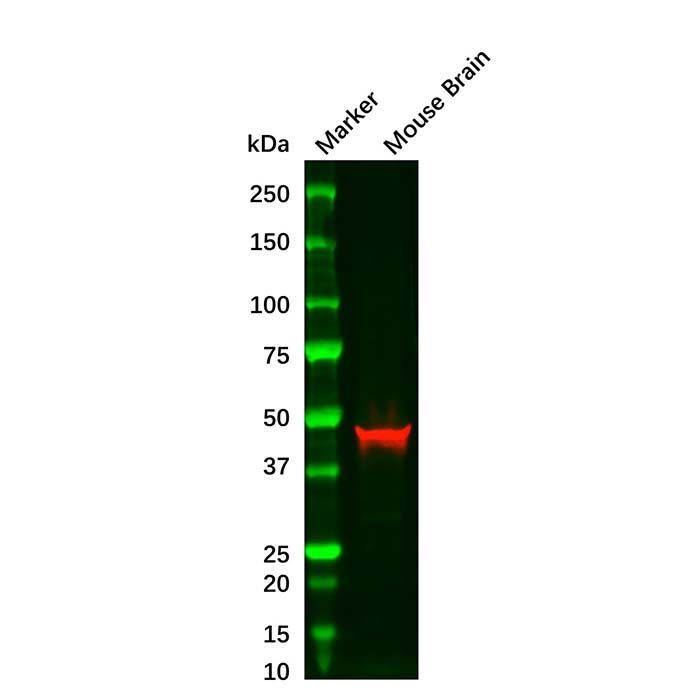
GFAP Mouse mAb (Ab179925) - Western Blot All lanes: Vinculin Antibody (Ab179925) at 0.5 μg/mL Samples: Lysate at 20 µg Secondary: Goat Anti-Mouse IgG H&L (HRP) at 1/20000 dilution
Predicted band size: 50.0 kDa Observed band size: 46.0 kDa Exposure time: 66.3 s
Determine the necessary mass, volume, or concentration for preparing a solution.
Dilution Calculator
Determine the dilution needed to prepare a stock solution.
Reconstitution Calculator
Bewertungen
Kundenbewertungen
Application Protocols
Only product-data-supported protocols can be listed as tested; none are specified for this item. Refer to the CoA/Spec Sheet for lot-specific recommendations.
General starting-point protocols (guidance; not item-specific claims):
Western Blot (WB):
Block: 5% milk or 3% BSA in TBS-T (0.1% Tween-20), 1 h RT.
Primary incubation: Optimize dilution empirically; 1 h RT or overnight 4°C.
Wash: 3 × 5–10 min in TBS-T.
Secondary: Species-appropriate HRP- or IRDye-conjugated anti-mouse, 1 h RT.
IHC/IF:
Antigen retrieval: heat-induced in citrate pH ~6 or Tris-EDTA pH ~9; cool, then block with serum/protein blocker.
Primary: Incubate in humid chamber 1–16 h; wash; detect with fluorescent or enzyme-labeled secondary.
ELISA (sandwich or direct):
Coat capture (if using this mAb as capture): 0.5–2 µg/mL in carbonate buffer pH 9.6; block; apply samples; detect with labeled anti-GFAP secondary.
Critical: Establish titration curves and positive/negative controls (GFAP+ brain tissue lysate) before routine use.
Biological Roles
Target: Glial Fibrillary Acidic Protein (GFAP)
Biology of GFAP (general literature overview):
GFAP is a type III intermediate filament protein expressed predominantly in astrocytes and certain glial subtypes. It provides cytoskeletal support, contributes to cell shape, and participates in astrocyte motility and neuroinflammatory responses.
Multiple GFAP isoforms arise from alternative splicing; expression patterns can change with development, injury, or reactive gliosis (literature).
GFAP integrates with other intermediate filament proteins (vimentin, nestin) and anchors organelles, affecting mechanotransduction and cell resilience.
Research applications enabled by anti-GFAP antibodies (general guidance):
Mapping astrocyte distribution and maturation, assessing reactive gliosis in brain and spinal cord tissues, and benchmarking differentiation state in stem cell-derived glia.
Co-labeling strategies with neuronal (e.g., MAP2, NeuN) or microglial (Iba1) markers to dissect neuroglial interplay.
Item-specific limitations:
Species reactivity, clone/epitope, and isotype are Not specified for this item; consult the CoA/Spec Sheet to ensure compatibility with your model system and detection reagents.
Note: This information contextualizes the target biology; it is not a claim of tested performance for this specific lot.
Buffer Applications
This antibody is provided in PBS Only (Carrier Free, Azide Free). While the product is not itself a buffering agent, correct buffer choice is central to assay success.
Item-specific: PBS Only; exact pH/ionic strength Not specified for this item; refer to CoA/Spec Sheet.
Practical buffer guidance for immunoassays (general):
Dilution/working buffer: PBS or TBS with 0.05–0.1% Tween-20 to reduce nonspecific binding; include 0.1–1% inert protein (e.g., BSA) if compatible to block surfaces (note: the stock is carrier-free; add carrier only to working solutions as needed).
Blocking buffers: 3–5% BSA, milk, or commercial blockers for WB; serum or protein blockers for IHC/IF depending on secondary species.
Antigen retrieval (IHC): Citrate (pH ~6) or Tris-EDTA (pH ~9) buffers, heat-induced epitope retrieval; optimize per fixation.
Wash buffers: PBS/TBS + 0.05% Tween-20; maintain consistent salt to limit hydrophobic interactions.
Storage buffer adjustments: For −20°C storage after first use, users may add 30–50% glycerol to aliquots to mitigate freeze–thaw stress, provided compatibility with downstream assays.
Always verify that buffer additives do not interfere with conjugation chemistry or detection enzymes.
Green Alternatives
Greener lab practices for antibody reagents focus on formulation, packaging, and workflow efficiency rather than replacing the active component.
Item-specific green advantages:
Azide Free: Eliminates disposal concerns associated with sodium azide (acute aquatic toxicity, heavy-metal azide formation in plumbing).
Shipped cold (ice pads) rather than on dry ice, lowering energy intensity when feasible.
Greener handling strategies (general guidance):
Aliquot once; avoid repeated freeze–thaw to extend product life and reduce wasted material.
Adopt miniaturized assay formats (microfluidic ELISA, high-density slides) to cut reagent volumes and consumables.
Use reusable secondary containers and consolidate shipments to reduce packaging waste.
Replace blocking buffers with plant-derived or synthetic alternatives where appropriate; validate performance.
Comparison (general):
Azide-containing stocks: longer bench stability but require hazardous waste management and are incompatible with HRP and live-cell work.
Glycerol-stabilized stocks: improved freeze–thaw resilience but increased viscosity and carbon footprint; assess need before adding.
Outcome: This carrier-free, azide-free PBS formulation aligns with greener, safer practice while maintaining flexibility for diverse assays.
Pharmaceutical Uses
No therapeutic or clinical claims are made. This product is for research use only.
Relevance to pharmaceutical R&D (general):
Biomarker development: Anti-GFAP antibodies are commonly used to characterize astroglial content and reactivity in preclinical models, supporting target validation and safety pharmacology.
Bioprocess analytics: May serve as a reagent in in-process controls or product characterization assays where GFAP is a matrix biomarker in CNS-derived materials.
Diagnostic assay prototyping: Useful for building and evaluating laboratory-developed tests or RUO immunoassays prior to design-transfer to regulated environments.
Formulation considerations (item attributes):
Carrier Free and Azide Free in PBS facilitate custom conjugation (e.g., HRP, AP, fluorophores) and compatibility with live-cell or enzyme-based readouts.
Compliance notes:
Not produced to cGMP for human administration (not specified; assume RUO). Any use in regulated diagnostics or manufacturing requires appropriate qualification, bridging studies, and vendor audits.
For regulated applications, obtain lot-specific CoA/Spec Sheet and validate fit-for-purpose performance.
Physical Properties
Antibody preparations do not have conventional small-molecule identifiers (bp, mp, SMILES). Properties below distinguish item-specific details from general protein behavior.
Item-specific formulation facts:
Buffer: PBS Only (exact composition not specified)
Additives: Carrier Free; Azide Free
Appearance/concentration: Not specified for this item; refer to CoA/Spec Sheet.
Storage form and stability:
Supplied for cold-chain shipment (Ice chest + Ice pads) and storage at −20°C; avoid repeated freeze–thaw.
General protein properties (literature/guidance, not item-specific specifications):
Approx. size: mouse monoclonal IgG typically ~150 kDa; hydrodynamic radius ~5–6 nm; diffusion-limited in dense matrices.
pI varies by isotype/sequence (often ~6–9), affecting binding to ion-exchange media and adsorption to plastics.
Solubility: readily soluble in isotonic buffers (e.g., PBS) at mg/mL concentrations; sensitive to extremes of pH, heat, and denaturants.
Optical: proteins have A280 absorbance governed by Trp/Tyr; extinction coefficient is sequence-dependent (not provided here).
Do not treat the above as specifications. For exact concentration, excipient levels, and UV properties, consult the product CoA/Spec Sheet.
Carrier Free: No stabilizing proteins (e.g., BSA) are added. Advantages: precise conjugation stoichiometry, reduced assay background, and flexibility for custom formulation. Implication: more sensitive to adsorption/aggregation—use low-binding plastics and consider adding carrier post-aliquoting if compatible with your workflow.
Azide Free: Suitable for azide-sensitive applications (e.g., live-cell labeling, HRP-based systems where azide inhibits peroxidase). Requires strict aseptic technique to limit bioburden during prolonged storage at 4°C; product is intended for storage at −20°C per item data.
PBS Only: Formulated solely in phosphate-buffered saline (exact composition not specified). Compatible with most immunoassays and coupling chemistries.
Validated; High Performance: Indicates internal performance verification. Specific validation datasets, tested applications, and species cross-reactivity are Not specified for this item; refer to CoA/Spec Sheet.
ExactAb™: Platform/branding denoting controlled manufacturing for consistency and reliability. Lot-specific metrics (purity by SDS-PAGE, monomer content by SEC, endotoxin, residuals) are Not specified for this item; refer to CoA/Spec Sheet.
Recommendation: Request the lot CoA for clone/isotype, purity profiles, and functional validation in your intended assay.
Reaction and Applications
This antibody specifically recognizes GFAP and is intended for immunoassay-based workflows rather than chemical synthesis.
Item-specific notes:
Intended use: For research use only.
Validated; High Performance (general designation). Specific tested applications are Not specified for this item; refer to CoA/Spec Sheet.
Typical application families for anti-GFAP antibodies (general guidance):
Immunohistochemistry (IHC) and Immunofluorescence (IF): Astrocyte and intermediate filament visualization in neural tissues; optimize antigen retrieval and blocking conditions per sample fixation method.
Western Blot (WB): Detection of GFAP isoforms; consider sample preparation to preserve intermediate filaments and include appropriate loading controls.
ELISA/Immunoassay: Quantitation in tissue lysates or biofluids; carrier-free format facilitates custom capture/detection conjugations (biotin, HRP, fluorophores).
Immunocytochemistry (ICC): Culture models of astrocytes or iPSC-derived glia; verify fixation compatibility (PFA vs methanol) empirically.
Practical tips (general):
Titration is critical; start with a broad dilution range to balance signal and background.
Employ low-protein-binding plastics; add carrier protein to working buffers (e.g., 0.1–1% BSA) to reduce nonspecific adsorption, if compatible with your assay.
Validate species cross-reactivity and epitope accessibility for your sample type using positive and negative controls.
Note: For definitive performance claims, consult the specific lot’s CoA/Spec Sheet.
Reaction Conditions
For antibody-based assays, “reaction conditions” pertain to binding equilibria and detection chemistries rather than classical organic reactions. The following are general, literature-based guidelines and are not item-specific specifications:
Binding kinetics: Typical antibody–antigen interactions exhibit KD from pM–nM; association favored by near-neutral pH (7.2–7.6), isotonic buffers, and temperatures from 4–25°C depending on assay sensitivity and background.
Incubation parameters (typical starting points):
IHC/IF: 1–16 h at 4–25°C; humidity-controlled chambers to prevent evaporation.
WB: 1 h at room temp or overnight at 4°C with gentle agitation.
ELISA: 1–2 h at room temp or overnight at 4°C for capture/detection.
Buffer composition:
PBS or TBS with 0.05–0.1% Tween-20 for washes; include protein blockers to reduce nonspecific interactions if compatible.
Conjugation (general):
NHS-ester labeling optimal at pH 7.5–8.5; maleimide–thiol coupling at pH 6.5–7.0; remove unreacted label by desalting/SEC.
Controls:
Include isotype controls, no-primary controls, and known positive tissues/lysates for GFAP to benchmark specificity.
Specific dilutions, epitope retrieval steps, and species cross-reactivity are Not specified for this item; consult the CoA/Spec Sheet.
Safety and Handling
This product is a proteinaceous research reagent in PBS, carrier-free and azide-free.
GHS/SDS:
Signal word, hazard statements, pictograms, and classification: Not specified for this item; refer to the SDS for authoritative safety information.
Practical lab safety (general guidance):
PPE: laboratory coat, gloves, and eye protection when handling solutions or frozen vials.
Hygiene: avoid ingestion and inhalation of aerosols; wash hands after use.
Azide-free formulation reduces risks associated with sodium azide (e.g., acute toxicity, heavy-metal azide formation in plumbing). Standard biosafety and chemical hygiene practices still apply.
Handling precautions:
Avoid repeated freeze–thaw cycles to prevent aggregation and loss of binding activity; aliquot upon first thaw.
Minimize foaming and vigorous vortexing; mix by gentle inversion.
Use low-protein-binding plastics to limit adsorption losses.
Incompatibilities (general protein considerations):
Avoid strong oxidants, extremes of pH, high ionic detergents, and organic solvents that can denature antibodies.
Microbial contamination can degrade proteins; work aseptically.
First-aid (general):
Skin/eye contact: rinse with water. Ingestion/inhalation: seek medical attention. Always follow institutional EHS procedures and consult the SDS.
Solvent Selection
As an antibody reagent, this product is supplied in aqueous buffer rather than organic solvents.
Item-specific formulation:
PBS Only; Carrier Free; Azide Free. Exact salt concentration and pH: Not specified for this item; refer to CoA/Spec Sheet.
Practical considerations for buffer selection (general guidance):
Binding assays (ELISA, IF, IHC, WB): PBS or TBS are commonly used; inclusion of mild detergents (e.g., 0.05% Tween-20) can reduce nonspecific binding (not present in this product).
Conjugation: Carrier-free PBS is often compatible with NHS-ester or isothiocyanate coupling; avoid primary amine buffers (e.g., Tris) during NHS reactions.
Live-cell use: Azide-free formulation is favorable; ensure buffer osmolarity and pH are physiologically appropriate (pH ~7.2–7.4, isotonic; literature guidance).
Storage stabilization: Users may add cryoprotectants (e.g., 10–50% glycerol) when storing at −20°C to minimize freeze–thaw damage, provided it suits downstream assays.
Incompatibilities:
High concentrations of chaotropes, alcohols, or organic solvents can denature IgG; maintain aqueous, near-neutral conditions.
Conclusion: Use as provided for most immunoassays; adjust only if your downstream chemistry or storage strategy requires it.
Storage and Reconstitution
Item-specific instructions (from Product Data):
Storage Conditions: Store at −20°C. Avoid repeated freezing and thawing.
Shipping: Ice chest + Ice pads (cold chain).
Formulation: PBS Only; Carrier Free; Azide Free. Exact concentration and pH: Not specified for this item; refer to CoA/Spec Sheet.
Reconstitution/handling (general best practices for antibodies):
If received frozen, thaw on ice. Mix gently by inversion; avoid vigorous vortexing and foaming.
Immediately aliquot into low-protein-binding tubes sized for single-use to minimize freeze–thaw cycles.
Optional user-added stabilizers for working stocks (if compatible with downstream assays):
10–50% glycerol for −20°C storage to reduce freeze–thaw damage.
0.1–1% inert protein (e.g., BSA) in assay diluents to reduce adsorption (do not add carrier to master stock if conjugation is planned).
Short-term storage: 2–8°C for hours to a few days may be acceptable for in-process handling; for extended storage follow −20°C guidance.
Do not expose to repeated temperature fluctuations or direct light if fluorophore-conjugated (this item is unconjugated; no label specified).
Always refer to the product’s CoA/Spec Sheet and SDS for lot-specific stability, concentration, and handling guidance.
Structure and Identity
Professional-grade mouse monoclonal antibody targeting glial fibrillary acidic protein (GFAP), supplied carrier-free in PBS and free of sodium azide.
Item-specific facts (from Product Data):
Type: Mouse monoclonal antibody (mAb) against GFAP
Typical IgG architecture with two heavy and two light chains linked by disulfide bonds; Y-shaped quaternary structure with two identical antigen-binding fragments (Fabs) and one Fc domain.
Approximate molecular mass of a mouse IgG is typically ~150 kDa (literature, varies with isotype and glycosylation).
Antigen-binding site (paratope) recognizes epitopes within GFAP, an intermediate filament protein enriched in astrocytes.
Identity markers (not specified for this item):
Clone ID, isotype, light chain type, and epitope mapping: Not specified for this item; refer to CoA/Spec Sheet.
2D/sequence description (general):
Variable domains (VH/VL) confer specificity to GFAP; constant domains (CH/CL) define isotype and effector functions (literature).
Synthetic Utility
Not a synthetic building block. As a protein reagent, this antibody does not participate in traditional small-molecule or polymer synthesis.
Relevant laboratory utility (general):
Bioconjugation: Carrier-free PBS enables covalent labeling via NHS-esters (amines on lysines), isothiocyanates, maleimides (reduced cysteines), and click-chemistry after appropriate functionalization.
Surface immobilization: Passive adsorption onto polystyrene (ELISA plates) or covalent coupling to activated resins (NHS-activated sepharose) to prepare affinity matrices for GFAP capture/enrichment from lysates.
Biosensor assembly: Orientation-controlled coupling (Protein A/G capture or Fc-specific linkers) to preserve antigen-binding sites for SPR/BLI assays.
Note: Conjugation conditions must be optimized empirically (pH, molar ratios, quenching) and verified by functional testing.
Target Specificity
Only information from the product data is provided here.
Clone, epitope, isotype, light chain type: Not specified for this item; refer to CoA/Spec Sheet.
Species reactivity and cross-reactivity: Not specified for this item; refer to CoA/Spec Sheet.
Applications validated by the manufacturer: Not specified for this item; refer to CoA/Spec Sheet.
Note: For precise targeting details and species coverage, obtain the lot-specific documentation.
Häufig gestellte Fragen
How is this product shipped?
This product ships in an insulated container with ice pads. Unpack on arrival and transfer it to the storage condition stated above.
How should this product be stored?
Store at ?20 °C. Avoid repeated freeze–thaw cycles. Aliquot into single-use volumes before freezing.
What does ExactAb? mean?
ExactAb? indicates the product has been validated for use in rigorous antibody validation workflows. Validation may include positive/negative control samples, signal-to-noise testing, and protocol-specific QC. Lot-specific test data is published on the Certificate of Analysis where available.
What does Carrier Free mean?
Carrier Free indicates that the material has been processed and tested for specialty industrial processing. Specifications focus on the impurities that affect performance in that application — for example, metal content for electronics, particle size for batteries, refractive index for optics, or moisture content for moisture-sensitive processes.
What documentation is provided?
Available product documentation, including Certificates of Analysis (COA), Safety Data Sheets (SDS), and specification sheets, is shown in the product document area. Document availability and access follow the current site policy.
Which species reactivity has this antibody been validated against?
Validated reactivity is listed on the PDP and on each lot's datasheet. We validate against the most commonly tested species for the target (GFAP Mouse mAb); cross-reactivity in untested species may exist but is not guaranteed. Contact technical support for specific species inquiries.
Benötigen Sie Hilfe bei der Auswahl der Qualität?
Unser Leitfaden zur Qualitätsauswahl behandelt Reinheit, Stabilisatorstatus und Anwendungseignung für alle Varianten in unserem Katalog.
Wir verwenden Cookies, um die ordnungsgemäße Funktion der Website sicherzustellen und, soweit zulässig, Ihr Nutzererlebnis zu verbessern. Sie können Ihre Einstellungen jederzeit unter „Einstellungen“ verwalten. Weitere Informationen finden Sie in unserer Cookie-Richtlinie.
Dürfen wir Sie über Rabattaktionen informieren?
Später erinnern
Vielen Dank! Bitte überprüfen Sie Ihren E-Mail-Posteingang, um zu bestätigen.
Products are supplied to verified businesses, institutions, and qualified professionals for research and development use only. Not for use in humans, animals, diagnosis, or therapy.

 ZJ23F1202279