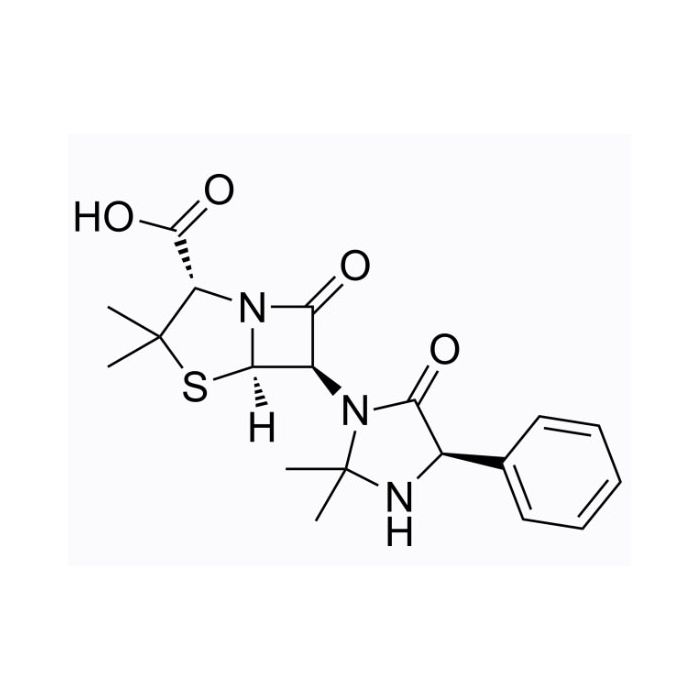
Hetacillin - Moligand™,≥95% , Penicillin-binding protein inhibitor, CAS No.3511-16-8, Penicillin-binding protein inhibitor

CAS: 3511-16-8 Cat. No.: H610818 Summenformel: C19H23N3O4S Molekulargewicht: 389.47 EG-Nummer: 222-512-5 PubChem CID: 443387
Zu bestellen verfügbar
QUALITÄT & REINHEIT Moligand™ ? Moligand™ — Aladdin's line of ligands and bioactive small molecules. Use for receptor, pathway, and binding studies needing defined small-molecule tools. ≥95%
Synonyms
BRL-804|Hetacillin (USAN:USP:INN:BAN)|Hetacilline (INN-French)|6beta-[(4R)-2,2-dimethyl-5-oxo-4-phenylimidazolidin-1-yl]penicillanic acid|HETACILLIN [USAN]|HETACILLIN [WHO-DD]|Hetacilline [INN-French]|4-THIA-1-AZABICYCLO(3.2.0)HEPTANE-2-CARBOXYLIC ACID, 6-((4R)-2,2-DIMETHYL-5-OXO-4-PHENYL-1-IMIDAZOLIDINYL)-3,3-DIMETHYL-7-OXO-, (2S,5R,6R)-|7-(2,2-dimethyl-5-oxo-4-phenyl-imidazolidin-1-yl)-3,3-dimethyl-6-oxo-2-thia-5-azabicyclo[3.2.0]heptane-4-carboxylic acid|Hetacillin acid|6-(2,2-Dimethyl-5-oxo-4-phenyl-1-imidazolidinyl)-3,3-dimethyl-7-oxo-4-thia-1-azabicyclo[3.2.0]heptane-2-carboxylic acid|J-100177|(2S,5R,6R)-6-[(4R)-2,2-dimethyl-5-oxo-4-phenylimidazolidin-1-yl]-3,3-dimethyl-7-oxo-4-thia-1-azabicyclo[3.2.0]heptane-2-carboxylic acid|Hetacilina|Hetacillinum|6-(2,2-Dimethyl-5-oxo-4-phenyl-1-imidazolidinyl)penicillansaeure|Hetacilina (INN-Spanish)|Phenazacillin|Versapen|Hetacillinum [INN-Latin]|Versapen (TN)|6-(2,2-Dimethyl-5-oxo-4-phenyl-1-imidazolidinyl)-3,3-dimethyl-7-oxo-4-thia-1-azabicyclo(3.2.0)heptane-2-carboxylic acid|HETACILLIN (MART.)|HETACILLIN [MART.]|Hetacillinum (INN-Latin)|hetacillin|4-Thia-1-azabicyclo(3.2.0)heptane-2-carboxylic acid, 6-(2,2-dimethyl-5-oxo-4-phenyl-1-imidazolidinyl)-3,3-dimethyl-7-oxo-, (2S-(2alpha,5alpha,6beta(S*)))-|6beta-((4R)-2,2-dimethyl-5-oxo-4-phenylimidazolidin-1-yl)penicillanic acid|(2S,5R,6R)-6-((4R)-2,2-dimethyl-5-oxo-4-phenylimidazolidin-1-yl)-3,3-dimethyl-7-oxo-4-thia-1-azabicyclo(3.2.0)heptane-2-carboxylic acid|BL-P 804|4-THIA-1-AZABICYCLO(3.2.0)HEPTANE-2-CARBOXYLIC ACID, 6-(2,2-DIMETHYL-5-OXO-4-PHENYL-1-IMIDAZOLIDINYL)-3,3-DIMETHYL-7-OXO-, (2S-(2.ALPHA.,5.ALPHA.,6.BETA.(S*)))-|6beta-((4R)-2,2-dimethyl-5-oxo-4-phenylimidazolidin-1-yl)-2,2-dimethylpenam-3alpha-carboxylic acid|Etacillina [DCIT]|6beta-[(4R)-2,2-dimethyl-5-oxo-4-phenylimidazolidin-1-yl]-2,2-dimethylpenam-3alpha-carboxylic acid|(2S,5R,6R)-6-((R)-2,2-dimethyl-5-oxo-4-phenylimidazolidin-1-yl)-3,3-dimethyl-7-oxo-4-thia-1-azabicyclo[3.2.0]heptane-2-carboxylic acid|Hetacillin [USAN:USP:INN:BAN]|Hetacillin (USAN/INN)|HETACILLIN [INN]|HETACILLIN [MI]|(2S,%R,6R)-6-(2,2-Dimethyl-5-oxo-4-phenyl-1-imidazolidinyl)-3,3-dimethyl-7-oxo-4-thia-1-azabicyclo(3.2.0)heptan-2-carbonsaeure|Hetacilina [INN-Spanish]|Hetacilline|BL-P-804|BLP-804|(2S,5R,6R)-6-[(4R)-2,2-Dimethyl-5-Oxo-4-Phenyl-Imidazolidin-1-Yl]-3,3-Dimethyl-7-Oxo-4-Thia-1-Azabicyclo[3.2.0]Heptane-2-Carboxylic Acid|(2S,5R,6R)-6-[(4R)-2,2-Dimethyl-5-Oxo-4-Phenyl-1-Imidazolidinyl]-3,3-Dimethyl-7-Oxo-4-Thia-1-Azabicyclo[3.2.0]Heptane-2-Carboxylic Acid|(2S,5R,6R)-7-Keto-6-[(4R)-5-Keto-2,2-Dimethyl-4-Phenyl-Imidazolidin-1-Yl]-3,3-Dimethyl-4-Thia-1-Azabicyclo[3.2.0]Heptane-2-Carboxylic Acid
Storage
Store at 2-8°C,Protected from light
Shipped In
Wet ice
★
Größe
Deutschland (EU)
USA*
Preis
Menge
1mg
H610818-1mg
Auf Bestellung · 8–12 Wochen
43,30€
5mg
H610818-5mg
Auf Bestellung · 8–12 Wochen
156,11€
10mg
H610818-10mg
Auf Bestellung · 8–12 Wochen
216,85€
25mg
H610818-25mg
Auf Bestellung · 8–12 Wochen
373,04€
Enter a quantity for the sizes you want to add.

Übersicht

Hetacillin is a beta-lactam antibiotic that is part of the aminopenicillin family. It is a prodrug and it has no antibacterial activity itself, but quickly splits of acetone in the human body to form ampicillin, which is active against a variety of bacteria

Spezifikationen

Synonyme
BRL-804 | Hetacillin (USAN:USP:INN:BAN) | Hetacilline (INN-French) | 6beta-[(4R)-2,2-dimethyl-5-oxo-4-phenylimidazolidin-1-yl]penicillanic acid | HETACILLIN [USAN] | HETACILLIN [WHO-DD] | Hetacilline [INN-French] | 4-THIA-1-AZABICYCLO(3.2.0)HEPTANE-2-CARBOXYLIC ACID, 6-((4R)-2,2-DIMETHYL-5-OXO-4-PHENYL-1-IMIDAZOLIDINYL)-3,3-DIMETHYL-7-OXO Show more
Spezifikationen & Reinheit
Moligand™,≥95%
Storage
Store at 2-8°C,Protected from light
Verschickt in
Wet ice
Dieses Produkt erfordert Kühlkettenversand. Grundversand und andere Economy-Optionen sind nicht verfügbar.
Note
Moligand™
Aktionsart
INHIBITOR
Mechanismus der Wirkung
Penicillin-binding protein inhibitor
Reinheit
≥95%
Produkteigenschaften
ALogP
-0.6
Namen und Kennungen
SMILES
CC1(C(N2C(S1)C(C2=O)N3C(=O)C(NC3(C)C)C4=CC=CC=C4)C(=O)O)C
IUPAC Name
(2S,5R,6R)-6-[(4R)-2,2-dimethyl-5-oxo-4-phenylimidazolidin-1-yl]-3,3-dimethyl-7-oxo-4-thia-1-azabicyclo[3.2.0]heptane-2-carboxylic acid
InChIKey
DXVUYOAEDJXBPY-NFFDBFGFSA-N
InChI
1S/C19H23N3O4S/c1-18(2)13(17(25)26)21-15(24)12(16(21)27-18)22-14(23)11(20-19(22,3)4)10-8-6-5-7-9-10/h5-9,11-13,16,20H,1-4H3,(H,25,26)/t11-,12-,13+,16-/m1/s1
Isomere SMILES
CC1([C@@H](N2[C@H](S1)[C@@H](C2=O)N3C(=O)[C@H](NC3(C)C)C4=CC=CC=C4)C(=O)O)C
PubChem CID
443387
Molekulargewicht
389.47

Erweiterte Daten

Taxonomic Classification

Taxonomy Tree

KingdomOrganic compounds
SuperclassOrganoheterocyclic compounds
KlasseLactams
SubclassBeta lactams
Intermediate Tree Nodes Penams
Direct ParentPenicillins
Alternative Parents Phenylimidazolidines  Alpha amino acids and derivatives  Imidazolidinones  Benzene and substituted derivatives  Thiazolidines  Tertiary carboxylic acid amides  Amino acids  Azetidines  Thiohemiaminal derivatives  Monocarboxylic acids and derivatives  Azacyclic compounds  Dialkylthioethers  Dialkylamines  Carboxylic acids  Carbonyl compounds  Hydrocarbon derivatives  Organic oxides  Organopnictogen compounds  
Molecular FrameworkAromatic heteropolycyclic compounds
Substituents Penicillin - Phenylimidazolidine - Alpha-amino acid or derivatives - Monocyclic benzene moiety - Imidazolidinone - Benzenoid - Imidazolidine - Thiazolidine - Tertiary carboxylic acid amide - Amino acid or derivatives - Azetidine - Amino acid - Carboxamide group - Carboxylic acid derivative - Carboxylic acid - Secondary aliphatic amine - Azacycle - Dialkylthioether - Monocarboxylic acid or derivatives - Hemithioaminal - Thioether - Secondary amine - Amine - Organic oxygen compound - Organopnictogen compound - Organic oxide - Organonitrogen compound - Organooxygen compound - Carbonyl group - Hydrocarbon derivative - Organic nitrogen compound - Aromatic heteropolycyclic compound
BeschreibungThis compound belongs to the class of organic compounds known as penicillins. These are organic compounds containing the penicillin core structure, which is structurally characterized by a penam ring bearing two methyl groups at position 2, and an amide group at position 6 [starting from the sulfur atom at position 1].
External Descriptors penicillin
3D-Struktur
Interaktives chemisches Strukturmodell


Zugehörige Ziele (nicht menschlich)
Streptococcus pneumoniae (31063 Activities)
Activity TypeRelationActivity valueUnitsAction TypeJournalPubMed IddoiAssay Aladdin ID
Proteus vulgaris (5823 Activities)
Activity TypeRelationActivity valueUnitsAction TypeJournalPubMed IddoiAssay Aladdin ID
Staphylococcus aureus (210822 Activities)
Activity TypeRelationActivity valueUnitsAction TypeJournalPubMed IddoiAssay Aladdin ID
Escherichia coli (133304 Activities)
Activity TypeRelationActivity valueUnitsAction TypeJournalPubMed IddoiAssay Aladdin ID
Proteus mirabilis (3894 Activities)
Activity TypeRelationActivity valueUnitsAction TypeJournalPubMed IddoiAssay Aladdin ID
Streptococcus pyogenes (16140 Activities)
Activity TypeRelationActivity valueUnitsAction TypeJournalPubMed IddoiAssay Aladdin ID
Wirkungsmechanismen
Zertifikate (CoA, COO, BSE/TSE und Analyse-Diagramm)
C of A & Other Certificates(BSE/TSE, COO):
Analytical Chart:

Find and download the COA for your product by matching the lot number on the packaging.

4 results found

Lot NumberCertificate TypeDatumArtikel
G2610365G2610365Certificate of AnalysisJan 30, 2026 H610818
G2610366G2610366Certificate of AnalysisJan 30, 2026 H610818
G2610367G2610367Certificate of AnalysisJan 30, 2026 H610818
G2610368G2610368Certificate of AnalysisJan 30, 2026 H610818
Chemische und physikalische Eigenschaften
Molekulargewicht389.500 g/mol
XLogP3-0.600
Hydrogen Bond Donor Count2
Hydrogen Bond Acceptor Count6
Rotatable Bond Count3
Exact Mass389.141 Da
Monoisotopic Mass389.141 Da
Topological Polar Surface Area115.000 Ų
Heavy Atom Count27
Formal Charge0
Complexity688.000
Isotope Atom Count0
Defined Atom Stereocenter Count4
Undefined Atom Stereocenter Count0
Defined Bond Stereocenter Count0
Undefined Bond Stereocenter Count0
The total count of all stereochemical bonds0
Covalently-Bonded Unit Count1
Lösungsrechner
Bewertungen

Kundenbewertungen

Application Protocols

Validated application data (e.g., specific assay types, recommended concentrations, or biological protocols) are Not specified for this item; refer to CoA/Spec Sheet.

General research-use examples (illustrative; adjust empirically):

  • Enzyme inhibition assay (serine transpeptidase model): Prepare a 10 mM DMSO stock. Dilute into assay buffer immediately before use to a final DMSO content ≤1% v/v. Incubate enzyme with serial dilutions on ice or at controlled temperature; initiate reaction promptly and monitor activity. Include controls for hydrolysis (no-enzyme) and for beta-lactamase interference.
  • LC–MS stability panel: Incubate aliquots in buffers spanning pH 5.5–8.0 at 4°C and 25°C. Sample at defined timepoints, quench with cold ACN, and quantify intact compound vs. degradants by RP-HPLC–MS.
  • Chemical derivatization for probes: Activate carboxyl group with HATU in dry DMF at 0–5°C; couple to an amine-tag. Purify immediately by semi-preparative RP-HPLC.

Always verify concentration by analytical assay (e.g., quantitative NMR or HPLC with a reference standard) due to possible degradation during handling.

Biological Roles

Context for research use only (no clinical claims):

  • Mechanistic class: Hetacillin is a penam beta-lactam that functions as an acylating agent toward active-site serine residues in transpeptidase (penicillin-binding) enzymes (literature). The acetone-derived protection increases lipophilicity and can hydrolyze to reveal the primary amine of the ampicillin scaffold under aqueous conditions.
  • Pro-molecule behavior: In aqueous/physiologic-like conditions, hetacillin can convert to ampicillin (literature), modulating uptake and reactivity profiles in biochemical systems.
  • Enzymology: Covalent acyl-enzyme complex formation with serine DD-transpeptidases and related serine hydrolases is a hallmark of beta-lactam reactivity; deacylation rates vary by enzyme, enabling mechanistic studies of inhibitor turnover.
  • Stability considerations: Hydrolysis of the beta-lactam to inactive ring-opened species competes with target acylation; experimental design should consider time-dependent loss of intact beta-lactam.
  • Assay relevance: Useful as a tool compound in assays probing cell wall biosynthetic enzyme function, beta-lactamase activity (hydrolysis), and structure–activity relationships of penams.

Item-specific biological data (potency, kinetics, selectivity): Not specified for this item; refer to primary literature and CoA as available.

Buffer Applications

Not a buffering agent. This compound does not serve as a pH buffer system.

Research-use handling in buffers (general guidance):

  • Prepare concentrated stocks in DMSO to limit aqueous exposure. Dilute into assay buffer immediately prior to use to the minimal final DMSO concentration compatible with the assay.
  • Choose neutral to slightly basic buffers (e.g., HEPES, phosphate) only for short incubations; prolonged exposure or elevated temperatures increase beta-lactam hydrolysis.
  • Avoid strong acid/base and high ionic strength if they negatively impact stability. Specific buffer recipes or pH ranges for this item: Not specified for this item; refer to CoA/Spec Sheet.

For work requiring stable aqueous beta-lactam solutions, consider on-ice handling, protected from light, and rapid analysis by HPLC to verify integrity.

Green Alternatives

This section addresses greener handling/formulation strategies rather than substituting the compound itself (a unique research ligand).

Greener solvent and workflow considerations (general):

  • Stock solution solvent: Prefer high-purity water with minimal co-solvent when stability allows. For beta-lactams like hetacillin that are moisture-sensitive, use the minimal effective DMSO volume, followed by rapid dilution into assay buffer immediately before use.
  • Safer solvents: Where organic solvent is required, consider ethyl acetate or 2-methyltetrahydrofuran (2-MeTHF) for extractions during workup instead of chlorinated solvents, provided the compound’s stability is verified.
  • Process intensification: Use cold temperatures and short contact times in aqueous phases to minimize degradation and waste.
  • Waste minimization: Prepare small aliquots to avoid repeated thaw/refreeze and disposal of degraded material.

Illustrative comparison (general trends; verify experimentally):

  • DMSO: Excellent solvating power; widely accepted in screening; higher persistence in the environment; minimize volumes.
  • Acetonitrile: Good for HPLC and sample prep; volatile and flammable; prefer closed systems to reduce VOCs.
  • Ethyl acetate vs DCM for extractions: EtOAc is less toxic and more environmentally benign; check for beta-lactam stability.

Note: Substitution of the active molecule with a “green alternative” is not applicable; instead, implement greener solvents and micro-scale protocols to reduce environmental footprint.

Pharmaceutical Uses

No therapeutic or clinical claims are made for this research-grade material.

Formulation context for research (general):

  • Hetacillin has historically been studied as a pro-molecule of ampicillin (literature). For research formulation work (e.g., in vitro dosing, permeability assays), its increased lipophilicity relative to ampicillin can influence dissolution and membrane interaction.
  • Typical research vehicles: DMSO stock with aqueous dilution; cyclodextrin complexation or co-solvent systems may enhance apparent solubility while limiting precipitation during dosing.
  • Salt forms: Many penams are handled as sodium or potassium salts for aqueous work; the specific salt form of this item is Not specified for this item; refer to CoA/Spec Sheet.
  • Excipient status and pharmacopeial monographs: Not specified for this item; refer to CoA/Spec Sheet. This Moligand™ material is intended for laboratory research only and is not produced under GMP.

Stability in formulations (general):

  • Avoid heat sterilization; use sterile filtration if aseptic conditions are required.
  • Short-term aqueous exposure, low temperatures, and protection from light help maintain the intact beta-lactam fraction during experimental dosing.
Physical Properties

Item-specific specifications

  • Appearance: Not specified for this item; refer to CoA/Spec Sheet.
  • Molecular formula: Not specified for this item; refer to CoA/Spec Sheet.
  • Molecular weight: Not specified for this item; refer to CoA/Spec Sheet.

Typical/literature characteristics for hetacillin and closely related penam structures (informational; not item specifications):

  • General state: Solid organic acid or its salt; many penicillins are crystalline solids.
  • Solubility profile: Beta-lactam penicillins often show limited solubility in nonpolar solvents and improved solubility in polar aprotic media (DMSO, DMF) and in aqueous buffers when formulated as salts. The acetone-derived hetacillin is more lipophilic than ampicillin (literature), improving solubility in organic media while remaining hydrolytically sensitive in water.
  • pKa (carboxyl): Penicillin carboxylates typically exhibit pKa ~2–3; amino side chains (where present) are basic (pKa ~7–9). Exact values for hetacillin: Not specified for this item; refer to CoA/Spec Sheet.
  • Partitioning: The acetone adduct increases logP relative to ampicillin (literature trend). Numerical logP for this item: Not specified for this item; refer to CoA/Spec Sheet.
  • Thermal behavior: Beta-lactams can undergo degradation rather than clean melting/boiling under heat. Specific MP/BP for this item: Not specified for this item; refer to CoA/Spec Sheet.

Practical notes

  • Avoid strong acid/base and elevated temperatures; hydrolysis and ring-opening are accelerated under these conditions.
  • Protect from light as provided; photo-assisted decomposition is possible in beta-lactams.
Quality and Grades
  • Grade/Purity: Moligand™

What Moligand™ signifies (general description):

  • Moligand™ denotes a screening-library grade intended for discovery chemistry and ligand/chemical biology screening. Emphasis is on structural identity and suitability for high-throughput screening rather than application-specific attributes such as ultrapure trace-metal levels or spectroscopic (HPLC/UV) solvent standards.
  • Typical deliverables for this grade include identity confirmation (e.g., NMR/MS/HRMS where applicable) and an intended purity sufficient for screening workflows. Exact purity threshold, residual solvent limits, water content, and stabilizers are Not specified for this item; refer to CoA/Spec Sheet.

Implications for use:

  • Suitable for medicinal chemistry SAR, target validation assays, and biochemical screening. For quantitative analytical validation (e.g., referential calibration standards) or regulated work, additional qualification may be required.
  • If the project is sensitive to beta-lactam hydrolysis or to trace impurities, verify batch-specific purity, impurity profile, and water content on the CoA prior to use.

Item-specific notes:

  • Storage at 2–8°C, protected from light, and shipment on wet ice are employed to minimize degradation of the beta-lactam framework.
  • Appearance, assay method, and impurity specifications: Not specified for this item; refer to CoA/Spec Sheet.
Reaction and Applications

This compound is primarily used as a research tool compound (Moligand™) rather than a solvent or routine reagent. Nonetheless, its functional groups enable distinctive chemistries relevant to derivatization and mechanistic studies.

Chemical reactivity (general, literature-based):

  • Beta-lactam ring: Highly strained and electrophilic; susceptible to nucleophilic ring opening by amines, thiols, alcohols under appropriate conditions. Reaction rates increase with base or with strong nucleophiles.
  • Carboxylic acid: Amenable to salt formation and coupling (e.g., amide formation via carbodiimide/HATU protocols) if ring integrity is maintained.
  • Imine/ketal-like acetone adduct: Hydrolyzable under aqueous conditions to regenerate the primary amine (related to the pro-molecule character of hetacillin). Acidic or basic conditions can influence deprotection kinetics.
  • Thioether: Generally inert under mild conditions; can undergo oxidation to sulfoxide/sulfone under strong oxidants (often undesirable).

Applications in the lab:

  • Probe and ligand discovery: Use in biochemical screening panels targeting serine hydrolases or penicillin-binding proteins to study covalent acylation mechanisms (no clinical claims; research context only).
  • Derivatization: Installation of reporter tags (e.g., via side-chain coupling to the carboxyl group) for imaging or affinity capture in chemical biology.
  • Stability studies: Model substrate for beta-lactam hydrolysis kinetics, degradation pathway elucidation, and method development (HPLC/LC–MS).

Practical notes:

  • Maintain low temperatures and exclude moisture where ring integrity matters.
  • Verify activity/integrity just prior to use; beta-lactam potency correlates with intact ring content.
Reaction Conditions

General guidance for transformations relevant to hetacillin (literature-based; adjust empirically). These are not product specifications.

  • Stock solution preparation: 10–50 mM in dry DMSO at 0–4°C, protected from light. Aliquot to single-use vials. Exact solubility limit for this item is Not specified; determine experimentally.
  • Amide coupling at the carboxyl group: Perform under anhydrous conditions in DMF or DCM/DMF mixtures using HATU or EDCI with DIPEA at 0–25°C for 0.5–4 h. Avoid excess base; monitor by LC–MS. Work up rapidly and purify by RP-HPLC.
  • Controlled deprotection (imine hydrolysis): Aqueous buffer (pH ~6–7.4) at 0–25°C can effect conversion to the primary amine over time (literature). Minimize extended exposure to prevent beta-lactam hydrolysis.
  • Beta-lactam ring-opening (for mechanistic derivatization): Nucleophile (e.g., amine or thiol) in polar aprotic solvent with mild base at 0–25°C; reactions are typically fast. This transformation abolishes beta-lactam integrity; use only when ring-opened products are desired.
  • Oxidation cautions: Peracids or Oxone can oxidize the thioether; perform at low temperatures and monitor continuously if attempted.

Analytical controls:

  • Stability-indicating HPLC with UV at multiple wavelengths and MS detection is recommended due to complex degradation pathways.
  • Use chilled autosamplers and protect from light to preserve sample integrity during analysis.
Safety and Handling

Authoritative safety guidance must be taken from the SDS. The following summarizes general considerations for beta-lactam penams and this catalog item.

GHS information (item-specific)

  • Signal word: Not specified for this item; refer to SDS.
  • Hazard statements (H-codes): Not specified for this item; refer to SDS.
  • GHS classification and pictograms: Not specified for this item; refer to SDS.

Key hazards and precautions (general for beta-lactams; not item-specific):

  • Sensitization risk: Beta-lactams may cause allergic skin/respiratory sensitization upon exposure. Handle in a fume hood with appropriate containment; avoid aerosol generation and skin contact.
  • Acute effects: Irritation to eyes, skin, and mucous membranes possible.
  • Chronic exposure: Sensitization can lead to severe reactions on re-exposure.

PPE and engineering controls

  • Use lab coat, nitrile gloves (double-glove for solid handling), and safety glasses or face shield.
  • Manipulate powders in a chemical fume hood or ventilated enclosure; consider a respirator if dust generation cannot be controlled (per institutional policy/SDS).

Incompatibilities and stability (general):

  • Avoid strong acids/bases and nucleophiles that can open the beta-lactam ring; avoid oxidants and prolonged exposure to moisture.
  • Protect from light. Store at 2–8°C as specified.

First-aid overview (general):

  • Inhalation: Move to fresh air; seek medical advice.
  • Skin/eye contact: Rinse with water for at least 15 minutes; remove contaminated clothing; obtain medical attention.
  • Ingestion: Rinse mouth; do not induce vomiting; seek medical attention.

Waste disposal: Collect as hazardous organic waste; follow local regulations and institutional policies.

Solvent Selection

Hetacillin is a polar, heteroatom-rich beta-lactam with an organic acid functionality and an acetone-derived protecting group, yielding a more lipophilic profile than ampicillin (literature). Solvent choice should balance solubility against hydrolytic stability.

General guidance (not item specifications):

  • Stock solutions for screening: DMSO is commonly used for beta-lactam stocks due to good solvating power and compatibility with assay formats. Prepare fresh, protect from light, and aliquot to limit freeze–thaw.
  • Aqueous buffers: Aqueous media accelerate hydrolysis and imine deprotection; use immediately after dilution and minimize time at room temperature.
  • Protic solvents (MeOH/EtOH): Can solubilize to some extent but may promote decomposition over time.
  • Polar aprotic alternatives: DMF, acetonitrile may be used for synthetic manipulations; assess stability.

Polarity/miscibility (literature trends for penams):

  • Expected limited solubility in nonpolar hydrocarbons; improved solubility in polar aprotic solvents and in basic aqueous media when salts are formed.

When to choose alternatives:

  • If extended aqueous incubation is required, consider direct use of ampicillin (more hydrophilic) or modify formulation strategies (co-solvents, cyclodextrins) to balance stability and solubility in research assays.

Practical tips:

  • Filter sterilize only if necessary; avoid heat sterilization.
  • Monitor integrity by LC–MS or HPLC before critical experiments.
Storage and Reconstitution

Item-specific storage and shipping

  • Storage conditions: Store at 2–8°C, protected from light (as provided by the manufacturer).
  • Shipped in: Wet ice.

Reconstitution and handling (general recommendations for beta-lactam research compounds; not item specifications):

  • Solvent: Prepare concentrated stocks in dry DMSO. Exact solubility for this item is Not specified; determine empirically.
  • Technique: Allow vial to equilibrate to 2–8°C before opening to minimize condensation. Work quickly, under low light, and avoid repeated vial openings.
  • Aliquoting: Dispense single-use aliquots into inert containers (amber vials or foil-wrapped microtubes). Store aliquots at 2–8°C if used within days; for longer storage, consider −20°C with desiccation and light protection, recognizing potential sensitivity to freeze–thaw and to prolonged storage.
  • Aqueous dilutions: Prepare immediately before use; keep on ice and use within a short time window to limit hydrolysis.
  • Quality check: Confirm integrity by HPLC/LC–MS after reconstitution and before critical assays.

Stability notes (general):

  • Avoid exposure to strong acids/bases, nucleophiles, oxidants, and elevated temperatures.
  • Discard solutions showing discoloration, precipitation, or new peaks in HPLC indicative of degradation.

For precise shelf-life and re-test periods, and any stabilizers present, refer to the batch-specific CoA/Spec Sheet.

Structure and Identity

Brief overview: Hetacillin is a beta-lactam (penicillin-class) small molecule supplied as a Moligand™ screening compound for research use.

  • SKU: H610818
  • Product name: Hetacillin
  • CAS: 3511-16-8
  • PubChem CID: 443387
  • InChIKey (as provided): 75664 (Note: this appears non-standard; verify against CoA/SDS.)
  • SMILES: Not specified for this item; refer to CoA/Spec Sheet.
  • Molecular formula: Not specified for this item; refer to CoA/Spec Sheet.
  • Molecular weight: Not specified for this item; refer to CoA/Spec Sheet.

Key structural features (general, literature-based description):

  • Contains the penicillin bicyclic core: a strained four-membered beta-lactam (azetidin-2-one) fused to a thiazolidine ring.
  • Side chain corresponds to the ampicillin scaffold bearing a primary amino-phenylglycine moiety; in hetacillin, this amino group is reversibly derivatized by acetone (a ketimine/Schiff-base-type protection), rendering a more lipophilic pro-molecule.
  • Functional groups: beta-lactam amide (highly electrophilic), carboxylic acid (typically deprotonated in salts), secondary amide, thioether in the thiazolidine ring, and an imine/ketal-like protection on the alpha-amino side chain (literature).
  • Stereochemistry: Penicillin core typically possesses defined stereocenters at the thiazolidine ring (literature). Specific absolute configuration for this item: Not specified for this item; refer to CoA/Spec Sheet.

2D structure in words: A bicyclic penam ring system (four-membered lactam fused to a five-membered thiazolidine) bearing a carboxylate and an amide side chain terminating in an acetone-protected alpha-aminobenzyl moiety.

Synthetic Utility

Although primarily a screening/ligand tool, hetacillin’s functional group array allows selective transformations in a synthesis or derivatization context.

Transformable sites (general, literature-based):

  • Carboxylic acid: Amenable to activation (e.g., EDCI/HOBt, HATU, CDI) for amide coupling to introduce reporter tags or affinity handles. Care must be taken to avoid conditions that open the beta-lactam.
  • Beta-lactam carbonyl: Reacts with nucleophiles (amines, thiols, alcohols) to afford ring-opened amide/ester products; this can be exploited for mechanistic probes but destroys penam activity.
  • Imine/acetone adduct: Hydrolytic deprotection to the primary amine can be used to access ampicillin-like derivatives under controlled aqueous conditions.
  • Thioether oxidation: Conversion to sulfoxide/sulfone (m-CPBA, Oxone) possible but often reduces stability and may proceed with epimerization; apply only when mechanistically justified.

Retrosynthetic value:

  • Serves as a protected form of an ampicillin scaffold that may have improved organic solubility during coupling or tagging steps before final deprotection.

Practical considerations:

  • Conduct couplings at low temperature in dry, polar aprotic solvents; include base scavengers and limit reaction times.
  • Monitor by LC–MS; quench and purify rapidly (reverse-phase HPLC preferred) to minimize post-reaction degradation.
Target Specificity

Item-specific target data (e.g., enzyme selectivity, Kd/IC50 values, organism spectrum, antibody epitopes) are Not specified for this item; refer to CoA/Spec Sheet and primary literature.

General mechanistic context for beta-lactam penams (literature):

  • Covalent acylation of active-site serine in penicillin-binding proteins (DD-transpeptidases) with formation of a stable acyl-enzyme intermediate.
  • Susceptibility to hydrolysis by beta-lactamases; rates and specificity vary widely by enzyme class (A–D).

Note: Use in biochemical assays should be guided by pilot studies to map concentration–response and time-dependent inactivation consistent with the intended target(s).

Häufig gestellte Fragen

What is the purity of this product?
This product is supplied at ≥95% purity (chemical assay). Lot-specific values are stated on the Certificate of Analysis.
What is Moligand??
Moligand? is one of Aladdin Scientific's premium product lines, formulated for high-purity applications across multiple workflows. Compared to standard grades in the same workflow, Moligand? products typically offer tighter specifications, more rigorous QC, and stronger lot-to-lot consistency.
How should this product be stored?
Store at 2–8 °C, protected from light. The material is light-sensitive — keep it in its original opaque or amber container.
How is this product shipped?
This product ships chilled on wet ice. Unpack on arrival and transfer it to the storage condition stated above.
What are the CAS number, molecular formula and molecular weight?
The CAS Number is 3511-16-8, the molecular formula is C19H23N3O4S, and the molecular weight is 389.47 g/mol. InChIKey DXVUYOAEDJXBPY-NFFDBFGFSA-N.
What documentation is provided?
Available product documentation, including Certificates of Analysis (COA), Safety Data Sheets (SDS), and specification sheets, is shown in the product document area. Document availability and access follow the current site policy.

Benötigen Sie Hilfe bei der Auswahl der Qualität?

Unser Leitfaden zur Qualitätsauswahl behandelt Reinheit, Stabilisatorstatus und Anwendungseignung für alle Varianten in unserem Katalog.

Moligand™ Qualitätsleitfaden ansehen →

Dürfen wir Sie über Rabattaktionen informieren?

Später erinnern

Vielen Dank! Bitte überprüfen Sie Ihren E-Mail-Posteingang, um zu bestätigen.

Hoppla! Benachrichtigungen sind deaktiviert.