
Determine the necessary mass, volume, or concentration for preparing a solution.
| Activity Type | Activity Value -log(M) | Mechanism of Action | Activity Reference | Publications (PubMed IDs) |
|---|
Moligand™,≥98% Moligand™ for sensitive chromatographic and analytical workflows requiring minimal baseline interference.
Store at -20°C Ships Ice chest + Ice pads Check lot-specific COA for exact specifications.
SDS, COA, datasheet, and spec sheet available for download. Lot-specific COA accessible via lot number lookup.
Cited in 0 peer-reviewed publications across chromatography, organic synthesis, and cross-coupling reactions.
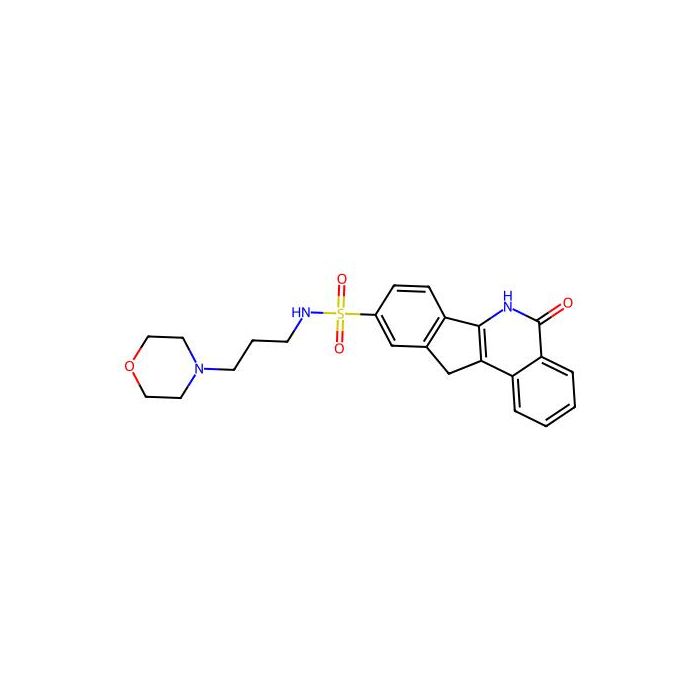
INO-1001 is a potent and selective poly (ADP-ribose) polymerase (PARP) inhibitor. INO-1001 is a potent enhancer of radiation sensitivity and enhances radiation-induced cell killing by interfering with DNA repair mechanisms, resulting in necrotic cell death INO-1001 has anti-tumor effects .
In Vitro
INO-1001 has an IC 50 of 0.05 μM in Chinese hamster ovary AA8 (CHO) cells. MCE has not independently confirmed the accuracy of these methods. They are for reference only.
Form:Solid
IC50& Target:PARP
| Canonical Smiles | C1COCCN1CCCNS(=O)(=O)C2=CC3=C(C=C2)C4=C(C3)C5=CC=CC=C5C(=O)N4 |
|---|---|
| IUPAC Name | N-(3-morpholin-4-ylpropyl)-5-oxo-6,11-dihydroindeno[1,2-c]isoquinoline-9-sulfonamide |
| InChIKey | LTZVLHHIAUKGBP-UHFFFAOYSA-N |
| INCHI | 1S/C23H25N3O4S/c27-23-20-5-2-1-4-19(20)21-15-16-14-17(6-7-18(16)22(21)25-23)31(28,29)24-8-3-9-26-10-12-30-13-11-26/h1-2,4-7,14,24H,3,8-13,15H2,(H,25,27) |
| Isomeric SMILES | C1COCCN1CCCNS(=O)(=O)C2=CC3=C(C=C2)C4=C(C3)C5=CC=CC=C5C(=O)N4 |
| Molecular Weight | 439.53 |
Comprehensive hazard, handling, storage, and regulatory compliance document.
Download SDS →Lot-specific quality data. Enter your lot number to retrieve the exact COA.
Look up COA →Full quality attributes and acceptance criteria for this grade.
View spec sheet →Taxonomy Tree
| Kingdom | Organic compounds |
|---|---|
| Superclass | Organoheterocyclic compounds |
| Class | Isoquinolines and derivatives |
| Subclass | Isoquinolones and derivatives |
| Intermediate Tree Nodes | Not available |
| Direct Parent | Isoquinolones and derivatives |
| Alternative Parents | Pyridinones Organosulfonamides Morpholines Benzenoids Heteroaromatic compounds Aminosulfonyl compounds Trialkylamines Lactams Oxacyclic compounds Dialkyl ethers Azacyclic compounds Organic oxides Hydrocarbon derivatives |
| Molecular Framework | Aromatic heteropolycyclic compounds |
| Substituents | Isoquinolone - Pyridinone - Morpholine - Oxazinane - Pyridine - Benzenoid - Organosulfonic acid amide - Heteroaromatic compound - Aminosulfonyl compound - Sulfonyl - Organosulfonic acid or derivatives - Organic sulfonic acid or derivatives - Lactam - Tertiary aliphatic amine - Tertiary amine - Dialkyl ether - Ether - Oxacycle - Azacycle - Organooxygen compound - Organonitrogen compound - Organic oxide - Organic oxygen compound - Organic nitrogen compound - Organosulfur compound - Hydrocarbon derivative - Amine - Aromatic heteropolycyclic compound |
| Description | This compound belongs to the class of organic compounds known as isoquinolones and derivatives. These are aromatic polycyclic compounds containing a ketone bearing isoquinoline moiety. |
| External Descriptors | Not available |
| Activity Type | Activity Value -log(M) | Mechanism of Action | Activity Reference | Publications (PubMed IDs) |
|---|
| Solubility | DMSO : 31.25 mg/mL (71.10 mM; Need ultrasonic) |
|---|---|
| Molecular Weight | 439.500 g/mol |
| XLogP3 | 1.500 |
| Hydrogen Bond Donor Count | 2 |
| Hydrogen Bond Acceptor Count | 6 |
| Rotatable Bond Count | 6 |
| Exact Mass | 439.157 Da |
| Monoisotopic Mass | 439.157 Da |
| Topological Polar Surface Area | 96.100 Ų |
| Heavy Atom Count | 31 |
| Formal Charge | 0 |
| Complexity | 815.000 |
| Isotope Atom Count | 0 |
| Defined Atom Stereocenter Count | 0 |
| Undefined Atom Stereocenter Count | 0 |
| Defined Bond Stereocenter Count | 0 |
| Undefined Bond Stereocenter Count | 0 |
| The total count of all stereochemical bonds | 0 |
| Covalently-Bonded Unit Count | 1 |
Our grade selection guide covers purity, stabilizer status, and application suitability for all variants in our catalog.
View Moligand™ grade guide →