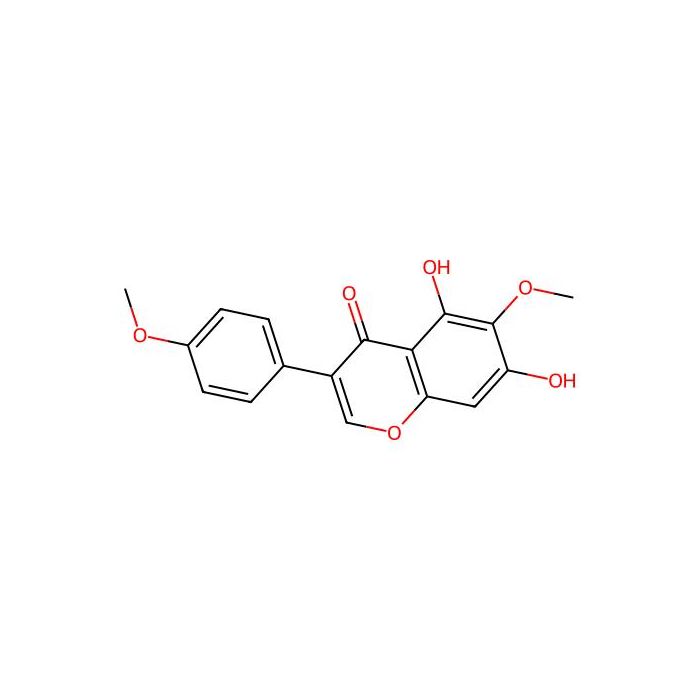
Irisolidone is a major isoflavone found in Pueraria lobata flowers. Irisolidone exhibits potent hepatoprotective activity. Irisolidone shows the high efficacy for volume-regulated anion channels (VRAC) blockade (IC 50 =9.8 μM) .
In Vitro
Irisolidone, an isoflavone metabolite, represses JC virus gene expression via inhibition of Sp1 binding in human glial cells. Irisolidone can inhibit endothelial cell proliferation. MCE has not independently confirmed the accuracy of these methods. They are for reference only.
Irisolidone is a major isoflavone found in Pueraria lobata flowers. Irisolidone exhibits potent hepatoprotective activity. Irisolidone shows the high efficacy for volume-regulated anion channels (VRAC) blockade (IC 50 =9.8 μM).
Storage
Protected from light,Store at -80°C
Verschickt in
Dry ice packs + Cold packs
Dieses Produkt erfordert Kühlkettenversand. Grundversand und andere Economy-Optionen sind nicht verfügbar.
This compound belongs to the class of organic compounds known as 4'-o-methylisoflavones. These are isoflavones with methoxy groups attached to the C4' atom of the isoflavone backbone.
External Descriptors
Isoflavonoids
1. Djoumbou Feunang Y, Eisner R, Knox C, Chepelev L, Hastings J, Owen G, Fahy E, Steinbeck C, Subramanian S, Bolton E, Greiner R, and Wishart DS. ClassyFire: Automated Chemical Classification With A Comprehensive, Computable Taxonomy. Journal of Cheminformatics, 2016, 8:61.
Zertifikate (CoA, COO, BSE/TSE und Analyse-Diagramm)
C of A & Other Certificates(BSE/TSE, COO):
Analytical Chart:
Chemische und physikalische Eigenschaften
Löslichkeit
DMSO : 100 mg/mL (318.18 mM; Need ultrasonic)
Molekulargewicht
314.290 g/mol
XLogP3
3.000
Hydrogen Bond Donor Count
2
Hydrogen Bond Acceptor Count
6
Rotatable Bond Count
3
Exact Mass
314.079 Da
Monoisotopic Mass
314.079 Da
Topological Polar Surface Area
85.200 Ų
Heavy Atom Count
23
Formal Charge
0
Complexity
468.000
Isotope Atom Count
0
Defined Atom Stereocenter Count
0
Undefined Atom Stereocenter Count
0
Defined Bond Stereocenter Count
0
Undefined Bond Stereocenter Count
0
The total count of all stereochemical bonds
0
Covalently-Bonded Unit Count
1
Lösungsrechner
Molarity Calculator
Determine the necessary mass, volume, or concentration for preparing a solution.
Dilution Calculator
Determine the dilution needed to prepare a stock solution.
Reconstitution Calculator
Bewertungen
Kundenbewertungen
Application Protocols
No tested applications or dilutions are provided in the Product Data. The following general, research-use-only protocols are commonly applied to small-molecule reference standards like isoflavones; verify and optimize for your system.
Preparation of stock solutions:
Weigh accurately (analytical balance). Dissolve in anhydrous DMSO to 10–50 mM. Vortex and sonicate if needed. Filter (0.22 µm PTFE). Aliquot in amber vials.
LC–UV/LC–MS standard curve (illustrative):
Prepare serial dilutions in 50:50 water–acetonitrile (0.1% formic acid) from a DMSO stock to 0.05–50 µg/mL. Inject 1–10 µL on C18 or phenyl-hexyl column. Monitor 254–360 nm (UV) and appropriate MS transitions. Establish linearity and LOD/LOQ.
Dilute to 10–200 µM in ethanol or MeOH. Mix with DPPH solution; incubate in dark; measure absorbance decrease at 517 nm. Include appropriate blanks and standards.
Protein-binding (research-use):
Equilibrium dialysis/fluorescence displacement in PBS with ≤1% DMSO co-solvent; quantify free vs bound fractions.
These are generic templates intended to help initiate method development. Adjust solvent composition, concentrations, and detection parameters to your compound’s verified properties and instrument constraints.
Biological Roles
No item-specific biological data are provided. The following context is general for the isoflavone class (literature-based); do not construe as clinical or therapeutic information.
Origin: Isoflavones are specialized plant metabolites, especially in Fabaceae (legumes) and some Iris species. They often function as phytoalexins or signaling molecules in plant–microbe interactions.
Structural features relevant to biology: The conjugated chromen-4-one with phenolic substituents enables hydrogen bonding, π–π stacking, and redox activity. These features underlie interactions with proteins, membranes, and nucleic acids in biochemical studies.
Metabolism (general): In mammals, phenolic isoflavones can undergo phase I/II metabolism including O-demethylation, hydroxylation, glucuronidation, and sulfation. Microbiota-mediated transformations (ring cleavage, deconjugation) are reported for many isoflavones.
Assay usage: In vitro, isoflavones are studied for antioxidant capacity, binding to transport proteins (e.g., albumin), and as ligands for various enzymes/receptors in discovery research. Exact targets and potencies are compound-specific and should be validated experimentally.
Spectroscopic utility: The strong UV chromophore facilitates detection in enzymatic turnover assays and binding studies without labeling.
Important: Aladdin Scientific supplies this item strictly for research use only, as indicated in the Product Data. No medical or clinical claims are made or implied.
Buffer Applications
This compound is not a buffer reagent and does not constitute a defined buffering system.
Typical use: Prepared as organic stock solutions (e.g., DMSO, ethanol) and then diluted into assay buffers as needed. Maintain final co-solvent content at levels compatible with your biological system.
If pH-dependent solubility is under investigation, buffers such as phosphate (pH 6–8), HEPES (pH 7–8), or acetate (pH 4–5.5) can be used to study ionization/solubility profiles; however, there is no item-specific buffer recipe.
For buffer preparation guidance, refer to general buffer preparation resources; this product itself is not intended to prepare buffers.
Green Alternatives
As a solid small molecule, the main environmental lever is solvent choice for handling, synthesis, and analysis rather than the compound itself. The following are literature-based, general recommendations for isoflavone handling and derivatization; optimize for your workflow.
Stock solution solvents:
Prefer ethanol (bio-based) over DMF/NMP when solubility allows; consider PEG-400 or propylene glycol blends for non-biological applications.
Use water–ethanol or water–acetonitrile mixtures for HPLC where compatible with detection and solubility.
Process/synthesis solvents (if derivatizing):
2-Methyltetrahydrofuran (2-MeTHF) or cyclopentyl methyl ether (CPME) as greener ethers compared to THF/diethyl ether for extractions and some reactions.
Ethyl acetate over dichloromethane for workups when phase behavior permits.
Energy/light management:
Product Data recommends protection from light and deep-cold storage; minimizing light and heat during operations simultaneously reduces energy for rework and material loss due to degradation.
Illustrative comparison (general):
DMSO vs Ethanol: DMSO offers higher solubility but is less renewable and more persistent; ethanol is greener but may limit achievable concentration and has different toxicological profile.
Acetonitrile vs Methanol in LC: ACN provides lower backpressure; MeOH is greener and cheaper; choose based on column, resolution, and waste profile.
Note: Always balance “green” choices against analytical/synthetic performance requirements and compound stability.
Pharmaceutical Uses
No pharmacopeial status, excipient role, or GMP-related information is provided for this item. Aladdin Scientific supplies this compound strictly for research use only.
Analytical reference: May serve as a reference standard for QC of botanical extracts or for method validation in non-clinical labs.
Pre-formulation studies: Solubility profiling in biorelevant media, partitioning (logD) assessments, and stability under light/oxidative stress can be performed to support discovery-stage research. Any such use should remain non-clinical and adhere to institutional policies.
Note: Do not use this product in drug substances, drug products, clinical trials, or diagnostic procedures. For regulated applications, request detailed CoA, impurity profile, and stability data; this listing does not specify those attributes.
Physical Properties
Item-specific physicochemical specifications were not provided in the Product Data. The following notes distinguish item-specific gaps from general literature context.
Appearance: Not specified for this item; refer to CoA/Spec Sheet.
Melting point: Not specified for this item; refer to CoA/Spec Sheet. (Literature: isoflavones typically melt in the 200–300 °C range, often decomposing; confirm actual value for irisolidone.)
Boiling point: Not typically applicable (isoflavones decompose before boiling under ambient pressure). No item-specific data provided.
Density: Not specified for this item; refer to CoA/Spec Sheet.
Solubility (qualitative, literature/general for isoflavones):
Low aqueous solubility at neutral pH due to phenyl–chromenone hydrophobic core.
Readily soluble in polar aprotic organic solvents (e.g., DMSO, DMF) and moderately soluble in alcohols (MeOH, EtOH) upon warming/sonication.
LogP/logD: Not specified for this item; refer to CoA/Spec Sheet. (Literature for isoflavones: moderate lipophilicity, logP often ~1.5–3 depending on substitution.)
pKa: Not specified for this item; refer to CoA/Spec Sheet. (General: phenolic OH pKa commonly ~6.5–10; specific values depend on substitution.)
UV/Vis: Not specified for this item; refer to CoA/Spec Sheet. (General: conjugated isoflavone chromophore shows strong UV bands near 250–280 nm and 300–360 nm; exact maxima depend on substituents and solvent.)
Important: For experimental planning, obtain the CoA/SDS for definitive physical constants and solution stability data specific to SKU I650962.
Quality and Grades
Grade/Purity: Not specified for this item; refer to CoA/Spec Sheet.
Interpretation and implications (general guidance for small-molecule reference compounds):
When the exact purity is unspecified, request the Certificate of Analysis (CoA) for lot-specific purity (e.g., HPLC area %, NMR assay), residual solvents, and water content. For structure-driven studies or analytical standards, ≥95–98% HPLC purity is typically expected; verify for your intended use.
UV-Vis background: Isoflavones possess strong UV chromophores. If this compound is to be used in chromatographic method development or as a reference standard, low UV-absorbing impurities and defined extinction coefficients in the chosen solvent are desirable; confirm via CoA.
Stabilizers: None indicated in the Product Data. If stabilizers or antioxidants are present in some lots (not specified here), they may affect MS and bioassays; check the CoA and SDS.
Lot traceability: For structure–activity screening in small-molecule libraries, maintain lot records and link assay data to specific lots due to potential polymorph/solvate differences.
Recommendation: Contact Aladdin Scientific support with your SKU and desired application (e.g., analytical standard, screening) to ensure the supplied grade meets your performance and regulatory needs.
Reaction and Applications
Manufacturer Applications: Not specifically stated in Product Data. Irisolidone (isoflavone class) is commonly used in research as:
A reference standard for phytochemical profiling (LC–UV/LC–MS) of plant extracts containing isoflavones.
A member of small-molecule screening libraries probing phenolic scaffolds, redox behavior, and protein–ligand interactions.
Analytical method development: Calibration standards for HPLC–UV/ESI-MS; evaluation of retention on phenyl-hexyl, C18, and polar-embedded phases; exploration of analyte–π interactions due to the extended aromatic system.
Photophysics/oxidation studies: Phenolic isoflavones undergo photooxidation; used to study antioxidant capacity (e.g., DPPH, ABTS assays) and radical-scavenging kinetics.
Derivatization chemistry: O-methylation, O-acylation, and etherification to tune lipophilicity and stability; boronate ester formation for protection of phenolic OH during multistep synthesis.
Solid-phase adsorption/desorption studies: Interaction with polymeric sorbents and protein matrices (albumin binding) due to mixed H-bond donor/acceptor and π-systems.
Practical tips:
Minimize light exposure during manipulations (amber glassware, foil) to limit photodegradation.
Use anhydrous, oxygen-poor conditions for sensitive transformations; inert gas blanket can improve stability during prolonged reactions.
For quantitative assays, use gravimetric preparation and verify concentration by UV with an extinction coefficient determined for your solvent system.
Reaction Conditions
No item-specific reaction condition data are provided. The following are general, literature-based guidelines for manipulating isoflavone scaffolds and preparing analytical solutions; adapt to your system and confirm experimentally.
Stock preparation (analytical/assay): Dissolve to 10–50 mM in dry DMSO at ambient temperature with sonication. Filter (0.22 µm PTFE) and store aliquots light-protected at ≤−20 °C for short-term, following the product’s deep-cold guidance for long-term.
O-Acylation/O-alkylation (derivatization):
Base: K2CO3 or Cs2CO3 in acetone/ACN/DMF; temperature 25–60 °C; 1–12 h. Monitor by TLC/HPLC.
Milder conditions: DIPEA or NaHCO3 with alkyl halides/anhydrides when sensitive.
Protection as boronate ester: React with aryl/alkyl boronic acids and dehydrating agents (Dean–Stark in toluene or use pinacol under azeotropic removal) to protect phenolic OH; deprotect under aqueous workup.
Electrophilic halogenation (aromatic): NBS/NCS in MeCN or AcOH at 0–25 °C; regioselectivity depends on substitution.
Photostability: Perform reactions and purifications under low light or amber glass to mitigate degradation.
Purification: Normal-phase silica gel (hexanes/EtOAc gradients) or reversed-phase C18 prep-HPLC (water/ACN or MeOH with 0.1% acid). Avoid strong base on silica which can cause isomerization.
These conditions are illustrative and should be validated for irisolidone’s exact substitution pattern.
Safety and Handling
Safety information specific to this SKU was not provided. Use prudent laboratory precautions and consult the SDS for authoritative guidance.
GHS classification: Not specified for this item; refer to SDS.
Signal word / Hazard statements / Pictograms: Not specified for this item; refer to SDS.
General laboratory precautions for small-molecule phenolic isoflavones (literature-based):
Avoid inhalation of dust; handle powders in a fume hood or ventilated enclosure.
Wear appropriate PPE: lab coat, safety glasses, and chemical-resistant gloves (e.g., nitrile). Use a dust mask/respirator if aerosolization is possible and permitted by local safety officer.
First aid (general):
Inhalation: Move to fresh air; seek medical attention if symptoms persist.
Skin/eye contact: Rinse with water for ≥15 minutes; remove contaminated clothing; obtain medical advice if irritation develops.
Ingestion: Rinse mouth; do not induce vomiting; seek medical attention.
Incompatibilities (general): Strong oxidizing agents; strong bases can cause phenoxide formation and potential discoloration. Avoid prolonged exposure to light and elevated temperatures (phenolic chromophores can photooxidize).
Thermal/photostability: Product Data indicates “Protected from light” and deep-cold storage; minimize light exposure during handling and store promptly after use.
Waste: Dispose according to institutional SOPs for non-halogenated organic solids/solutions unless local rules dictate otherwise.
Always defer to the product-specific SDS and institutional EHS policies for final safety measures.
Solvent Selection
Irisolidone is an isoflavone-type small molecule. Item-specific solubility was not provided; the following solvent guidance is literature-based for the isoflavone class. Verify experimentally for this item/lot.
Polarity/character: Moderately lipophilic, polyphenolic aromatic ketone; neutral under acidic–neutral conditions, deprotonates under strong base.
Preferred stock solvents (screening/analytical):
DMSO: Typically affords high-concentration stocks (10–50 mM) with mild warming/sonication.
DMF or NMP: Alternative polar aprotics when DMSO is undesirable.
Methanol/Ethanol: Useful for UV/LC analysis and preparative work; lower solubility than DMSO expected.
Aqueous media: Poor solubility at neutral pH; co-solvent systems (e.g., 0.1–1% DMSO or 5–20% EtOH) or inclusion of surfactants (Tween-80) may be required for bioassays. Avoid strong base unless phenoxide formation is acceptable.
Dielectric/miscibility (general): DMSO, DMF fully miscible with water and most organics; alcohols miscible with water; adjust to maintain compound in solution during dilutions.
Quick comparison (literature-based):
DMSO: Highest solvating power; may interfere with some enzymes/cells at >0.5–1% v/v.
MeOH/EtOH: Cleaner MS background; flammable; lower solubility ceiling.
Acetonitrile: Good for LC; moderate solubility; low viscosity; often combined with water for HPLC.
Tip: Filter stock solutions (0.22 µm PTFE) to remove particulates prior to analytical injections.
Storage and Reconstitution
Storage conditions (item-specific from Product Data):
Store at −80 °C.
Protect from light.
Shipped on dry ice packs + cold packs to maintain low temperature.
Research use note: For research use only.
Reconstitution and handling (general best practices for small-molecule solids):
Upon receipt: Keep the container sealed and cold. Allow to equilibrate to room temperature in sealed form to prevent condensation before opening.
Aliquoting: If frequent use is anticipated, prepare single-use aliquots of solid (if feasible) or concentrated stock solutions (e.g., 10–50 mM in dry DMSO) in amber vials to minimize freeze–thaw and light exposure.
Light protection: Use amber glassware; limit exposure during weighing and solution prep by working under subdued light or using foil wraps.
Freeze–thaw: Avoid repeated cycles. Thaw aliquots quickly at room temperature, use immediately, and return any unused sealed aliquots to deep-cold storage.
Solution stability: Not specified for this item; refer to CoA/Spec Sheet. As a precaution, store solutions at ≤−20 °C (short term) or −80 °C (long term) and verify integrity by LC–MS/HPLC before critical experiments.
Container compatibility: Use PTFE-lined caps for organic solutions; prefer glass vials for DMSO/organic stocks.
Always consult the lot-specific CoA/SDS for definitive stability and handling guidance.
Structure and Identity
Brief overview: Irisolidone is widely cited in the literature as a plant-derived isoflavone. Item-specific identifiers from the current listing are incomplete; key structural descriptors below are provided with appropriate caveats.
SKU: I650962
Product name: Irisolidone
CAS: 2345-17-7 (literature association with the isoflavone “irisolidone”)
PubChem CID: 5281781 (literature)
InChIKey: 384354 (as provided; note: typical InChIKeys are 27-character hashed strings; verify on CoA/SDS)
SMILES: Not specified for this item; refer to CoA/Spec Sheet.
Molecular formula: Not specified for this item; refer to CoA/Spec Sheet.
Molecular weight: Not specified for this item; refer to CoA/Spec Sheet.
Structural features (general, literature-based for the isoflavone class; confirm for this item):
Isoflavone core (3-phenylchromen-4-one) comprising a benzopyranone ring fused to a phenyl substituent at C-3.
Typical substitution pattern includes phenolic OH and/or methoxy groups on A- and/or B-rings; exact positions must be confirmed for this batch/item.
Planar, conjugated π-system supporting UV absorption in the near-UV; phenolic tautomerism possible.
2D structure in words (general isoflavone motif):
A 1-benzopyran-4-one (chromen-4-one) ring system with a phenyl substituent at the 3-position. Substituents (e.g., hydroxy/methoxy) can reside on the A ring (benzopyran part) and/or B ring (phenyl at C-3). Exact regiochemistry for irisolidone should be verified from the CoA or authoritative databases.
Synthetic Utility
While irisolidone is typically employed as a reference/assay compound rather than a synthetic intermediate, its isoflavone scaffold offers useful reactivity in derivatization (general, literature-based):
Functional groups: Conjugated enone (chromen-4-one), phenolic OH groups (if present), and potential methoxy substituents. These enable:
O-acylation and O-alkylation to modulate lipophilicity and protect phenolic sites.
Electrophilic aromatic substitution at activated positions (subject to substitution pattern) for halogenation or nitration under controlled conditions.
Formation of boronate esters for temporary protection of phenols during multistep synthesis.
Redox/photochemistry: The extended π-system participates in photoinduced electron transfer and oxidative coupling; conditions must be tuned to avoid unwanted degradation.
Conjugation strategies: Carbamate/carbonate formation on phenolic OH enables bioconjugation to linkers for affinity matrices or probes (non-biological, research-only tools).
Retrosynthetic context: Isoflavones are commonly assembled via chalcone cyclization (Baker–Venkataraman, Algar–Flynn–Oyamada variants) or deoxybenzoin routes; irisolidone can serve as a comparator substrate in methodology studies targeting isoflavone formation or late-stage functionalization.
Note: Verify the exact substitution pattern of irisolidone from the CoA before planning selective transformations (regiochemistry dictates reactivity and protecting-group strategy).
Target Specificity
Not applicable. This product is a small organic molecule, not a biological affinity reagent (e.g., antibody, enzyme, or ligand with validated target selectivity provided). No target, epitope, or species reactivity information is supplied in the Product Data.
For discovery research, any putative molecular targets should be established empirically using appropriate biochemical/biophysical assays; Aladdin Scientific provides no target-specific claims for this item.
Häufig gestellte Fragen
What is the purity of this product?
This product is supplied at ≥99% purity (chemical assay). Lot-specific values are stated on the Certificate of Analysis.
How should this product be stored?
Store at ?80 °C, protected from light. The material is light-sensitive — keep it in its original opaque or amber container.
How is this product shipped?
This product ships frozen with dry ice and cold packs. Unpack on arrival and transfer it to the storage condition stated above; handle dry ice with insulated gloves in a ventilated area.
What are the CAS number, molecular formula and molecular weight?
The CAS Number is 2345-17-7, the molecular formula is C17H14O6, and the molecular weight is 314.29 g/mol. InChIKey VOOFPOMXNLNEOF-UHFFFAOYSA-N.
What documentation is provided?
Available product documentation, including Certificates of Analysis (COA), Safety Data Sheets (SDS), and specification sheets, is shown in the product document area. Document availability and access follow the current site policy.
Wir verwenden Cookies, um die ordnungsgemäße Funktion der Website sicherzustellen und, soweit zulässig, Ihr Nutzererlebnis zu verbessern. Sie können Ihre Einstellungen jederzeit unter „Einstellungen“ verwalten. Weitere Informationen finden Sie in unserer Cookie-Richtlinie.
Dürfen wir Sie über Rabattaktionen informieren?
Später erinnern
Vielen Dank! Bitte überprüfen Sie Ihren E-Mail-Posteingang, um zu bestätigen.
Products are supplied to verified businesses, institutions, and qualified professionals for research and development use only. Not for use in humans, animals, diagnosis, or therapy.