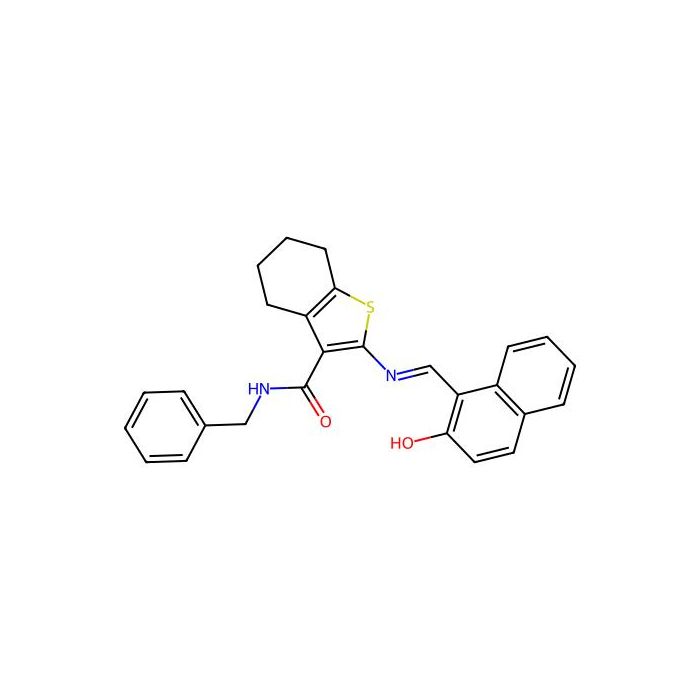
JGB1741 (ILS-JGB-1741) is a potent and specific SIRT1 activity inhibitor with an IC 50 of ∼15 μM. JGB1741 is a weak SIRT2 and SIRT3 inhibitor with an all IC 50 >100 μM. JGB1741 increases the acetylated p53 levels leading to p53-mediated apoptosis with modulation of Bax/Bcl2 ratio, cytochrome c release and PARP cleavage. JGB1741 has the potential for breast cancer research
In Vitro
JGB1741 (ILS-JGB-1741; 1-10000 nM; 24 h) inhibits MDA-MB 231 cell proliferation. JGB1741 (0.01-1 μM; 24 h) induces apoptosis of MDA-MB 231 cells. JGB1741 (0.01-1 μM; 24 h) shows a cell cycle arrest at G1 phase with more and more cells entering into sub G0/G1 phase. JGB1741 (0.01-1 μM; 24 h) shows an increase in the global acetylation of H3K9, p53 expression and acetylated p53K382 levels. MCE has not independently confirmed the accuracy of these methods. They are for reference only. Cell Proliferation AssayCell Line: K562, HepG2 and MDA-MB 231 cell lines Concentration: 1, 10, 50, 100, 500, 1000, 10000 nM Incubation Time: 24 hours Result: Inhibited MDA-MB 231 cell proliferation more potently with an IC 50 of 0.5 μM than K562 and HepG2 cell proliferation (IC 50 >1 μM). Apoptosis AnalysisCell Line: MDA-MB 231 cells Concentration: 0.01, 0.1, 0.5, 1 μM Incubation Time: Result: Showed an increase in the percent apoptotic cells in a dose-dependent fashion with ∼70% apoptosis at 1 μM concentration. Cell Cycle AnalysisCell Line: MDA-MB 231 cells Concentration: 0.01, 0.1, 0.5, 1 μM Incubation Time: Result: Showed a cell cycle arrest at G1 phase with more and more cells entering into sub G0/G1 phase, the apoptotic phase, in a dose-dependent fashion. Western Blot AnalysisCell Line: MDA-MB 231 cells Concentration: 0.01, 0.1, 0.5, 1 μM Incubation Time: Result: Caused a dose-dependent increase in the global acetylation of H3K9. Showed an increase in both p53 expression and acetylated p53K382 levels.
JGB1741 (ILS-JGB-1741) is a potent and specific SIRT1 activity inhibitor with an IC 50 of ∼15 μM. JGB1741 is a weak SIRT2 and SIRT3 inhibitor with an all IC 50 >100 μM. JGB1741 increases the acetylated p53 levels leading to p53-mediated apoptosis with mod
Storage
Protected from light,Store at -80°C
Verschickt in
Dry ice packs + Cold packs
Dieses Produkt erfordert Kühlkettenversand. Grundversand und andere Economy-Optionen sind nicht verfügbar.
Aktionsart
INHIBITOR
Reinheit
≥99%
Namen und Kennungen
Molekulargewicht
440.56
Erweiterte Daten
Zertifikate (CoA, COO, BSE/TSE und Analyse-Diagramm)
Determine the necessary mass, volume, or concentration for preparing a solution.
Dilution Calculator
Determine the dilution needed to prepare a stock solution.
Reconstitution Calculator
Bewertungen
Kundenbewertungen
Application Protocols
No vendor-validated assay protocols are provided for this item. The following general procedures are common for small-molecule library compounds.
General DMSO stock preparation (example)
Equilibrate the sealed vial to room temperature in the dark and dry environment to avoid condensation.
Add anhydrous DMSO to prepare a 10–50 mM stock (volume based on required assay throughput). Vortex and, if needed, sonicate briefly.
If particulates persist, warm gently to ~30–40°C in the dark, then cool; or sterile-filter (0.22 µm) if sterility is required and the compound is filter-stable.
Assay dilution
Add the DMSO stock slowly to buffer or media with vigorous mixing to achieve final test concentrations. Keep final DMSO typically ≤0.5–1% v/v for sensitive cell assays and ≤2% for many biochemical assays (general practice; verify assay tolerance).
Include vehicle controls at the matching DMSO percentage and incorporate positive/negative assay controls.
Storage of working solutions
Aliquot into light-protective, low-bind tubes; freeze at −80°C when not in use. Avoid more than 2–3 freeze–thaw cycles; discard turbid or discolored solutions.
Item-specific protocols and validated dilutions: Not specified for this item; refer to CoA/Spec Sheet.
Biological Roles
No target, pathway, or mode-of-action information is provided for this item.
Biological target/mechanism: Not specified for this item; refer to CoA/Spec Sheet or screening library annotation.
Assay context (general): Such compounds are commonly used in in vitro biochemical assays, biophysical binding studies (e.g., TSA/DSF, SPR), or cell-based phenotypic screens to generate hypotheses regarding potential biological roles.
Selectivity/off-targets: Not specified for this item; evaluate empirically with counter-screens to de-risk assay artifacts.
ADME/tox flags: Not specified for this item; if relevant, perform basic in vitro profiling (stability in microsomes, permeability, solubility, and cytotoxicity) before extensive deployment in biological systems.
Note: Supplied strictly for research use only. No medical, diagnostic, or therapeutic use is intended or implied.
Buffer Applications
This product is not a buffering agent. No specific buffer formulations apply to the compound itself.
Practical notes for assay buffers (general)
Dissolve the compound in DMSO (or suitable solvent), then add gradually to the pre-made buffer (e.g., HEPES, Tris, PBS) with mixing to prevent precipitation.
Maintain a consistent final DMSO percentage across wells/samples and include vehicle controls.
If adsorption is suspected, include inert protein (e.g., BSA at low %), surfactant at assay-tolerated levels, or use low-bind plastics.
Item-specific buffering interactions, pKa, and solubility-pH profiles are not specified for this item; consult the CoA/Spec Sheet if available.
Green Alternatives
This product is a research-use compound, not a bulk solvent or reagent where green-replacement guidance is typically most impactful. Nevertheless, solvent choices during handling can influence the environmental footprint.
Prefer lower-toxicity, readily recoverable solvents when feasible for solution preparation and cleanup (e.g., ethanol or isopropanol for surface decontamination instead of chlorinated solvents, if compatible).
When concentrated stocks in DMSO are required (common for discovery compounds), minimize waste by aliquoting and using microvolumes to avoid repeated thawing and disposal of expired stocks.
For assay dilution, use buffer systems optimized to reduce the need for high organic cosolvent percentages.
Trade-offs (general)
Ethanol is greener than DMF/NMP but may not dissolve hydrophobic chemotypes; DMSO offers superior solvency but requires careful waste segregation and has higher aquatic toxicity concerns.
Item-specific solvent compatibility and greener handling pathways are not specified; validate experimentally and follow institutional green-chemistry guidelines.
Pharmaceutical Uses
No pharmacopeial status or excipient role is provided. This product is supplied for research use only and is not intended for human or veterinary use.
Regulatory status: Research-use chemical; not for clinical, diagnostic, or GMP manufacturing applications.
Formulation research (preclinical lab context): If used in exploratory formulation studies (e.g., solubility screening, enabling excipient scouting), document nonclinical status and avoid any use beyond laboratory research.
CMC/analytical development (general): Where relevant, establish reference standards, stability-indicating methods (HPLC/UPLC), and impurity tracking; these are user-implemented activities and not item guarantees.
Item-specific excipient compatibility, ICH stability data, and pharmacopoeial monographs: Not specified for this item; refer to CoA/Spec Sheet.
Physical Properties
Item-specific physicochemical data have not been provided in the product record. Do not treat the guidance below as specifications.
Appearance: Not specified for this item; refer to CoA/Spec Sheet.
Melting point / Boiling point: Not specified for this item; refer to CoA/Spec Sheet.
Density / Refractive index: Not specified for this item; refer to CoA/Spec Sheet.
LogP, pKa, PSA: Not specified for this item; refer to CoA/Spec Sheet.
Aqueous/DMSO solubility: Not specified for this item; refer to CoA/Spec Sheet.
General laboratory guidance (literature/practice, not item-specific)
For discovery compounds, initial dissolution is commonly attempted in anhydrous DMSO (e.g., 10–50 mM stock). If insoluble, consider DMF or mixed solvent systems (DMSO:water or DMSO:buffer with surfactant) while monitoring for precipitation.
Confirm solubility empirically by visual inspection and, if critical, by nephelometry or HPLC area-response.
If thermal properties are required for processing, determine experimentally by DSC/TGA. Avoid prolonged heating or exposure to strong light unless stability data are available.
Quality and Grades
Quality grade and purity are not listed in the current record.
Grade/Purity: Not specified for this item; refer to CoA/Spec Sheet.
What to expect in discovery-compound documentation (general):
Identity confirmation by LC–MS and/or 1H NMR.
Purity reporting by HPLC/UPLC (typical library practice is ≥90–95%, but this item’s value is not specified; consult the CoA).
Water content (KF) and residual solvents may be reported where relevant.
Implications for use:
For biochemical or cell-based assays, confirm purity and counter-screen for optical interference if using spectroscopic readouts.
If you require a specific grade (e.g., analytical, screening, or GLP-compliant documentation), contact us for the detailed CoA and batch-specific analytics.
Stabilizers/antioxidants: Not specified for this item; refer to CoA/Spec Sheet.
Recommendation: Before quantitative SAR, obtain the batch CoA, verify identity/purity in-house if needed (orthogonal methods), and document lot number and storage history for data integrity.
Reaction and Applications
This catalog entry represents a small-molecule research compound primarily intended for discovery workflows rather than as a general synthetic reagent.
Primary use cases (research):
Inclusion in screening decks for target-based or phenotypic assays (biochemical, biophysical, or cell-based).
Hit validation, preliminary SAR exploration, and mechanism-of-action hypothesis generation.
Analytical characterization benchmarks (method development for LC–MS/UPLC).
Not typically used for: Named synthetic transformations (e.g., cross-couplings, condensations) unless the structure is disclosed and your protocol requires derivatization.
Assay implementation tips (general):
Prepare fresh DMSO stocks; confirm clarity after dilution to avoid false negatives from precipitation.
Track final DMSO in assay plates and include vehicle controls.
If optical assays are used, check for intrinsic UV/Vis/fluorescence to avoid interference.
Stability considerations: Protect from light per product data. Avoid prolonged ambient exposure and repeated freeze–thaw cycles.
Item-specific reactivity, functional-group behaviors, and chemical compatibility are not specified; consult the CoA/Spec Sheet if synthetic or derivatization use is intended.
Reaction Conditions
Reaction conditions cannot be prescribed without structural information.
Item-specific temperature, catalysts, and solvents: Not specified for this item; refer to CoA/Spec Sheet and primary literature once the structure is available.
General laboratory considerations (non-item-specific)
If planning chemical modification, begin with microscale scouting under mild conditions, monitor by LC–MS, and gradually explore bases (e.g., carbonate/tertiary amines), acids (mild protic), or metal-catalyzed couplings only after functional-group mapping.
Avoid prolonged exposure to heat and light until stability is established (this item is specified to be light sensitive; store accordingly).
For purification, start with analytical scouting (reverse phase or normal phase as appropriate) before committing to prep-scale workflows.
Safety and Handling
Hazard classification has not been provided for this item; default to conservative handling of unknown bioactive small molecules.
Signal Word / H-Statements / GHS Class / Pictograms: Not specified for this item; refer to SDS.
Primary hazards (general): Potential for irritation, acute toxicity, or off-target biological activity. Treat as harmful if swallowed, inhaled, or in contact with skin until SDS confirms otherwise.
PPE: Lab coat, safety glasses, and appropriate gloves (e.g., nitrile). Work in a certified chemical fume hood or ventilated enclosure when weighing or making solutions.
Engineering controls: Use containment when opening lyophilized vials; minimize aerosol formation and dust.
Storage incompatibilities: Keep away from oxidants, acids/bases, and moisture until compatibility is known. Protect from light as specified.
Spill/accidental release: Absorb with inert material, avoid dust, and dispose as hazardous chemical waste. Decontaminate surfaces with suitable solvent and detergent.
First aid (general): In case of skin/eye contact, rinse with water for ≥15 min; if inhaled, move to fresh air; if ingested, seek medical attention. Provide SDS to responders.
Always defer to the product’s SDS and institutional EHS guidance for authoritative information.
Solvent Selection
No item-specific solubility data are provided. The following are general best practices for small-molecule research compounds.
Primary solvent: Anhydrous DMSO is the first-line solvent for preparing concentrated stocks (e.g., 10–50 mM). Filter if necessary to remove particulates.
Secondary solvents:DMF or NMP for difficult cases; miscible cosolvent blends (DMSO:water or DMSO:buffer) can aid dilution into assays. For nonpolar chemotypes, consider MeOH, EtOH, acetonitrile, or isopropanol before aqueous dilution.
Aqueous media: Introduce organic stocks slowly into buffered solutions with vortexing to reduce precipitation. Maintain final DMSO content typically ≤0.5–1% v/v for sensitive cell assays (laboratory convention; not item-specific).
pH considerations: If ionizable, solubility may improve with pH adjustment; avoid extreme pH unless stability is confirmed.
Adsorption mitigation: Use low-bind plasticware or glass where non-specific binding is suspected; include small amounts of surfactant (e.g., 0.01% Tween-20) if assay-compatible.
Quick comparison (general)
DMSO: broad solvating power, biologically tolerated at low %, hygroscopic.
DMF/NMP: strong solvency; assess biocompatibility and disposal requirements.
EtOH/MeOH/ACN: volatile, convenient for analytical workflows; watch assay compatibility.
Item-specific solubility limits and partition data: Not specified for this item; refer to CoA/Spec Sheet.
Storage and Reconstitution
Follow the item-specific storage requirements provided; additional best practices are included for library compounds.
Storage conditions (item-specific):Protected from light; store at −80°C.
Container handling: Keep vials tightly closed. Minimize headspace humidity; consider storing in a desiccated, light-protective secondary container.
Upon receipt: Inspect packaging integrity and temperature indicators. Transfer immediately to −80°C in the dark.
Reconstitution solvent: If not otherwise specified, start with anhydrous DMSO. Item-specific solvent guidance: Not specified for this item; refer to CoA/Spec Sheet.
Aliquoting: Prepare single-use aliquots to avoid repeated freeze–thaw. Label with lot, concentration, solvent, and date.
Stability/shelf-life: Not specified for this item; refer to CoA/Spec Sheet. In absence of data, use conservative timelines (days to weeks for solutions at −80°C) and monitor by LC–MS/HPLC.
Thawing: Thaw on ice or at room temperature protected from light. Mix gently and verify clarity prior to use.
Research use only. For authoritative storage and stability limits, always consult the product’s CoA and SDS.
Structure and Identity
Concise identity summary based on the available product data. Structural details are not disclosed for this catalog code.
SKU: J649081
Product Name: JGB1741
CAS: 1256375-38-8
Category: Small molecules and compound libraries (小分子和化合物库)
Molecular Formula: Not specified for this item; refer to CoA/Spec Sheet.
Molecular Weight: Not specified for this item; refer to CoA/Spec Sheet.
SMILES/InChIKey: Not specified for this item; refer to CoA/Spec Sheet.
Structural features
Item-specific 2D/3D structure, ring systems, functional groups, and stereochemistry: Not specified for this item; refer to CoA/Spec Sheet.
Notes
This listing represents a research-use small molecule supplied as part of a screening/discovery collection. Detailed identifiers (SMILES, InChIKey) are often provided on the Certificate of Analysis or library file; request these documents if needed for cheminformatics integration.
If you plan to perform computational docking, ADME prediction, or analytical method development, obtain the full structural identifiers from the CoA/Spec Sheet or your library annotation file.
Synthetic Utility
The structure of JGB1741 is not disclosed in the product data; thus, reaction-specific synthetic roles cannot be defined.
General note: Library compounds may serve as synthetic intermediates or reference materials if their functional groups are compatible with your route. Without structural information, treat this item primarily as a screening compound rather than a building block.
If derivatization is planned: Obtain the full structure, perform functional-group compatibility assessments, and map protecting-group needs. Verify stability toward bases/acids, nucleophiles/electrophiles, oxidants/reductants before scale-up.
Analytical readiness: Develop LC–MS methods first to track any transformations. If chirality is involved (unknown here), implement chiral analysis early.
Item-specific reactive handles, named-reaction suitability, and protecting-group guidance are not specified; consult the CoA/Spec Sheet and relevant literature after structure disclosure.
Target Specificity
Target, selectivity, and binding data are not provided for this item.
Target/Pathway: Not specified for this item; refer to CoA/Spec Sheet or library annotations.
Selectivity profile / off-targets: Not specified for this item; determine empirically with orthogonal assays.
Species reactivity: Not applicable; this is a small molecule, not a biologic reagent.
Use this compound strictly for research use and develop appropriate positive/negative controls to interpret activity data.
Häufig gestellte Fragen
What is the purity of this product?
This product is supplied at ≥99% purity (chemical assay). Lot-specific values are stated on the Certificate of Analysis.
How should this product be stored?
Store at ?80 °C, protected from light. The material is light-sensitive — keep it in its original opaque or amber container.
How is this product shipped?
This product ships frozen with dry ice and cold packs. Unpack on arrival and transfer it to the storage condition stated above; handle dry ice with insulated gloves in a ventilated area.
What are the CAS number, molecular formula and molecular weight?
The CAS Number is 1256375-38-8, the molecular formula is C27H24N2O2S, and the molecular weight is 440.56 g/mol.
What documentation is provided?
Available product documentation, including Certificates of Analysis (COA), Safety Data Sheets (SDS), and specification sheets, is shown in the product document area. Document availability and access follow the current site policy.
Wir verwenden Cookies, um die ordnungsgemäße Funktion der Website sicherzustellen und, soweit zulässig, Ihr Nutzererlebnis zu verbessern. Sie können Ihre Einstellungen jederzeit unter „Einstellungen“ verwalten. Weitere Informationen finden Sie in unserer Cookie-Richtlinie.
Dürfen wir Sie über Rabattaktionen informieren?
Später erinnern
Vielen Dank! Bitte überprüfen Sie Ihren E-Mail-Posteingang, um zu bestätigen.
Products are supplied to verified businesses, institutions, and qualified professionals for research and development use only. Not for use in humans, animals, diagnosis, or therapy.