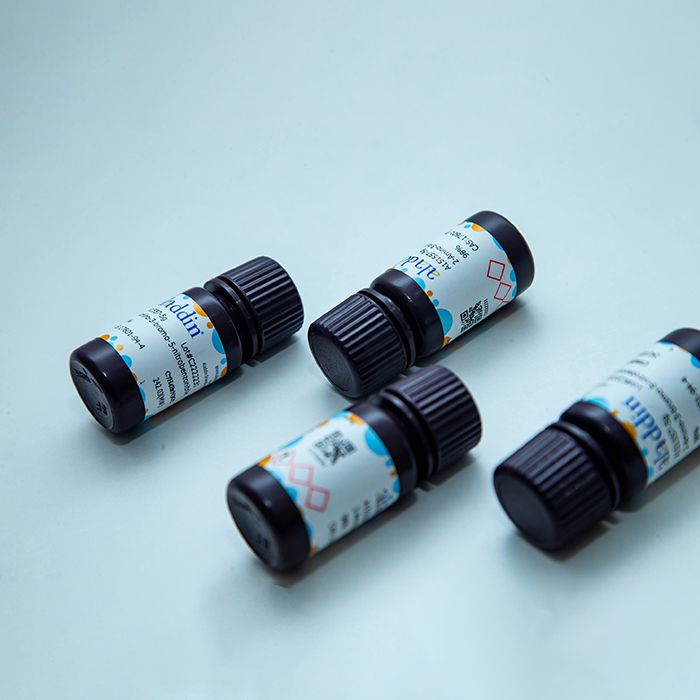
GRADE & PURITYMoligand™?Moligand™ — Aladdin's line of ligands and bioactive small molecules. Use for receptor, pathway, and binding studies needing defined small-molecule tools.≥98%
Moligand™, ≥98% Moligand™ for sensitive chromatographic and analytical workflows requiring minimal baseline interference.
🌡
Storage & shipping
Store at -20°C Ships Ice chest + Ice pads Check lot-specific COA for exact specifications.
📋
Quality documents
SDS, COA, datasheet, and spec sheet available for download. Lot-specific COA accessible via lot number lookup.
📚
Literature proof
Cited in 0 peer-reviewed publications across chromatography, organic synthesis, and cross-coupling reactions.
Übersicht
JI-101 is an orally available multi-kinase inhibitor of VEGFR2 , PDGFRβ and EphB4 with potent anti-cancer activity.
In Vitro
JI-101 is found to be stable in all preclinical and human liver microsomes. The % metabolized is ranged between 3.03-3.95 across the tested species liver microsomes. The % metabolized is relatively higher in mice liver microsomes followed by dog, human and rat liver microsomes. MCE has not independently confirmed the accuracy of these methods. They are for reference only.
In Vivo
JI-101excreted through bile along with its mono- and di-hydroxy metabolites. Following oral administration, JI-101 is rapidly absorbed, reaching C max within 2 h. The t 1/2 of JI-101 with intravenous and oral route is found to be 1.75±0.79 and 2.66±0.13 h, respectively. The Cl and Vd by intravenous route for JI-101 are found to be 13.0±2.62 mL/min/kg and 2.11±1.42 L/kg, respectively. The tissue distribution of JI-101 is extensive with rapid and preferred uptake into lung tissue. Overall, the oral bioavailability of JI-101 is 55% and the primary route of elimination for JI-101 is feces . MCE has not independently confirmed the accuracy of these methods. They are for reference only.
This compound belongs to the class of organic compounds known as n-phenylureas. These are compounds containing a N-phenylurea moiety, which is structurally characterized by a phenyl group linked to one nitrogen atom of a urea group.
External Descriptors
Not available
1. Djoumbou Feunang Y, Eisner R, Knox C, Chepelev L, Hastings J, Owen G, Fahy E, Steinbeck C, Subramanian S, Bolton E, Greiner R, and Wishart DS. ClassyFire: Automated Chemical Classification With A Comprehensive, Computable Taxonomy. Journal of Cheminformatics, 2016, 8:61.
Wir verwenden Cookies, um die ordnungsgemäße Funktion der Website sicherzustellen und, soweit zulässig, Ihr Nutzererlebnis zu verbessern. Sie können Ihre Einstellungen jederzeit unter „Einstellungen“ verwalten. Weitere Informationen finden Sie in unserer Cookie-Richtlinie.
Shall we send you a message when we have discounts available?
Remind me later
Thank you! Please check your email inbox to confirm.
Products are supplied to verified businesses, institutions, and qualified professionals for research and development use only. Not for use in humans, animals, diagnosis, or therapy.

 G2508470