QUALITÄT & REINHEITMoligand™?Moligand™ — Aladdin's line of ligands and bioactive small molecules. Use for receptor, pathway, and binding studies needing defined small-molecule tools.≥98%
Moligand™,≥98% Moligand™ für empfindliche chromatographische und analytische Workflows, die minimale Basislinieninterferenzen erfordern.
🌡
Lagerung & Versand
Store at -20°C,Desiccated Versand Ice chest + Ice pads. Genaue Spezifikationen finden Sie im chargenspezifischen COA.
📋
Qualitätsdokumente
SDS, COA, Datenblatt und Spezifikationsblatt stehen zum Download bereit. Chargenspezifische COA über Chargennummernsuche abrufbar.
📚
Literaturbeleg
In 1 peer-reviewten Publikationen zu Chromatographie, organischer Synthese und Kreuzkupplungsreaktionen zitiert.
Übersicht
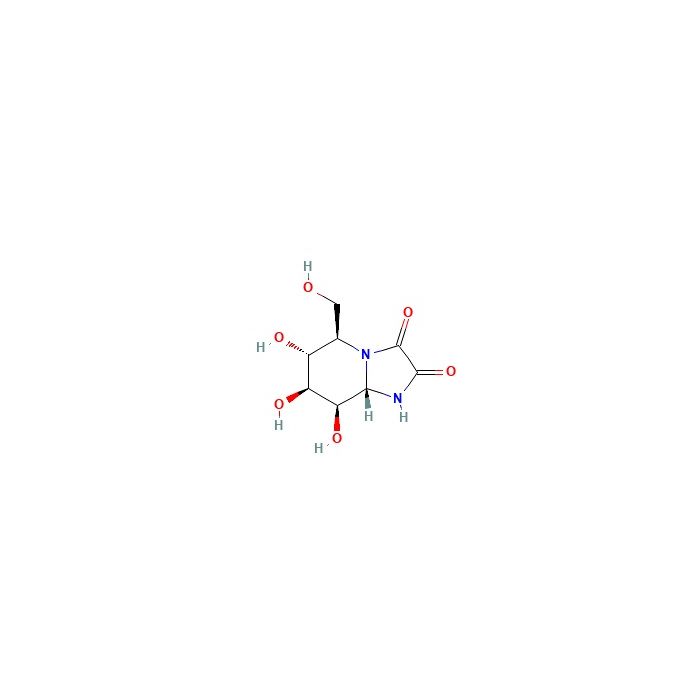
Kifunensine is an effective selective inhibitor of type I α-mannosidases that can be isolated from actinomycetes. It can prevent the trimming of mannose residues on glycoproteins by α-mannosidases I. Kifunensine can inhibit the endoplasmic reticulum-related protein degradation pathway.
Cell-permeable, potent, selective inhibitor of class I α-mannosidases. (IC 50 = 20-50 nM for\xa0mung bean α-1,2-mannosidase I). Alkaloid originally isolated from the actinomycete Kitasatosporia kifunense . Used to suppress Endoplasmic Reticulum-Associated
Storage
Store at -20°C,Desiccated
Verschickt in
Ice chest + Ice pads
Dieses Produkt erfordert Kühlkettenversand. Grundversand und andere Economy-Optionen sind nicht verfügbar.
Note
Moligand™
Aktionsart
INHIBITOR
Hinweis
Wherever possible, you should prepare and use solutions on the same day. However, if you need to make up stock solutions in advance, we recommend that you store the solution as aliquots in tightly sealed vials at -20°C. Generally, these will be useable for up to one month. Before use, and prior to opening the vial we recommend that you allow your product to equilibrate to room temperature for at least 1 hour. Need more advice on solubility, usage and handling? Please visit our frequently asked questions (FAQ) page for more details.
This compound belongs to the class of organic compounds known as alpha amino acids and derivatives. These are amino acids in which the amino group is attached to the carbon atom immediately adjacent to the carboxylate group (alpha carbon), or a derivative thereof.
External Descriptors
Not available
1. Djoumbou Feunang Y, Eisner R, Knox C, Chepelev L, Hastings J, Owen G, Fahy E, Steinbeck C, Subramanian S, Bolton E, Greiner R, and Wishart DS. ClassyFire: Automated Chemical Classification With A Comprehensive, Computable Taxonomy. Journal of Cheminformatics, 2016, 8:61.
Determine the necessary mass, volume, or concentration for preparing a solution.
Dilution Calculator
Determine the dilution needed to prepare a stock solution.
Reconstitution Calculator
Bewertungen
Kundenbewertungen
Application Protocols
No tested or validated protocols are provided in the Product Data for this SKU.
Recommended working concentrations, dilution schemes, assay panels, or positive controls: Not specified for this item; users should develop and validate protocols suitable for their specific system.
For general solution handling, see Solvent Selection and Reaction Conditions. Always consult the SDS and your institutional SOPs.
Biological Roles
Context for researchers (literature/general):
Kifunensine is a well-established small-molecule tool in glycobiology research, commonly employed to perturb N-linked glycan processing pathways in the secretory pathway. By modulating early mannose trimming steps, investigators can study quality control mechanisms, ER-associated pathways, and glycoprotein folding/trafficking.
Use cases include producing research-grade proteins enriched in high-mannose glycans for analytical method development (e.g., glycoproteomics, endoglycosidase mapping) and for evaluating glycan-dependent interactions in vitro.
In cell culture, transient exposure enables controlled changes to glycan profiles without genetic manipulation, facilitating comparative studies between treated and untreated populations.
Important caveats:
Effects may be cell-type and context dependent; empirical titration and time-course studies are recommended.
Avoid clinical or in vivo extrapolation—this product is for research use only.
Item-specific biological activity parameters (potency, Ki/IC50, selectivity): Not specified for this item; consult primary literature and perform in-system validation.
Buffer Applications
This product is not a buffering reagent. However, it is commonly dosed into buffered biological media in research settings.
Practical notes (general):
Compatible with standard biological buffers (e.g., PBS, HEPES-buffered media) when delivered from a concentrated stock solution.
Ensure complete dissolution before dosing; filter sterilize solutions prepared for cell culture if required by aseptic practice.
Item-specific buffer recipes, pH ranges, or concentrations: Not specified for this item; refer to CoA/Spec Sheet and validate in your system.
Green Alternatives
As a solid bioactive compound used at low concentrations, the “greenness” considerations focus on solvent choice and handling rather than replacing the molecule itself.
Greener handling considerations (general):
Prefer water or buffered aqueous media when feasible to avoid organic solvent use.
If organic cosolvent is required, minimize DMSO or alcohol content to the lowest effective percentage.
Prepare higher-concentration stocks to reduce solvent volumes and shipment of dilute solutions.
Comparison of solvent options (general):
Water/buffer: highest EHS profile; compatible with most biochemical assays; confirm stability and solubility.
DMSO: effective solubilizer; use sparingly due to environmental and biological considerations; manage waste appropriately.
Alcohols (EtOH/MeOH): moderate environmental impact; consider flammability and biological effects.
Packaging and storage:
Product is shipped cold and stored at −20°C, minimizing degradation and waste. Maintain desiccation to reduce hygroscopic uptake and preserve shelf life.
Note: There are no “alternative actives” to kifunensine within this listing; selection of different tool compounds should be based on scientific rationale rather than green chemistry alone.
Pharmaceutical Uses
No excipient or pharmacopeial role is provided for this item.
Scope: This listing is supplied for laboratory research only (discovery, screening, analytical studies). It is not formulated, certified, or intended for human or veterinary use.
Process development research (general): In bioprocess and analytical development research, tool compounds like kifunensine may be introduced in cell culture studies to explore how altered glycosylation affects downstream processing and analytics. Such use remains firmly within research contexts.
Regulatory/compendial status:
Pharmacopeial monographs, GMP status, or clinical-grade specifications: Not specified for this item; not intended for clinical applications.
Any claims of therapeutic benefit are outside the scope of this product and are not made.
Physical Properties
Item-specific specifications are not provided in the Product Data. Refer to the CoA/Spec Sheet for definitive values.
Appearance: Not specified for this item; refer to CoA/Spec Sheet.
Melting point: Not specified for this item; refer to CoA/Spec Sheet. (Typical values are reported in the literature for kifunensine, but item-specific specs are not provided.)
Boiling point: Not applicable/Not reported (decomposes before boiling; literature trend for polyhydroxylated alkaloids).
Density: Not specified for this item; refer to CoA/Spec Sheet.
Refractive index: Not applicable for a solid; not specified.
pKa/logP: Not specified for this item; refer to CoA/Spec Sheet. (Literature describes kifunensine as a highly polar, polyhydroxylated amine with overall hydrophilic character.)
Solubility: Not specified for this item; refer to CoA/Spec Sheet. (Literature/general: typically soluble in polar media such as water, aqueous buffers, and DMSO.)
General physicochemical profile (literature/general):
Polar, hydrogen-bond rich small molecule; strong tendency for aqueous solubility compared to apolar organic solvents.
Hygroscopicity can be observed for polyols; handle under dry conditions as recommended under Storage.
Quality and Grades
Grade/Purity: Moligand™ (per Product Data).
What Moligand™ implies (general description):
Moligand™ designates compounds curated for small-molecule/ligand discovery and screening applications. Typical expectations include high chemical purity suitable for biochemical assays, accurate identity confirmation (e.g., LC–MS/HRMS, NMR), and lot-to-lot consistency aimed at screening workflows. Exact specifications for this SKU (e.g., residual solvent limits, assay %) are not provided here—refer to the CoA/Spec Sheet.
Stabilizers and additives:
Stabilizer: Not specified for this item; refer to CoA/Spec Sheet.
Analytical documentation and suitability:
Identity/purity confirmation: Expect LC–MS and/or NMR data provided on the CoA for the specific lot. UV cutoff, water/peroxide/metal limits are Not specified for this item; refer to CoA/Spec Sheet.
Use case: Appropriate for in vitro research, target engagement studies, and cell-based assay development where consistent potency and minimal assay interference are required.
Practical notes:
Upon receipt, verify lot documentation (CoA) for assay purity and identity.
For sensitive biological assays, consider preparing fresh stock solutions and performing a small pilot dose–response to confirm activity with your system.
Reaction and Applications
This product is primarily a bioactive research compound rather than a synthetic reagent. Accordingly, its laboratory applications are predominantly in chemical biology and glycobiology rather than as a stoichiometric reactant.
Research applications (literature/general):
Widely used as a biochemical tool in glycoprotein processing studies to modulate N-glycan maturation, enabling enrichment of high-mannose glycoforms for analytical characterization and mechanism studies.
Employed in cell culture workflows to standardize glycosylation patterns of secreted proteins, facilitating downstream purification and structure–function analyses.
Utilized in target validation assays probing endoplasmic-reticulum-associated glycan trimming enzymes.
Assay design notes (general practice):
Prepare concentrated DMSO or aqueous stock; validate solubility and absence of precipitation upon dilution into assay media.
Include solvent controls to account for any DMSO effects.
Titrate compound to determine concentration–response relationships in the specific cell line or enzyme system.
Synthetic chemistry usage:
Not typically used as a reagent or catalyst in synthetic transformations. For synthetic considerations, see “Synthetic Utility” (largely non-applicable for this item).
Item-specific application claims from manufacturer: none provided beyond Research Use Only.
Reaction Conditions
This compound is not typically used to drive chemical reactions; instead it is dosed as a solution into biological systems. Consequently, there are no standard “reaction conditions” in the synthetic sense for this SKU.
General solution preparation (research practice):
Solvents: water/buffer or DMSO are commonly used carriers in biochemical/cell-based assays.
Concentrations: prepare concentrated stock solutions suitable for your assay, then dilute into media while keeping any organic cosolvent low. Exact concentrations are assay-dependent and must be empirically determined.
Temperature and light: prepare and store solutions at low temperature when possible; avoid prolonged exposure to elevated temperature and light to limit degradation.
Expected yields, catalysts, or time courses (synthetic context): Not applicable.
Item-specific preparation instructions: Not specified for this item; refer to CoA/Spec Sheet and SDS.
Safety and Handling
Authoritative safety data must be taken from the product-specific SDS.
GHS classification: Not specified for this item; refer to SDS.
Signal word / H-statements / Pictograms: Not specified for this item; refer to SDS.
General laboratory precautions (good practice):
PPE: lab coat, safety glasses, and appropriate chemical-resistant gloves.
Engineering controls: handle powders in a fume hood or containment to minimize dust/aerosol; avoid inhalation and contact.
Handling: avoid moisture uptake; kifunensine is a polyhydroxylated amine and may be hygroscopic—keep containers tightly closed and desiccated.
Incompatibilities: strong oxidizers and strong acids/bases may cause degradation; avoid prolonged exposure to elevated temperature and light.
First aid (overview; consult SDS): if inhaled—fresh air; if on skin—wash with soap and water; if in eyes—rinse cautiously with water for several minutes; if ingested—rinse mouth, seek advice.
Waste: dispose according to institutional and local regulations for organic laboratory chemicals.
For cell-based or enzymatic assays: prepare concentrated DMSO stocks and dilute into aqueous buffer, keeping final DMSO below cell-tolerated limits (often ≤0.1–0.5%, lab practice).
For purely biochemical in vitro work where DMSO is undesirable, direct dissolution in water or buffer may be feasible; adjust pH only if necessary and validated.
DMSO: excellent solubilizer; monitor final DMSO percentage.
Methanol/ethanol: secondary choice; consider effects on proteins/cells.
Item-specific solubility values: Not specified for this item; refer to CoA/Spec Sheet.
Storage and Reconstitution
Item-specific conditions (from Product Data):
Storage: Store at −20°C, desiccated.
Shipment: Ice chest + ice pads.
Reconstitution:
Item-specific reconstitution solvent, concentration, and filter-sterilization guidance: Not specified for this item; refer to CoA/Spec Sheet.
General handling guidance (good practice):
Allow vial to equilibrate to room temperature in a desiccated environment before opening to prevent condensation.
Prepare single-use aliquots of any stock solutions to avoid repeated freeze–thaw cycles.
Use clean, dry tools to avoid introducing moisture.
Stability:
Long-term stability data, solution stability, and retest/expiry: Not specified for this item; consult the CoA and perform in-lab verification as needed.
Structure and Identity
Brief description: Kifunensine is a polyhydroxylated, bicyclic indolizidine alkaloid widely used as a research tool compound in glycobiology.
SKU: K274698
Product Name: Kifunensine
CAS: 109944-15-2
CID: 130611
InChIKey: Not specified for this item; refer to CoA/Spec Sheet. (Product Data lists a truncated key.)
SMILES: Not specified for this item; refer to CoA/Spec Sheet.
Molecular Formula: Not specified for this item; refer to CoA/Spec Sheet.
Molecular Weight: Not specified for this item; refer to CoA/Spec Sheet.
Structural features (literature/general):
Core scaffold: indolizidine (fused bicyclic azabicyclo framework with a bridgehead nitrogen).
Functional groups: multiple secondary alcohols (polyhydroxylated), typically no aromatic rings; overall highly polar neutral amine or hemiaminal character depending on tautomeric form (literature).
Stereochemistry: multiple defined stereocenters across the bicyclic ring system; kifunensine is a single, well-defined stereochemical entity (literature).
2D description in words: a fused five–six membered ring containing one ring nitrogen (indolizidine), bearing several vicinal hydroxyl substituents around the saturated backbone; no extended conjugation.
Kifunensine is generally the end product (a bioactive tool compound) rather than a synthetic intermediate or reagent.
Functional group reactivity (general): Multiple alcohols and a tertiary/secondary amine within a saturated bicyclic system could, in principle, undergo protection/deprotection, acylation, carbamate formation, or salt formation. However, such transformations are typically part of kifunensine’s total synthesis or derivatization studies rather than routine laboratory use.
Named reactions: Not commonly employed as a reagent/catalyst in named organic reactions.
Use in synthesis workflows:
If derivatization is desired for probe development (e.g., attaching reporter tags), strategies often target alcohol functionalization (e.g., carbonate/carbamate linkers) or amine modification with careful retention of stereochemistry (literature/general guidance).
Item-specific synthetic specifications (reactivity, protective group strategies, etc.): Not specified for this item; consult primary literature for total synthesis/derivatization methods.
Target Specificity
Target/biological specificity details are not provided in the Product Data for this SKU.
Target name, selectivity profile, potency metrics: Not specified for this item; refer to CoA/Spec Sheet or primary literature.
Antigen/epitope/clone/isotype (antibody-style metadata): Not applicable for a small-molecule research compound.
Note: Any mechanistic or target discussions elsewhere are general literature context and are not item-specific claims.
Wir verwenden Cookies, um die ordnungsgemäße Funktion der Website sicherzustellen und, soweit zulässig, Ihr Nutzererlebnis zu verbessern. Sie können Ihre Einstellungen jederzeit unter „Einstellungen“ verwalten. Weitere Informationen finden Sie in unserer Cookie-Richtlinie.
Dürfen wir Sie über Rabattaktionen informieren?
Später erinnern
Vielen Dank! Bitte überprüfen Sie Ihren E-Mail-Posteingang, um zu bestätigen.
Products are supplied to verified businesses, institutions, and qualified professionals for research and development use only. Not for use in humans, animals, diagnosis, or therapy.

 H2624506