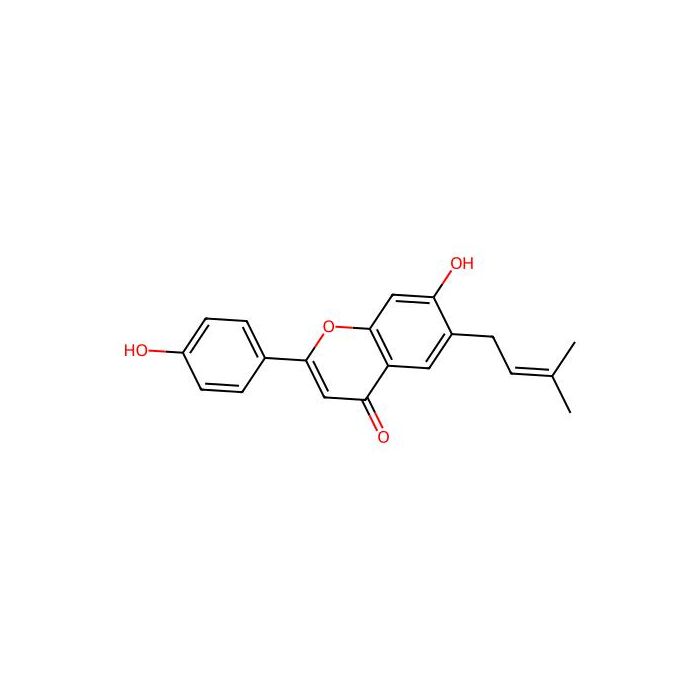
Licoflavone A is a flavonoid isolated from the roots of Glycyrrhiza uralensis , inhibits protein tyrosine phosphatase-1B ( PTP1B ), with an IC 50 of 54.5 μM
Licoflavone A is a flavonoid isolated from the roots of Glycyrrhiza uralensis , inhibits protein tyrosine phosphatase-1B ( PTP1B ), with an IC 50 of 54.5 μM.
Storage
Store at 2-8°C,Protected from light
Verschickt in
Wet ice
Dieses Produkt erfordert Kühlkettenversand. Grundversand und andere Economy-Optionen sind nicht verfügbar.
This compound belongs to the class of organic compounds known as 6-prenylated flavones. These are flavones that features a C5-isoprenoid substituent at the 6-position.
External Descriptors
Flavones and Flavonols
1. Djoumbou Feunang Y, Eisner R, Knox C, Chepelev L, Hastings J, Owen G, Fahy E, Steinbeck C, Subramanian S, Bolton E, Greiner R, and Wishart DS. ClassyFire: Automated Chemical Classification With A Comprehensive, Computable Taxonomy. Journal of Cheminformatics, 2016, 8:61.
Zertifikate (CoA, COO, BSE/TSE und Analyse-Diagramm)
C of A & Other Certificates(BSE/TSE, COO):
Analytical Chart:
Chemische und physikalische Eigenschaften
Löslichkeit
DMSO : 100 mg/mL (310.22 mM; Need ultrasonic) H2O : 1 mg/mL (3.10 mM; Need ultrasonic) Licoflavone A is usually formulated as a suspension.
Molekulargewicht
322.400 g/mol
XLogP3
5.200
Hydrogen Bond Donor Count
2
Hydrogen Bond Acceptor Count
4
Rotatable Bond Count
3
Exact Mass
322.121 Da
Monoisotopic Mass
322.121 Da
Topological Polar Surface Area
66.800 Ų
Heavy Atom Count
24
Formal Charge
0
Complexity
524.000
Isotope Atom Count
0
Defined Atom Stereocenter Count
0
Undefined Atom Stereocenter Count
0
Defined Bond Stereocenter Count
0
Undefined Bond Stereocenter Count
0
The total count of all stereochemical bonds
0
Covalently-Bonded Unit Count
1
Lösungsrechner
Molarity Calculator
Determine the necessary mass, volume, or concentration for preparing a solution.
Dilution Calculator
Determine the dilution needed to prepare a stock solution.
Reconstitution Calculator
Bewertungen
Kundenbewertungen
Application Protocols
No tested application protocols are provided in the Product Data for this item. The following general, non-spec suggestions can aid initial handling and method setup:
Preparation of analytical standard (HPLC/UPLC):
Accurately weigh solid quickly under low light. Dissolve in HPLC-grade methanol or acetonitrile to prepare a 1.0–5.0 mg/mL stock. Store aliquots in amber vials at 2–8°C for short term; freeze for long-term if stability permits.
For LC-MS, add 0.05–0.1% formic acid (or ammonium formate for ESI+) if needed to improve peak shape; evaluate ESI− for phenolic analytes.
Bioassay stock handling:
Prepare a concentrated DMSO stock (e.g., 10–50 mM). Filter through 0.22 µm PTFE if particulate is present. Dilute into pre-warmed media with vigorous mixing; verify that final DMSO is within tolerated assay limits.
Use amber plates/tubes or wrap in foil to minimize light exposure during assays.
Spectral characterization (quick check):
Record UV–Vis spectrum in MeOH: expect dual-band absorption with a longer-wavelength band in the ~320–380 nm region characteristic of flavones (literature guidance).
These are illustrative starting points. Optimize to your instrumentation, matrix, and regulatory requirements. Always consult the product’s CoA/SDS for definitive handling instructions.
Biological Roles
No biological/clinical claims are made for this product. The following summarizes general, literature-based roles of licorice-derived flavonoids in plant systems and biochemistry; use only for context in research planning.
Origin and biosynthesis (literature):
Flavonoids are produced via the phenylpropanoid pathway, coupling a C6–C3 phenylpropanoid unit with malonyl-CoA extensions to form the flavone skeleton. Prenylation is mediated by prenyltransferases, influencing membrane association and defense roles in plants.
Functional roles in plants (literature):
UV protection and pigmentation due to strong absorption in near-UV/visible regions.
Antioxidant and redox-buffering capacity via phenolic –OH groups and radical delocalization over the conjugated system.
Defense metabolites with deterrent or signaling properties against herbivores and microbes.
Biochemical properties relevant to research:
Metal chelation (Fe3+, Cu2+) via catechol/phenolic motifs; can modulate redox and Fenton chemistry in vitro.
Interactions with lipid bilayers increased by prenyl groups; affects compound uptake in model systems.
In mammalian in vitro systems, phase II conjugation (glucuronidation, sulfation) of phenolic OH groups is common; oxidative metabolism may occur on prenyl substituents.
These notes are for biochemical context only and do not imply any health-related use.
Buffer Applications
Licoflavone A is a neutral, poorly water-soluble small molecule and is not used as a buffering agent. It lacks acid/base functionality appropriate for maintaining solution pH over a controlled range.
Practical notes for working in aqueous buffers (research operations):
To introduce Licoflavone A into aqueous assay buffers, first dissolve in a water-miscible organic co-solvent (commonly DMSO), then dilute into buffer with vigorous mixing to avoid precipitation. Maintain final co-solvent percentage within assay tolerances.
Consider solubilization aids (e.g., 1–5 mM HP-β-cyclodextrin) if higher aqueous concentrations are required.
For actual buffer preparation and pH control, use established buffer systems (e.g., phosphate, HEPES, Tris) appropriate to your pH target; Licoflavone A does not serve that role.
Green Alternatives
When working with flavonoid natural products like Licoflavone A, solvent choices dominate the environmental footprint. Consider substituting conventional solvents with greener options where feasible.
Typical operations and greener substitutions (literature-based guidance):
| Operation | Conventional choice | Greener alternative | Trade-offs |
|---|---|---|---|
| Extraction/workup | Dichloromethane, chloroform | Ethyl acetate, 2-MeTHF, CPME | Slightly different partitioning; may need additional washes |
| Normal-phase chromatography | Hexane/toluene | Heptane or bio-based cycloalkanes | Elution strength adjustments required |
| RP-HPLC mobile phase | ACN | Bioethanol or MeOH (renewable grade) | Viscosity/backpressure increases; MS response differences |
| Stock solutions | DMF | DMSO, bio-derived sulfoxides | DMSO has higher polarity; may affect assay tolerability |
Process intensification and waste minimization:
Employ SPE for fractionation to reduce silica/solvent consumption.
Optimize gradient LC methods to shorten run times and lower solvent use.
Use light-protective glassware to limit degradation and repeat preparations.
Energy considerations:
Store at 2–8°C (as specified) rather than deep-freeze to reduce energy burden, provided stability is acceptable.
Always validate analytical performance and solubility when switching to greener media, as retention times and recovery of polyphenolics can change significantly with solvent composition and pH.
Pharmaceutical Uses
No clinical or therapeutic claims are made for this product. The following covers formulation-related considerations relevant to research and development contexts only.
Potential roles in R&D workflows:
Analytical reference standard for profiling raw materials and extracts (e.g., licorice-containing botanicals) by HPLC/UPLC.
Impurity/degradation marker in stability studies of botanical ingredients.
Photostability: Protect from light; use amber vials and limit UV exposure during processing to minimize oxidative or photolytic changes.
Compendial status: No pharmacopeial monograph is indicated for Licoflavone A in the provided data. If using as a reference standard, establish in-house specifications and document traceability to a well-characterized lot.
All uses are restricted to laboratory research and development. This product is not approved as an excipient or active ingredient.
Physical Properties
Item-specific specifications are not provided in the Product Data. Do not treat the following as specifications; consult the CoA/Spec Sheet for this lot.
Appearance (item-specific): Not specified for this item; refer to CoA/Spec Sheet.
Molecular weight (item-specific): Not specified for this item; refer to CoA/Spec Sheet.
Molecular formula (item-specific): Not specified for this item; refer to CoA/Spec Sheet.
General/literature expectations for flavone-type, prenylated flavonoids (for planning only):
Physical state/color (literature): typically yellow to yellow-brown crystalline solid due to extended conjugation in the flavone chromophore.
Solubility profile (literature):
Water: very low solubility.
Organic: good solubility in DMSO and DMF; moderate to good in methanol, ethanol, acetone; limited in nonpolar alkanes unless prenylated extensively.
logP/logD (literature trends): prenylation increases lipophilicity relative to non-prenylated flavones; logP often >3.
UV–Vis (literature): strong absorption in 240–280 nm (Band II, A-ring) and 320–380 nm (Band I, B-ring/α,β-unsaturated system) regions; exact λmax depends on substitution.
pKa (literature): phenolic OH groups typically show pKa ~7–10 depending on substitution and intramolecular H-bonding; deprotonation shifts UV bands.
Melting point/boiling point, density, refractive index: Not specified here; check primary literature or vendor CoA for the exact compound.
Note: Treat all quantitative values above as general literature guidance for the class; verify with experimental data before method validation.
Quality and Grades
Grade/Purity (item-specific): Not specified for this item; refer to CoA/Spec Sheet.
Interpretation and typical considerations for natural-product small molecules:
Research grade: Generally suitable for discovery biology, screening, mechanism studies, and analytical method development. Where stated, higher purities (e.g., ≥95% by HPLC) are often preferred for quantitative biological assays and as calibration standards.
Documentation: CoA commonly includes assay purity (HPLC/UPLC), chromatographic conditions, water content (KF), and residual solvent testing. If your application is quantitative (e.g., reference standard), request or review the full CoA chromatogram and method.
Identity confirmation: For complex flavonoids, multi-orthogonal confirmation is recommended: HRMS (exact mass), 1H/13C NMR with key correlations (HMBC/HSQC), and UV-Vis profile characteristic of flavones. Where stereochemistry applies (not typical for planar flavones), consider chiroptics (ECD) or derivatization.
Stabilizers/additives: None are listed for this item. If present in other lots, stabilizers can influence UV background and LC-MS ionization; verify prior to use.
Bioassays: ensure batch-to-batch consistency in purity and counterions (if any) to avoid variability.
For this catalog entry, defer to the item-specific CoA/Spec Sheet for definitive grade, purity, and analytical details.
Reaction and Applications
This compound is primarily used as a reference standard, a probe in natural product chemistry, and as a member of small-molecule libraries for screening. There are no manufacturer-stated applications in the Product Data; the following expands on typical uses of licorice-derived flavonoids (literature-based, non-spec):
Analytical reference material:
Calibration/qualifier in HPLC/UPLC-UV and LC-MS methods profiling Glycyrrhiza spp. extracts. Characteristic UV dual-band spectrum of flavones aids identification.
Stability studies: monitor degradation under light/oxidative stress to establish handling conditions.
Chemical biology/discovery screening:
Utilized in phenotypic or target-agnostic screens as a structurally rich, polyphenolic scaffold; supports SAR when compared with related flavones/prenylflavonoids.
Synthetic chemistry contexts (derivatization of flavonoids):
O-alkylation/acylation of phenolic OH to modulate lipophilicity and metabolic stability.
Electrophilic substitution on activated aromatic positions for halogenation or nitration (with selectivity challenges due to phenolic protection needs).
Prenyl group manipulations (oxidation/hydroxylation, cyclizations) to access analog libraries.
Isolation and characterization workflows:
Often co-occurs with other licorice flavonoids; separation by RP-HPLC using aqueous MeCN or MeOH with acid modifier. MS/MS fragmentation typically shows neutral losses from prenyl/phenolic groups.
Note: Reaction-scale synthetic transformations should be planned with protection strategies for phenolic OH groups and attention to light/oxygen sensitivity that can drive unwanted oxidation.
Reaction Conditions
There are no manufacturer-specified reaction conditions for Licoflavone A. The following general conditions summarize literature practices for derivatizing flavone-type polyphenols; adapt to the exact substitution pattern and protect sensitive motifs as needed.
O-Alkylation (to ethers):
Reagents/bases: alkyl halide (R–X), K2CO3 or Cs2CO3; catalytic KI may assist.
Solvents/temps: acetone, MeCN, or DMF; 25–60°C. Monitor for over-alkylation.
O-Acylation (to esters/carbonates):
Reagents: acyl chlorides/anhydrides, CDI or DSC for carbonates.
Conditions: pyridine, Et3N, or DMAP catalysis in DCM/THF; 0–25°C.
Prenyl oxidation (if applicable):
Epoxidation: mCPBA or performic/peracetic acids in DCM at 0–25°C.
Hydroxylation/allylic oxidation: SeO2 or Mn-catalyzed systems; control to avoid aromatic oxidation.
Aromatic halogenation (selective):
NBS/NCS under mild conditions in polar aprotic solvents; protect phenols to guide regioselectivity.
RP-HPLC: C18, 5 µm, 250 × 4.6 mm; gradient 20–80% MeOH or ACN in water with 0.1% formic acid over 20–30 min; UV detection at 254–360 nm (literature guidance for flavones).
LC-MS: ESI(−) often gives deprotonated [M–H]− with informative phenoxide fragments.
Stability considerations:
Protect from light and oxygen; include antioxidants (0.1% ascorbate) for extended solution stability where compatible.
These conditions are illustrative, based on general flavonoid chemistry, and should be verified experimentally for Licoflavone A.
Safety and Handling
Intended use: For research use only (not for human or veterinary use, diagnosis, or therapeutic applications).
Item-specific hazard information (from Product Data):
Signal word: Not specified for this item; refer to SDS.
H-statements: Not specified for this item; refer to SDS.
GHS classification/pictograms: Not specified for this item; refer to SDS.
General laboratory safety considerations for flavonoid small molecules:
Potential hazards: Many polyphenolics may cause irritation to skin/eyes/respiratory tract. Avoid inhalation of dusts and contact with skin/eyes.
PPE: Use lab coat, safety glasses/goggles, appropriate chemically resistant gloves (e.g., nitrile), and handle powders in a fume hood or ventilated enclosure.
Handling: Minimize exposure to light and air to limit oxidative discoloration; cap containers promptly. Avoid elevated temperatures.
Incompatibilities: Strong oxidizers; strong bases/acids may cause degradation (e.g., hydrolysis of sensitive moieties) or oxidation of phenolic groups.
First aid (overview; defer to SDS):
Inhalation: Move to fresh air; seek medical attention if symptoms persist.
Skin/eye contact: Rinse with plenty of water for at least 15 minutes; remove contaminated clothing; obtain medical advice if irritation persists.
Ingestion: Rinse mouth; do not induce vomiting; seek medical attention.
Spill/accidental release: Avoid dust generation; collect mechanically or with dampened inert absorbent; dispose according to local regulations.
Fire-fighting: Use CO2, dry chemical, or foam; combustion may produce CO/CO2 and irritating fumes. Wear self-contained breathing apparatus.
Always consult the product-specific SDS for authoritative, up-to-date hazard, exposure limits, and response measures.
Solvent Selection
Licoflavone A behaves as a moderately to highly lipophilic polyphenolic flavone-type molecule (literature, class-based). Selection hinges on balancing solubility, stability, and downstream compatibility.
Polarity/miscibility (class-based guidance):
Highly soluble: DMSO, DMF.
Good solubility: methanol, ethanol, acetone, acetonitrile (varies by substitution pattern).
Limited solubility: water; aqueous buffers unless co-solvent, cyclodextrin inclusion, or surfactant is used.
Nonpolar solvents: variable; prenylation can improve solubility in EtOAc, MTBE, toluene, and CPME.
Practical recommendations:
Stock solutions: Prepare concentrated stocks in anhydrous DMSO (e.g., 10–50 mM) for bioassays; dilute into media last to minimize precipitation. Maintain final DMSO ≤0.1–0.5% v/v for cellular systems as needed.
Analytical chemistry: For HPLC/UPLC, MeOH or ACN with formic acid (0.05–0.1%) provides robust peak shape and ionization for MS. Shield light during sample prep to minimize photodegradation.
Isolation/cleanup: Solid-phase extraction on reversed-phase sorbents (C18, phenyl-hexyl) with MeOH/H2O or ACN/H2O gradients is typical.
When to choose alternatives:
If aqueous delivery is mandatory, consider co-solvent systems (DMSO→buffer), use of solubilizers (HP-β-CD), or formulate as microemulsions.
For greener workflows, 2-MeTHF, EtOAc, or bioethanol can replace chlorinated solvents for extractions and workups.
Note: Verify solvent compatibility for your instrumentation and assay; precipitation can occur upon aqueous dilution if supersaturation is exceeded.
Storage and Reconstitution
Item-specific instructions (from Product Data):
Storage conditions: Store at 2–8°C, protected from light.
Shipping: Shipped on wet ice.
General guidance for reconstitution and handling of flavonoid small molecules:
Reconstitution solvent: Use anhydrous DMSO for highest solubility; methanol or ethanol are acceptable alternatives depending on application. Begin with small volumes and vortex/sonicate as needed.
Concentrated stocks: Prepare aliquots (e.g., 10–50 mM in DMSO) to avoid repeated freeze–thaw and minimize headspace oxygen. Store in amber, airtight vials.
Light/oxygen protection: Work swiftly under subdued light; flush vial headspace with inert gas (N2 or Ar) for long-term storage if feasible.
Aqueous use: Dilute organic stock into buffer immediately before use with vigorous mixing to prevent precipitation. Verify clarity; if turbidity forms, reduce concentration or increase co-solvent fraction within assay limits.
Freeze–thaw: If frozen stocks are employed, avoid multiple cycles; thaw on ice, mix gently, and return promptly to storage.
Note: If a lyophilized or solid form is supplied, bring to room temperature in the sealed container before opening to prevent condensation. For lot-specific stability and maximum shelf-life, rely on the CoA and SDS.
Structure and Identity
Licoflavone A is a plant-derived small molecule classified within the flavonoid family (natural product; small-molecule library member).
Item-specific identifiers (from Product Data):
CAS: 61153-77-3
SKU: L650947
InChIKey: Not specified for this item; refer to CoA/Spec Sheet. (Product Data field provided is non-informative.)
SMILES: Not specified for this item; refer to CoA/Spec Sheet.
Molecular formula: Not specified for this item; refer to CoA/Spec Sheet.
Molecular weight: Not specified for this item; refer to CoA/Spec Sheet.
Literature/registry cross-references (non-spec, for reference only):
Structural features (general, literature-based description):
Core scaffold is a flavone-type skeleton (15-carbon C6–C3–C6 framework) comprising two aromatic rings (A and B) connected via a heterocyclic pyrone (C ring).
Phenolic hydroxyl groups are commonly present on A/B rings in licorice flavonoids, enabling hydrogen bonding and metal-chelation behavior (literature, typical for this class).
Many licorice flavones are O- or C-prenylated (isoprenyl substituent, –CH2–C(CH3)=CH2) which increases lipophilicity and membrane affinity (literature).
One benzoyl-derived ring fused to a γ-pyrone (chromen-4-one) makes the flavone core; a second phenyl ring is attached at C-2 of the chromenone. Phenolic –OH groups decorate the rings, and an isoprenyl-type side chain may appear on the A or B ring, typical of licorice flavones.
Synthetic Utility
Although primarily supplied as a natural product standard, Licoflavone A can serve as a versatile scaffold for method development and small-library synthesis (literature-based for flavonoids):
Functional groups and reactivity:
Phenolic OH groups enable etherification (O-alkylation), esterification (acylation, carbonate formation), and urethane formation; careful base selection (e.g., K2CO3, Cs2CO3) controls chemoselectivity.
Conjugated enone (chromen-4-one) motif participates in Michael-type additions under strongly activated conditions; more commonly, it is preserved and used for π–π interactions in probes.
Prenyl substituents (if present) allow oxidation, epoxidation, or cyclization to generate diverse analogs (furans, dihydrofurans) via intramolecular attack onto the aromatic ring (Friedel–Crafts-type cyclizations).
Named/typical transformations on flavones:
Baker–Venkataraman rearrangement is relevant in the synthesis of flavones (contextual for back-synthesis and analog preparation).
Algar–Flynn–Oyamada oxidation for flavonol generation (if 2′-hydroxychalcone intermediates are employed).
Claisen–Schmidt condensation provides access to chalcone precursors for structure–activity comparisons with licorice metabolites.
Conjugation/labeling:
Installation of linkers at phenolic positions (carbonate/carbamate) for affinity matrices or fluorescent tags while preserving the aromatic core.
Analytics-driven utility:
Use as a test analyte for optimizing RP-LC separations of polyphenolics, probing column selectivity (C18 vs phenyl-hexyl vs pentafluorophenyl) and mobile-phase pH effects.
Target Specificity
Not applicable. Licoflavone A is a small molecule, not an antibody or affinity reagent, and no target-binding specificity data are provided in the Product Data. If used in biochemical assays, any observed activity should be validated independently with orthogonal methods and counter-screens.
Häufig gestellte Fragen
What is the purity of this product?
This product is supplied at ≥99% purity (chemical assay). Lot-specific values are stated on the Certificate of Analysis.
How should this product be stored?
Store at 2–8 °C, protected from light. The material is light-sensitive — keep it in its original opaque or amber container.
How is this product shipped?
This product ships chilled on wet ice. Unpack on arrival and transfer it to the storage condition stated above.
What are the CAS number, molecular formula and molecular weight?
The CAS Number is 61153-77-3, the molecular formula is C20H18O4, and the molecular weight is 322.35 g/mol. InChIKey HJGURBGBPIKRER-UHFFFAOYSA-N.
What documentation is provided?
Available product documentation, including Certificates of Analysis (COA), Safety Data Sheets (SDS), and specification sheets, is shown in the product document area. Document availability and access follow the current site policy.
Wir verwenden Cookies, um die ordnungsgemäße Funktion der Website sicherzustellen und, soweit zulässig, Ihr Nutzererlebnis zu verbessern. Sie können Ihre Einstellungen jederzeit unter „Einstellungen“ verwalten. Weitere Informationen finden Sie in unserer Cookie-Richtlinie.
Dürfen wir Sie über Rabattaktionen informieren?
Später erinnern
Vielen Dank! Bitte überprüfen Sie Ihren E-Mail-Posteingang, um zu bestätigen.
Products are supplied to verified businesses, institutions, and qualified professionals for research and development use only. Not for use in humans, animals, diagnosis, or therapy.