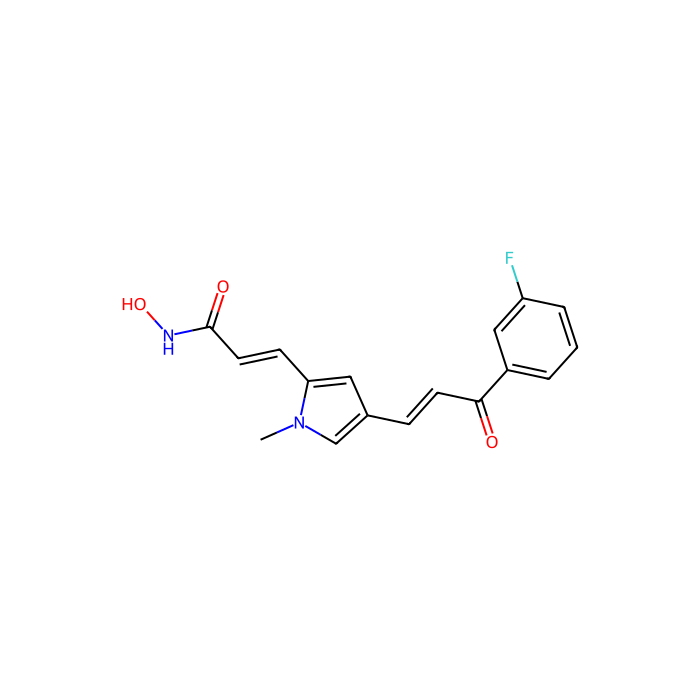
Information
MC1568 is a selectiveHDACinhibitor for maize HD1-A withIC50of 100 nM in a cell-free assay. It is 34-fold more selective for HD1-A than HD1-B.
In vitro
MC1568 is a selective class II (IIa) histone deacetylas (HDAC II) inhibitor with IC50 of 220 nM and 176-fold class II selectivity (against class I). In human breast cancer ZR-75.1 cell lysates, MC1568 (5 μM) shows no inhibitory activity against HDAC1 but is able to inhibit HDAC4. In MCF-7 cells, MC1568 (20 μM) increases the accumulation of acetylated H3 and H4 histones, as well as the levels of acetyl-tubulin, which indicates a inhibitory effect of MC1568 on HDAC6. In C2C12 cells, MC1568 (5 μM) arrests myogenesis by decreasing myocyte enhancer factor 2D (MEF2D) expression, stabilizing the HDAC4-HDAC3-MEF2D complex, and by inhibiting differentiation-induced MEF2D acetylation. MC1568 (5 or 10 μM) interferes with the RAR- and PPARγ-mediated differentiation-inducing signaling pathways. In F9 cells, MC1568 specifically blocks endodermal differentiation despite not affecting retinoic acid-induced maturation of promyelocytic NB4 cells. In 3T3-L1 cells, MC1568 attenuates PPARγ-induced adipogenesis.
In vivo
In mice, MC1568 (50 mg/kg) shows an apparent tissue-selective HDAC inhibition. In skeletal muscle and heart, MC1568 inhibits the activity of HDAC4 and HDAC5 without affecting HDAC3 activity, thereby leaving MEF2-HDAC complexes in a repressed state. In reporting PPRE-Luc mice, MC1568 (50 mg/kg) impairs PPARγ signaling mostly in the heart and adipose tissues. In a recent study of pancreatic explants, MC1568 enhances expression of Pax4, a key factor required for proper β-and δ-cell differentiation and amplifies endocrine β- and δ-cells.
Cell Data
cell lines:Raji, SU-DHL-4 and SU-DHL-10 cell lines
Concentrations:~10 μM, dissolved in DMSO
Incubation Time:8 days
Powder Purity:≥95%