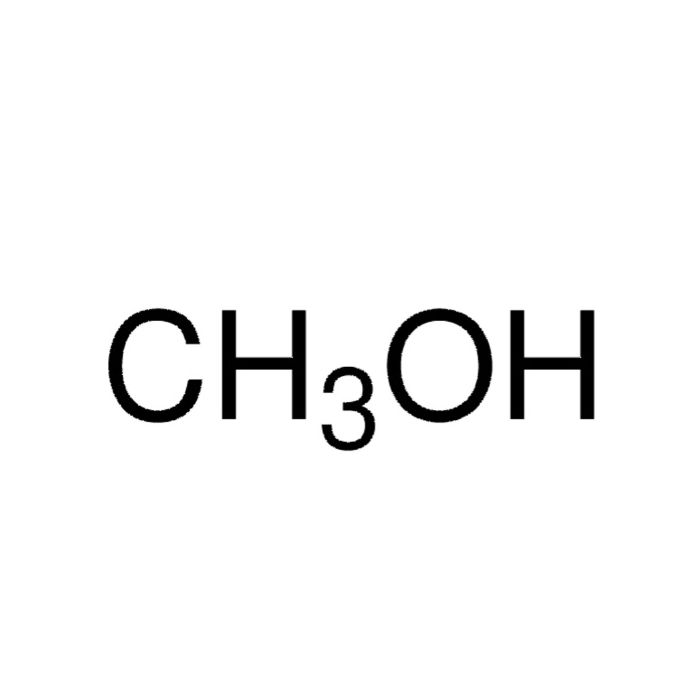
Methanol - Ultra dry, ≥99.9%, water≤30 ppm , CAS No.67-56-1

CAS: 67-56-1 Cat. No.: M1521045 Summenformel: CH3OH Molekulargewicht: 32.04 Beilstein Registry Number: 3662861 EG-Nummer: 200-659-6
Zu bestellen verfügbar
QUALITÄT & REINHEIT Ultra dry ? Ultra-dry grade with extremely low water content, packaged to exclude moisture. Use for moisture-sensitive reactions and air-free chemistry. ≥99.9% water≤30 ppm
Storage
Room temperature
Shipped In
FedEx DG Service
★
Größe
Deutschland (EU)
USA*
Preis
Menge
100ml
M1521045-100ml
Auf Bestellung · 8–12 Wochen
51,98€
500ml
M1521045-500ml
Auf Bestellung · 8–12 Wochen
86,69€
Enter a quantity for the sizes you want to add.
🧪
Warum diese Qualität

Ultra dry, ≥99.9%, water≤30 ppm Ultra dry für empfindliche chromatographische und analytische Workflows, die minimale Basislinieninterferenzen erfordern.

🌡

Lagerung & Versand

Room temperature Versand FedEx DG Service. Genaue Spezifikationen finden Sie im chargenspezifischen COA.

📋

Qualitätsdokumente

SDS, COA, Datenblatt und Spezifikationsblatt stehen zum Download bereit. Chargenspezifische COA über Chargennummernsuche abrufbar.

📚

Literaturbeleg

In 7070 peer-reviewten Publikationen zu Chromatographie, organischer Synthese und Kreuzkupplungsreaktionen zitiert.

Übersicht

Methanol is an industrial organic solvent commonly used in organic synthesis. It is being considered as a potential hydrogen source in fuel cell technology due to its high H/C ratio, low propensity for soot generation, relatively low reforming temperature and its liquid state at room temperature. The olefins (ethylene or propylene) formed from methanol via MTO (methanol-to-olefins) process, can be an alternative to oil and gas to produce hydrocarbon fuels.

Application

Methanol has been used for fixing the tissues during preparation of thin giemsa stained blood smears. It has been used in the purification step during the synthesis of pyocyanin, a toxic compound found in Pseudomonas aeruginosa . Methanol has been used in following applications: Used for the synthesis and purification of pyocyanin, spectrophotometric estimation of pyocyanin concentration, and the calculation of pyocyanin molar concentration using spectrophotometer absorption data. Used as a component of staining solution used in karyotyping. Used as a component of staining solution to stain cell colonies in colony formation assay.

Spezifikationen

Spezifikationen & Reinheit
Ultra dry, ≥99.9%, water≤30 ppm
Storage
Room temperature
Verschickt in
FedEx DG Service
Note
Ultra dry
Reinheit
≥99.9%
Namen und Kennungen
Kanonisches Lächeln
CO
IUPAC Name
methanol
InChIKey
OKKJLVBELUTLKV-UHFFFAOYSA-N
INCHI
1S/CH4O/c1-2/h2H,1H3
Isomere SMILES
CO
WGK Deutschland
1
RTECS
1
UN-Nummer
1230
Verpackungsgruppe
II
Molekulargewicht
32.04
Beilstein
3662861

Dokumentation

📋 Sicherheitsdatenblatt (SDS)

Umfassendes Dokument zu Gefahren, Handhabung, Lagerung und Einhaltung regulatorischer Vorschriften.

<<<<<<< HEAD SDS herunterladen → ======= SDS herunterladen → >>>>>>> release248-p3

✅ Analysezertifikat (COA)

Chargenspezifische Qualitätsdaten. Geben Sie Ihre Chargennummer ein, um das genaue COA abzurufen.

COA nachschlagen →

📊 Datenblatt

Kurzübersicht über Produktspezifikationen und Anwendungen.

Datenblatt ansehen →

🔬 Spezifikationsblatt

Vollständige Qualitätsmerkmale und Akzeptanzkriterien für diese Qualität.

Spezifikationsblatt ansehen →

Erweiterte Daten

Taxonomic Classification

Taxonomy Tree

KingdomOrganic compounds
SuperclassOrganic oxygen compounds
KlasseOrganooxygen compounds
SubclassAlcohols and polyols
Intermediate Tree Nodes Not available
Direct ParentPrimary alcohols
Alternative Parents Hydrocarbon derivatives  
Molecular FrameworkAliphatic acyclic compounds
Substituents Hydrocarbon derivative - Primary alcohol - Aliphatic acyclic compound
BeschreibungThis compound belongs to the class of organic compounds known as primary alcohols. These are compounds comprising the primary alcohol functional group, with the general structure RCOH (R=alkyl, aryl).
External Descriptors a short-chain alcohol
3D-Struktur
Interaktives chemisches Strukturmodell


Zertifikate (CoA, COO, BSE/TSE und Analyse-Diagramm)
C of A & Other Certificates(BSE/TSE, COO):
Analytical Chart:

Find and download the COA for your product by matching the lot number on the packaging.

6 results found

Lot NumberCertificate TypeDatumArtikel
I2624112I2624112Certificate of AnalysisOct 13, 2026 M1521045
I2624113I2624113Certificate of AnalysisOct 10, 2026 M1521045
G2618039G2618039Certificate of AnalysisAug 01, 2026 M1521045
G2618040G2618040Certificate of AnalysisAug 01, 2026 M1521045
E2614127E2614127Certificate of AnalysisMay 20, 2026 M1521045
E2614128E2614128Certificate of AnalysisMay 20, 2026 M1521045
Chemische und physikalische Eigenschaften
Brechungsindex1.329
Flammpunkt (°F)49.5 °F
Flammpunkt (°C)9.7 °C
Siedepunkt (°C)64.7°C
Schmelzpunkt (°C)-97.8°C
Molekulargewicht32.042 g/mol
XLogP3-0.500
Hydrogen Bond Donor Count1
Hydrogen Bond Acceptor Count1
Rotatable Bond Count0
Exact Mass32.0262 Da
Monoisotopic Mass32.0262 Da
Topological Polar Surface Area20.200 Ų
Heavy Atom Count2
Formal Charge0
Complexity2.000
Isotope Atom Count0
Defined Atom Stereocenter Count0
Undefined Atom Stereocenter Count0
Defined Bond Stereocenter Count0
Undefined Bond Stereocenter Count0
The total count of all stereochemical bonds0
Covalently-Bonded Unit Count1
FAQs und Artikel
Preparation Methods and Precautions for Silane Coupling Agent Primer Solutions
Applications and Differences of Neisser Staining, Albert Staining, and Gram Staining in the Differentiation of Corynebacteria
Application Differences Among Glutaraldehyde, Paraformaldehyde, and Formalin in Tissue and Cell Sample Fixation
Microbial Morphological Identification: Observation Systems, Staining Methods, and Result Interpretation
How to Troubleshoot Abnormal Impurities in Peptide Synthesis? Locating Process Issues Through Amino-Related Side Reactions
Peptide Intermediates Difficult to Dissolve and Separate? Route Design and Workup Strategies for Tag-Assisted Liquid-Phase Peptide Synthesis (TAG-LPPS)
Why Do Phenolic Resins Have Good Heat and Chemical Resistance? Analyzing the Source of Their Performance from Molecular Structure to Cured Networks
Porous Graphitic Carbon (PGC) Chromatography Columns: Creating New Selectivity for Challenging Separations through Molecular Shape and the π-Electron Cloud on the Graphitic Surface
Applications of Rosin and Modified Rosin Resins in Coatings and Inks: Structure–Property Relationships, Modification Pathways, and Usage Guidelines
Application of Shellac, a Natural Film-Forming Resin, in Coatings: Alcohol-Soluble Fast-Drying Film Formation, Sealing and Repair, and Performance Boundaries
What Is an Etchant? Etching Mechanisms for Revealing Metallographic Microstructures, Selection Methods, and Applications of Related Wet-Etching Reagents
Formation and Control of Carboxyl- and Hydroxyl-Related Impurities in Peptide Synthesis — Using Asp/Glu and Ser/Thr Residue Side Reactions as Examples
β-Hydroxybutyrate Detection Methods and Metabolic Significance: Comparative Applications of Enzymatic Assays, Blood Ketone Meters, and LC-MS
In Vitro Exposure Simulation and Bioaccessibility Assessment of Particulate Chemicals from Consumer Products Using Simulated Lung Fluid
Discovery and Structural Optimization of the Noncovalent 3CL Protease Inhibitor S-217622
How Coenzyme Q10 Acts on the Skin: Mitochondrial Electron Transfer, Antioxidant Protection of Membrane Lipids, and Lipid-Carrier Delivery
Why Primary and Secondary Amines Have Difficulty Participating Directly in the Classical Mitsunobu Reaction: Mechanism, Inversion of Configuration, and Reaction Scope of BEHT-Mediated Alcohol Amination
Solid Supports in Packed Gas Chromatography Columns: Definition, Mechanisms of Action, Classification, and Selection
Form Selection of 2,5-Dihydropyrrol-3-yl Boron Building Blocks: Functional Roles of Bpin and BF₃K in Coupling, Isolation, and Storage
Kinetic Matching in Photoredox/Nickel C(sp²)–C(sp³) Coupling: Radical Generation, Nickel-Species Stability, and Photon Flux
Construction of the Key α-Bromoketone Intermediate for LY3509754: A β-Keto Ester Strategy and Concomitant Decarboxylation Following Enzymatic Ester Hydrolysis
Bond-Formation Sequence and Process Improvement for 3-Bromo-6-alkyl-1,6-naphthyridin-5(6H)-ones: From Late-Stage N-Alkylation to Enamine Cyclization with Primary Amines
Citations of This Product
Lösungsrechner
Bewertungen

Kundenbewertungen

Benötigen Sie Hilfe bei der Auswahl der Qualität?

Unser Leitfaden zur Qualitätsauswahl behandelt Reinheit, Stabilisatorstatus und Anwendungseignung für alle Varianten in unserem Katalog.

Ultra dry Qualitätsleitfaden ansehen →

Dürfen wir Sie über Rabattaktionen informieren?

Später erinnern

Vielen Dank! Bitte überprüfen Sie Ihren E-Mail-Posteingang, um zu bestätigen.

Hoppla! Benachrichtigungen sind deaktiviert.