Product Introduction
Hyaluronic acid (HA) is an important component of the human extracellular matrix, with key physiological functions including water retention, maintenance of extracellular space, osmotic pressure regulation, lubrication, and promotion of cell repair. HA has been approved by the FDA, exhibits excellent biosafety, and is widely used in the biomedical field.
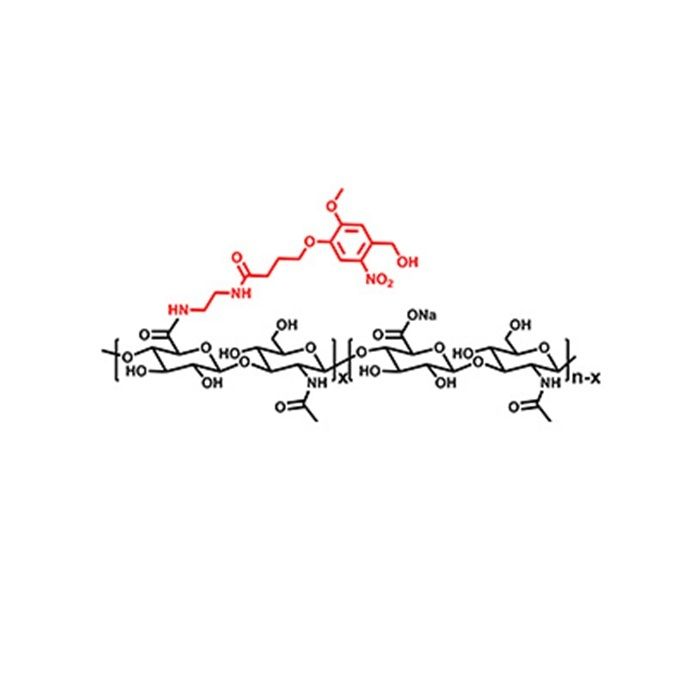
HANB is a photosensitive polymer material obtained by modifying sodium hyaluronate with o‑nitrobenzyl alcohol (NB). Under light irradiation at 365–405 nm, NB undergoes photolysis to produce aldehyde groups that can react with amino groups, thereby enabling covalent conjugation of HANB with amino‑containing substances (e.g., proteins, peptides, drugs, bioactive factors) as well as seamless integration and adhesion to tissues.In addition, when used in combination with photosensitive polymers containing double bonds, the photolysis products of NB can participate in free‑radical polymerization to form hydrogels with excellent mechanical strength.
Product Specification
| Component | Appearance | Specification | Remarks |
| HANB | Pale yellow to yellow powder or granules | 1 g/vial, 5 g/vial | Store in the dark. |
Recommended Use
1. HANB can be used in combination with amino‑containing polymers such as polylysine, chitosan, carboxymethyl chitosan, and gelatin, and crosslinks to form a gel under light irradiation at 365-405 nm.
2. HANB can be used with methacrylate‑modified polymers (including CMCMA, GelMA, HAMA, CSMA, ChMA, CMChMA) and allyl‑modified polymers such as F127DA, and polymerized under photoinitiator and light exposure to construct hydrogel materials with diverse physicochemical properties.
Preparation Method
1. When used with double‑bond‑containing polymers and photoinitiators, the recommended photoinitiator dosage is:
Low substitution degree HANB (1.5%-2.0%): 30 mg (LAP/NAP) per 1 g HANB;
Medium substitution degree HANB (3.0%-4.0%): 54 mg (LAP/NAP) per 1 g HANB.
2. Preparation of photoinitiator stock solution (if applicable): Dissolve an appropriate amount of NAP or LAP to the desired concentration; store at 2-8 °C protected from light.
3. Weigh the required amount of HANB into a centrifuge tube, then add the corresponding volume of initiator stock solution or mixture. If clumps form, crush gently with a spatula first.
4. Stir the mixture at room temperature in the dark or shake on an orbital shaker until completely dissolved.
Precautions
1. Higher substitution degree of HANB and higher solution concentration lead to stronger tissue adhesion, but also higher light blocking and longer required irradiation time.
HANB with substitution degree 1.5%-2.5%: recommended concentration ≤ 10 wt%;
HANB with substitution degree 3.0%-4.0%: recommended concentration ≤ 5 wt%.
2. Higher molecular weight of HANB results in higher solution viscosity.
HANB with molecular weight 890 kDa: recommended concentration ≤ 3 wt%;
HANB with molecular weight 340 kDa: recommended concentration ≤ 5 wt%.
Applications
3D chondrocyte culture, hemostatic materials, bone defect repair, drug loading, tissue engineering, regenerative medicine, protein immobilization, bioprinting, postoperative anti‑adhesion, etc.
Sterilization Methods
1. Filter sterilization (recommended): Sterilize the solution using a 0.22 μm sterile syringe filter. Only suitable for low‑viscosity solutions. For high‑viscosity solutions, use pasteurization or autoclaving.
2. Pasteurization: Heat the solution to 80 °C for 30 min, then rapidly cool to room temperature in an ice‑water bath. Repeat the cycle three times.
3. Moist heat sterilization (autoclaving): Sterilize in an autoclave at 121 °C for 8 min. After manual venting, cool rapidly to room temperature in an ice‑water bath. Note that high temperature may reduce gel performance; strictly follow the above procedure.
Note: Sterile solutions: store at 2-8 °C protected from light, use within 7 days; Non‑sterile solutions: store at 2-8 °C protected from light, use within 48 hours.
Product Features
1. In situ formation of high‑strength hydrogelsThe aldehyde groups generated by HANB photolysis react with amino groups on polymer backbones to form a gel network.
2. Tissue adhesion and integrationAldehyde groups from HANB photolysis react with amino groups on tissue surfaces at the application site, achieving covalent bonding between the gel and tissue.
3. Immobilization of bioactive substancesAldehyde groups from HANB photolysis conjugate with amino groups on bioactive molecules, enabling controllable immobilization within the hydrogel.
Typical Applications
Benefiting from the above advantages, HANB hydrogel systems have been used by researchers worldwide in cardiac hemostasis, bone/cartilage repair, wound treatment, 3D cell culture, etc., with numerous landmark achievements.
1. Puncture hemostasis: Second-scale curing, high‑strength, high‑adhesion photocrosslinkable hydrogel for hemostasis of cardiac punctures.
2. Bone repair: Rapid preparation of high‑strength cell‑laden microgels via microfluidics for bone defect repair.
3. Cartilage repair: Second-scale curing, high‑strength, high‑adhesion photocrosslinkable hydrogel for arthroscopic cartilage repair.
4. Wound treatment: Fast-curing, high‑adhesion photocrosslinkable hydrogel for defective wound repair.
5. Cell culture: Regulation of bioactive molecule immobilization in 3D hydrogels to construct a favorable cellular microenvironment.
Product Advantages
1. Batch-to-batch consistencyStandardized manufacturing ensures high repeatability and controllability in composition, physicochemical properties, and biological performance across batches.
2. Ultra-high purityUnique purification process effectively removes residual NB monomers and process impurities, achieving an ultra-low impurity profile and ensuring safety in biomedical applications.
3. Reliable safetyHANB is the first commercially available product of its kind to have completed biocompatibility evaluation by a third-party institution, supporting safe and non-toxic use and accelerating lab-to-clinic translation.
4. High stabilityIn accordance with the Guidelines for Stability Studies of Non‑Active Implantable Medical Devices, real-time and accelerated stability tests confirm that HANB remains stable under labeled storage conditions.



 ZJ26F0434426