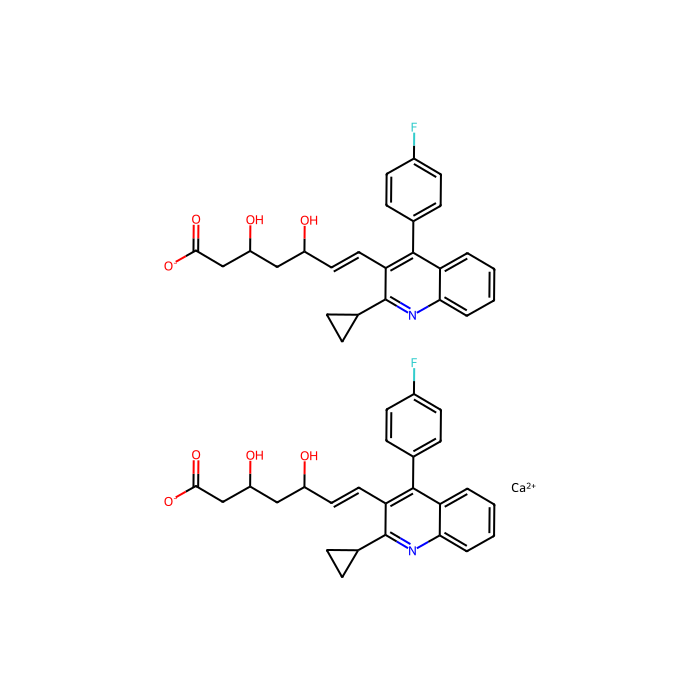
Determine the necessary mass, volume, or concentration for preparing a solution.
| Activity Type | Relation | Activity value | Units | Action Type | Journal | PubMed Id | doi | Assay Aladdin ID |
|---|

Pitavastatin Calcium is a competitive inhibitor of the enzyme HMGCR (HMG-CoA reductase) results in a reduction in LDL cholesterol synthesis. Alternate studies show that pitavastatin can suppress oxygen production in endothelial cells by inhibiting NADPH oxidase. In addition, pitavastatin reduces the expression of eNOS mRNA while increasing the NO dependent response stimulated by acetylcholine and the calcium ionophore, A23187. Furthermore, pitavastatin inhibits the up-regulation of conductance calcium-activated potassium channels by lowering cholesterol levels in cells.
A competitive inhibitor of HMG-CoA reductase
Taxonomy Tree
| Kingdom | Organic compounds |
|---|---|
| Superclass | Organoheterocyclic compounds |
| Klasse | Quinolines and derivatives |
| Subclass | Phenylquinolines |
| Intermediate Tree Nodes | Not available |
| Direct Parent | Phenylquinolines |
| Alternative Parents | Phenylpyridines Medium-chain hydroxy acids and derivatives Medium-chain fatty acids Beta hydroxy acids and derivatives Fluorobenzenes Halogenated fatty acids Heterocyclic fatty acids Hydroxy fatty acids Aryl fluorides Unsaturated fatty acids Heteroaromatic compounds Secondary alcohols Carboxylic acid salts Organic calcium salts Organic metal halides Azacyclic compounds Carboxylic acids Monocarboxylic acids and derivatives Hydrocarbon derivatives Carbonyl compounds Organopnictogen compounds Organic oxides Organic zwitterions Organofluorides Organonitrogen compounds |
| Molecular Framework | Not available |
| Substituents | Phenylquinoline - 4-phenylpyridine - Medium-chain hydroxy acid - Medium-chain fatty acid - Beta-hydroxy acid - Fluorobenzene - Halobenzene - Halogenated fatty acid - Heterocyclic fatty acid - Hydroxy fatty acid - Aryl fluoride - Aryl halide - Monocyclic benzene moiety - Hydroxy acid - Pyridine - Unsaturated fatty acid - Fatty acyl - Benzenoid - Fatty acid - Heteroaromatic compound - Carboxylic acid salt - Secondary alcohol - Carboxylic acid derivative - Azacycle - Monocarboxylic acid or derivatives - Carboxylic acid - Organic calcium salt - Organic metal halide - Organooxygen compound - Organic oxide - Organopnictogen compound - Organic oxygen compound - Hydrocarbon derivative - Organohalogen compound - Alcohol - Organofluoride - Organic nitrogen compound - Carbonyl group - Organic zwitterion - Organonitrogen compound - Organic salt - Aromatic heteropolycyclic compound |
| Beschreibung | This compound belongs to the class of organic compounds known as phenylquinolines. These are heterocyclic compounds containing a quinoline moiety substituted with a phenyl group. |
| External Descriptors | calcium salt - statin (synthetic) |
| Activity Type | Relation | Activity value | Units | Action Type | Journal | PubMed Id | doi | Assay Aladdin ID |
|---|
| Activity Type | Relation | Activity value | Units | Action Type | Journal | PubMed Id | doi | Assay Aladdin ID |
|---|
| Activity Type | Relation | Activity value | Units | Action Type | Journal | PubMed Id | doi | Assay Aladdin ID |
|---|
| Activity Type | Relation | Activity value | Units | Action Type | Journal | PubMed Id | doi | Assay Aladdin ID |
|---|
| Activity Type | Relation | Activity value | Units | Action Type | Journal | PubMed Id | doi | Assay Aladdin ID |
|---|
| Activity Type | Relation | Activity value | Units | Action Type | Journal | PubMed Id | doi | Assay Aladdin ID |
|---|
| Activity Type | Relation | Activity value | Units | Action Type | Journal | PubMed Id | doi | Assay Aladdin ID |
|---|
| Activity Type | Relation | Activity value | Units | Action Type | Journal | PubMed Id | doi | Assay Aladdin ID |
|---|
| Activity Type | Relation | Activity value | Units | Action Type | Journal | PubMed Id | doi | Assay Aladdin ID |
|---|
| Activity Type | Relation | Activity value | Units | Action Type | Journal | PubMed Id | doi | Assay Aladdin ID |
|---|
| Activity Type | Relation | Activity value | Units | Action Type | Journal | PubMed Id | doi | Assay Aladdin ID |
|---|
| Activity Type | Relation | Activity value | Units | Action Type | Journal | PubMed Id | doi | Assay Aladdin ID |
|---|
| Activity Type | Relation | Activity value | Units | Action Type | Journal | PubMed Id | doi | Assay Aladdin ID |
|---|
| Activity Type | Relation | Activity value | Units | Action Type | Journal | PubMed Id | doi | Assay Aladdin ID |
|---|
| Activity Type | Relation | Activity value | Units | Action Type | Journal | PubMed Id | doi | Assay Aladdin ID |
|---|
Find and download the COA for your product by matching the lot number on the packaging.
| Lot Number | Certificate Type | Datum | Artikel |
|---|---|---|---|
 D2301867 | Certificate of Analysis | Sep 22, 2026 | P129617 |
| D2301876 | Certificate of Analysis | Sep 22, 2026 | P129617 |
| D2301878 | Certificate of Analysis | Sep 22, 2026 | P129617 |
| D2301885 | Certificate of Analysis | Sep 22, 2026 | P129617 |
| J1417061 | Certificate of Analysis | Nov 06, 2025 | P129617 |
| K2329081 | Certificate of Analysis | Sep 08, 2025 | P129617 |
| K2329082 | Certificate of Analysis | Sep 08, 2025 | P129617 |
| K2329083 | Certificate of Analysis | Sep 08, 2025 | P129617 |
| D2301868 | Certificate of Analysis | Mar 10, 2025 | P129617 |
| D2301873 | Certificate of Analysis | Mar 10, 2025 | P129617 |
| D2301877 | Certificate of Analysis | Mar 10, 2025 | P129617 |
| G1918124 | Certificate of Analysis | Feb 09, 2023 | P129617 |
| Löslichkeit | DMSO 51 mg/mL Water <1 mg/mL Ethanol <1 mg/mL |
|---|---|
| Molekulargewicht | 881.000 g/mol |
| XLogP3 | |
| Hydrogen Bond Donor Count | 4 |
| Hydrogen Bond Acceptor Count | 12 |
| Rotatable Bond Count | 14 |
| Exact Mass | 880.285 Da |
| Monoisotopic Mass | 880.285 Da |
| Topological Polar Surface Area | 187.000 Ų |
| Heavy Atom Count | 63 |
| Formal Charge | 0 |
| Complexity | 626.000 |
| Isotope Atom Count | 0 |
| Defined Atom Stereocenter Count | 4 |
| Undefined Atom Stereocenter Count | 0 |
| Defined Bond Stereocenter Count | 2 |
| Undefined Bond Stereocenter Count | 0 |
| The total count of all stereochemical bonds | 2 |
| Covalently-Bonded Unit Count | 3 |
No vendor-validated protocols are provided for this item. The following are general, non-binding examples for research use only.
Example 1: Preparation of 10 mM DMSO stock
Example 2: LC–MS/MS calibration standards
Example 3: Cell-based assay dosing
Notes
General mechanistic context (literature; no medical/clinical claims):
Research implications:
Note: Biological roles and mechanisms are provided for research context only. This product is for research use only and is not intended for diagnostic or therapeutic use.
This product is not a buffering agent and is not typically used to set or maintain pH in laboratory buffers.
Practical handling in buffers (general guidance):
While Pitavastatin Calcium itself is the research target compound (not a solvent/reagent), greener choices can be made for its handling and analysis.
Greener solvent choices for solution prep (general):
Analytical method considerations:
Small comparison (general guidance):
Operational practices:
No clinical or therapeutic claims are made for this research product.
Research/formulation-related contexts (general, literature-informed):
Regulatory/compendial status: Specific pharmacopeial monographs, if any, are not provided here; consult relevant pharmacopeias and vendor CoA/Spec Sheet for compendial compliance information.
Note: For research use only; not for human or veterinary use, clinical administration, or compounding.
Item-specific specifications (this lot):
Literature/general values and qualitative behavior (for guidance only):
Practical notes (general): If preparing aqueous solutions, adjust pH slightly basic or use a cosolvent (e.g., DMSO→buffer dilution) to mitigate precipitation of the calcium salt.
Interpretive guidance (general):
Documentation: Retain batch-specific CoA and SDS with your experimental records to support method validation or screening provenance.
This product is a finished small-molecule research compound rather than a synthetic reagent. Accordingly, its primary laboratory uses are analytical and biological assay–oriented rather than as a building block.
Research applications (general, literature-informed):
Practical tips:
This product is not typically used as a reagent or substrate in synthetic reactions; therefore, canonical reaction conditions (catalysts, temperatures, yields) are not applicable.
Conditioning for analytical/biological use (general guidance):
All numeric parameters above are general literature/experience-based guidance; optimize for your specific assay and instrumentation.
Authoritative safety data are provided in the product SDS; always consult the SDS before use. The following are general laboratory handling practices for small-molecule research compounds of this class.
For research use only; not for human or animal use.
Solubility behavior for Pitavastatin Calcium is primarily governed by its ionic calcium–dicarboxylate/diol complex and lipophilic aromatic core.
Item-specific directions:
General handling and reconstitution guidance (research use):
For research use only; not for human or animal use.
Brief overview: Pitavastatin Calcium is the calcium salt of a dihydroxyheptenoic acid statin scaffold, supplied for research use only.
Structural features (general chemistry knowledge):
2D structure in words (general description): a fused bicyclic aromatic nitrogen heteroaromatic ring bearing a lipophilic aryl substituent is connected via a spacer to an alkenyl chain terminating in a dihydroxy carboxylate moiety, present here as a calcium salt.
Pitavastatin Calcium is a finished active small molecule, not a typical synthetic building block. Its synthetic utility in the bench chemistry sense is limited; however, it can be useful in certain study types.
If a reactive handle is required for conjugation or probe synthesis, chemists typically use protected/lactone forms or advanced intermediates rather than the calcium salt to maintain control over the diol/carboxylate chemistry. For transformations of the statin core (e.g., cross-couplings on the aryl/heteroaryl moieties), appropriately protected precursors are recommended.
Item-specific antibody/biomolecule targeting details are not applicable to this small-molecule product.
Note: Any potency/selectivity figures should be established under your own assay conditions or sourced from peer-reviewed literature; they are not provided as specifications for this product.