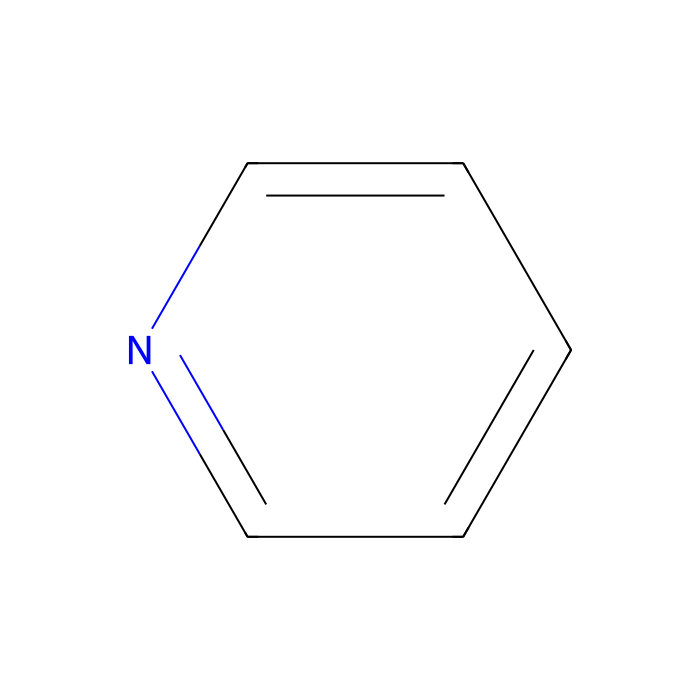
Pyridine - Standard for GC, ≥99.9%(GC) , CAS No.110-86-1

CAS: 110-86-1 Cat. No.: P111510 Summenformel: C5H5N Molekulargewicht: 79.1 Beilstein Registry Number: 103233 EG-Nummer: 203-809-9
Zu bestellen verfügbar
GRADE & PURITY Standard for GC ? GC reference standard — characterized compound for calibrating GC methods. Use to build calibration curves and verify GC quantitation. ≥99.9%(GC)
Synonyms
4-pyridine | A802257 | CEFTAZIDIME IMPURITY F [EP IMPURITY] | HSDB 118 | Piridina [Italian] | Pyridine, SAJ first grade, >=99.0% | Pyridine, spectrophotometric grade, >=99% | 2-pyridine | NCIOpen2_007866 | NCIOpen2_007986 | Pesticide Code: 069202 | Pyridi
Storage
Protected from light,Room temperature
Shipped In
FedEx DG Service
★
Size
Deutschland (EU)
USA*
Price
Qty
5ml
P111510-5ml
—
3 Auf Lager
17,27€
Enter a quantity for the sizes you want to add.
🧪
Why this grade

Standard for GC, ≥99.9%(GC) Standard for GC for sensitive chromatographic and analytical workflows requiring minimal baseline interference.

🌡

Storage & shipping

Protected from light,Room temperature Ships FedEx DG Service Check lot-specific COA for exact specifications.

📋

Quality documents

SDS, COA, datasheet, and spec sheet available for download. Lot-specific COA accessible via lot number lookup.

📚

Literature proof

Cited in 533 peer-reviewed publications across chromatography, organic synthesis, and cross-coupling reactions.

Specifications

Synonyme
4-pyridine | A802257 | CEFTAZIDIME IMPURITY F [EP IMPURITY] | HSDB 118 | Piridina [Italian] | Pyridine, SAJ first grade, >=99.0% | Pyridine, spectrophotometric grade, >=99% | 2-pyridine | NCIOpen2_007866 | NCIOpen2_007986 | Pesticide Code: 069202 | Pyridi
Spezifikationen & Reinheit
Standard for GC, ≥99.9%(GC)
Storage
Protected from light,Room temperature
Verschickt in
FedEx DG Service
Note
Standard for GC
Reinheit
≥99.9%(GC)
Namen und Kennungen
Pubchem Sid
Pubchem Sid Url
https://pubchem.ncbi.nlm.nih.gov/substance/508812914
Kanonisches Lächeln
C1=CC=NC=C1
IUPAC Name
pyridine
InChIKey
JUJWROOIHBZHMG-UHFFFAOYSA-N
INCHI
1S/C5H5N/c1-2-4-6-5-3-1/h1-5H
Isomere SMILES
C1=CC=NC=C1
WGK Deutschland
2
RTECS
UR8400000
UN-Nummer
1282
Verpackungsgruppe
II
Molekulargewicht
79.1
Beilstein
103233
Reaxy-Rn
103233
Reaxys-RN_link_address
https://www.reaxys.com/reaxys/secured/hopinto.do?context=S&query=IDE.XRN=103233&ln=

Documentation

📋 Safety Data Sheet (SDS)

Comprehensive hazard, handling, storage, and regulatory compliance document.

Download SDS →

✅ Certificate of Analysis (COA)

Lot-specific quality data. Enter your lot number to retrieve the exact COA.

Look up COA →

📊 Datasheet

Quick-reference summary of product specifications and applications.

View datasheet →

🔬 Specification Sheet

Full quality attributes and acceptance criteria for this grade.

View spec sheet →

Advanced Data

Taxonomic Classification

Taxonomy Tree

KingdomOrganic compounds
SuperclassOrganoheterocyclic compounds
KlassePyridines and derivatives
SubclassNot available
Intermediate Tree Nodes Not available
Direct ParentPyridines and derivatives
Alternative Parents Heteroaromatic compounds  Azacyclic compounds  Organopnictogen compounds  Organonitrogen compounds  Hydrocarbon derivatives  
Molecular FrameworkAromatic heteromonocyclic compounds
Substituents Pyridine - Heteroaromatic compound - Azacycle - Organic nitrogen compound - Organopnictogen compound - Hydrocarbon derivative - Organonitrogen compound - Aromatic heteromonocyclic compound
BeschreibungThis compound belongs to the class of organic compounds known as pyridines and derivatives. These are compounds containing a pyridine ring, which is a six-member aromatic heterocycle which consists of one nitrogen atom and five carbon atoms.
External Descriptors a ring
3D-Struktur
Interaktives chemisches Strukturmodell


Zugehörige Ziele (menschlich)
NAPRT Tchem Nicotinate phosphoribosyltransferase (2 Activities)
Activity TypeActivity Value -log(M)Mechanism of ActionActivity ReferencePublications (PubMed IDs)
TSHR Tclin Thyroid stimulating hormone receptor (29986 Activities)
Activity TypeRelationActivity valueUnitsAction TypeJournalPubMed IddoiAssay Aladdin ID
TBXAS1 Tchem Thromboxane-A synthase (3355 Activities)
Activity TypeRelationActivity valueUnitsAction TypeJournalPubMed IddoiAssay Aladdin ID
CYP3A4 Tclin Cytochrome P450 3A4 (53859 Activities)
Activity TypeRelationActivity valueUnitsAction TypeJournalPubMed IddoiAssay Aladdin ID
TDP1 Tchem Tyrosyl-DNA phosphodiesterase 1 (345557 Activities)
Activity TypeRelationActivity valueUnitsAction TypeJournalPubMed IddoiAssay Aladdin ID
NAPRT Tchem Nicotinate phosphoribosyltransferase (37 Activities)
Activity TypeRelationActivity valueUnitsAction TypeJournalPubMed IddoiAssay Aladdin ID
Zugehörige Ziele (nicht menschlich)
Lithobates pipiens (29 Activities)
Activity TypeRelationActivity valueUnitsAction TypeJournalPubMed IddoiAssay Aladdin ID
Rattus norvegicus (775804 Activities)
Activity TypeRelationActivity valueUnitsAction TypeJournalPubMed IddoiAssay Aladdin ID
E Lysozyme (95 Activities)
Activity TypeRelationActivity valueUnitsAction TypeJournalPubMed IddoiAssay Aladdin ID
lef Anthrax lethal factor (7585 Activities)
Activity TypeRelationActivity valueUnitsAction TypeJournalPubMed IddoiAssay Aladdin ID
Chrna3 Neuronal acetylcholine receptor (756 Activities)
Activity TypeRelationActivity valueUnitsAction TypeJournalPubMed IddoiAssay Aladdin ID
Wirkungsmechanismen
Zertifikate (CoA, COO, BSE/TSE und Analyse-Diagramm)
C of A & Other Certificates(BSE/TSE, COO):
Analytical Chart:

Find and download the COA for your product by matching the lot number on the packaging.

6 results found

Lot NumberCertificate TypeDatumArtikel
I2624588Certificate of AnalysisSep 18, 2026 P111510
H2504353Certificate of AnalysisJul 08, 2025 P111510
J2109069Certificate of AnalysisApr 08, 2025 P111510
L2202366Certificate of AnalysisNov 22, 2022 P111510
K2223723Certificate of AnalysisNov 10, 2022 P111510
B2217197Certificate of AnalysisFeb 07, 2022 P111510
Chemische und physikalische Eigenschaften
LöslichkeitSoluble in most organic solvents such as water, alcohol and ether.
EmpfindlichkeitLight sensitive.
Brechungsindex1.5092
Flammpunkt (°F)68.0 °F - closed cup
Flammpunkt (°C)20 °C - closed cup
Siedepunkt (°C)115°C
Schmelzpunkt (°C)-42°C
Molekulargewicht79.100 g/mol
XLogP30.700
Hydrogen Bond Donor Count0
Hydrogen Bond Acceptor Count1
Rotatable Bond Count0
Exact Mass79.0422 Da
Monoisotopic Mass79.0422 Da
Topological Polar Surface Area12.900 Ų
Heavy Atom Count6
Formal Charge0
Complexity30.900
Isotope Atom Count0
Defined Atom Stereocenter Count0
Undefined Atom Stereocenter Count0
Defined Bond Stereocenter Count0
Undefined Bond Stereocenter Count0
The total count of all stereochemical bonds0
Covalently-Bonded Unit Count1
FAQs und Artikel
How to Choose the Correct Reference Material Quality Grade?
Standard for GC: A Practical Guide
Late-Stage Fluorination Toolbox: “Minimally Invasive Upgrades” for Lead Candidates: Four “Fluorine Knobs” → Two major routes (electrophilic vs nucleophilic) → An ¹⁸F-PET tracer branch → Selection navigation & representative product list
From Piperidine to Pyridine: The “Most Common N-Heterocycle” Shift in FDA Small-Molecule New Drugs (2013–2023) and a Selection Guide (Tables 1–4)
Plant Omics Panorama: Workflow Frameworks and Multi-Omics Integration from Genomics to Transcriptomics, Proteomics, and Metabolomics
Pyridine Research Selection Roadmap: Structural Features, Reaction Logic, and a Classification Navigator for Reagents/Building Blocks/Reference Standards (Tables 1–6)
Review of the Principles, Common Methods, and Key Application Considerations for the Determination of Glycerol and Triglyceride Contents
Revisiting Titanium Tetrachloride: New Advances in the Direct Amidation and Esterification of Carboxylic Acids
Reconsidering N-Acyl Amino Protecting Groups: Deprotection Differences, Strategic Roles, and Experimental Selection of Ac, Bz, and Tfa
Phthaloyl: Its Role in Primary Amine Protection and Practical Considerations for Experimental Selection
Selective Deprotection and Sulfonyl Group Migration of N-Aryl Sulfonamides Mediated by TfOH (Trifluoromethanesulfonic Acid): Reaction Patterns and Synthetic Implications
The Positioning of TBTU in Practice: Racemization Risk, Extended Uses, and Selection Criteria
The Methodological Value of DSC: Building NHS-Type Activated Intermediates and Deciding When to Use Them
The Methodological Value of TPS-Cl: The Logic of Selective Activation and Representative Transformations in Nucleoside and Nucleotide Chemistry
The Methodological Value of TCFH: Advantages in Challenging Amidation and the Switching Logic of Carboxylic Acid Activation Pathways
Decision Logic for Selecting Coupling Reagents in Amide Bond Formation: Activation Pathways, Side Reactions, Epimerization, Workup, and Safety
Experimental Selection Logic for Carboxylic Acid Preactivation Pathways: Differences and Suitable Use Cases for Classical Mixed Anhydrides, CDI, Sulfonyl Chloride Systems, and the Yamaguchi System
Triphenylphosphine Dibromide (PPh₃Br₂) Is More Than Just a Brominating Reagent: Experimental Selection Logic from Alcohol-to-Alkyl Bromide Conversion to Carboxylic Acid Activation and One-Pot Esterification, Vinyl Bromide Formation, and Nitrile Constructi
Selection Logic for the Teoc Amino Protecting Group: From Fluoride-Triggered Deprotection to Orthogonal Protecting-Group Design
Boc₂O Selection Cannot Be Judged by Protection Installation Alone: Experimental Decision-Making from Substrate Nucleophilicity and Medium Effects to Deprotection Pathways
DMAP Is More Than Just an Organic Base: Experimental Judgment from Nucleophilic Acyl Transfer to Esterification and Macrolactonization
Experimental Selection Logic for Pentafluorophenyl-Based Systems: Practical Judgment from Active Esters and Pre-Activated Monomers to Downstream Transformations
Experimental Evaluation of Triphosgene in Organic Synthesis: Understanding Its Selection Logic Through Reaction Tasks
Coupling Activators, Nucleoside Building Blocks, and Modification Design in Oligonucleotide Chemical Synthesis: Their Effects on Synthetic Efficiency, Purity, and Product Properties
Principles, Method Selection, and Result Interpretation for Malondialdehyde Content Detection
Why Is the meta-Fluoropyridine Motif Difficult to Make? Understanding the Synthetic Logic of Stable Enamine Building Blocks from the Risks of the Balz–Schiemann Reaction
From Nitroarenes to Pharmaceutically Relevant Pyridines: A Photochemically Induced Aryl Nitrene-Mediated Skeletal Editing Strategy
Dual Role of NH₄SCN and CN Transfer: From Electrochemical Oxidation of SCN⁻ to the Construction of 1-Cyanoimidazo[1,5-a]pyridines
Direct Construction of Methylsulfonyl-Containing Heterocycles: Synthesis and Applications of Prefunctionalized Three-Carbon Vinamidinium Salts
From 459,000 Recorded Ring Systems to 3,902 Candidate Ring Systems: Selection Patterns of Clinically Relevant Ring Systems
Structural Elucidation of Unknown Flavonoid O-Glycosides—Molecular Formula, Aglycone and Sugar Composition, Linkage Positions, and Anomeric Configurations
How to Evaluate Reaction Generality through Substrate Scope: From the Number of Examples to Standardized Substrate Selection
MTAD-Mediated Oxidative Dearomatization of Pyridines: Transient para-Cycloaddition, Alkene Oxidation, and Heteroatom Functionalization
Citations of This Product
Lösungsrechner
Bewertungen

Kundenbewertungen

Shall we send you a message when we have discounts available?

Remind me later

Thank you! Please check your email inbox to confirm.

Oops! Notifications are disabled.