Determine the necessary mass, volume, or concentration for preparing a solution.
| Activity Type | Activity Value -log(M) | Mechanism of Action | Activity Reference | Publications (PubMed IDs) |
|---|

Hygroscopic. Forms an azeotropic mixture with three water molecules and can volatilize with water vapor. Mixes with water, ethanol, ether, petroleum ether, oils, and most other organic solvents. Weakly alkaline. Soluble in water at 0.2 mol/L with a pH of 8.5. Used as a solvent in organic synthesis. For the qualitative and quantitative determination of antimony, arsenic, aluminum, bismuth, cadmium, cerium, chlorates, chromates, cyanides, chromium, cobalt, copper, cyanides, gold, dichromates, halogens, lanthanum, lead, lithium, manganese, mercury, germanium, nickel, perchlorates, persulfates, platinum, phosphorus, rhenium, praseodymium, silicon, silver, sulfur, thallium, tellurium, thiocyanates, thorium, thiosulfates, titanium, uranium, vanadium, zinc, and zirconium. For moisture determination, mutagen for microorganisms. Solvent for acylation reactions. Catalyst.
Taxonomy Tree
| Kingdom | Organic compounds |
|---|---|
| Superclass | Organoheterocyclic compounds |
| Klasse | Pyridines and derivatives |
| Subclass | Not available |
| Intermediate Tree Nodes | Not available |
| Direct Parent | Pyridines and derivatives |
| Alternative Parents | Heteroaromatic compounds Azacyclic compounds Organopnictogen compounds Organonitrogen compounds Hydrocarbon derivatives |
| Molecular Framework | Aromatic heteromonocyclic compounds |
| Substituents | Pyridine - Heteroaromatic compound - Azacycle - Organic nitrogen compound - Organopnictogen compound - Hydrocarbon derivative - Organonitrogen compound - Aromatic heteromonocyclic compound |
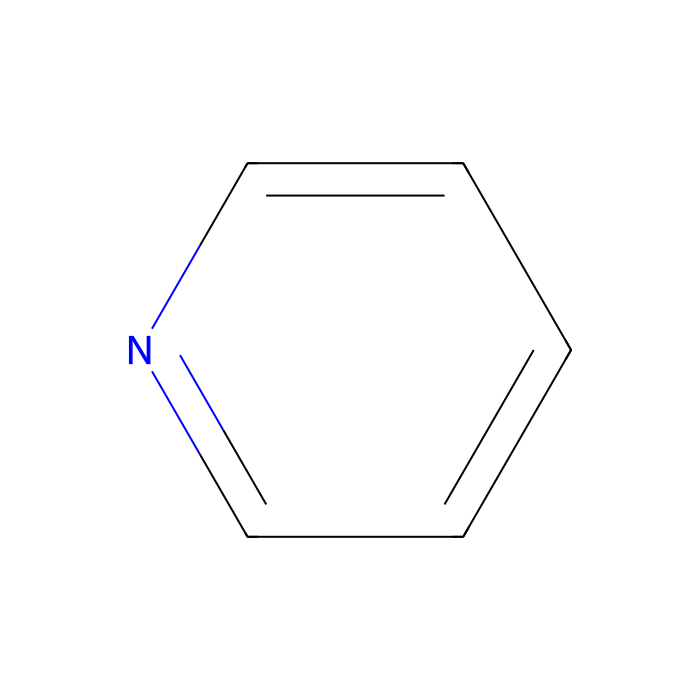
| Beschreibung | This compound belongs to the class of organic compounds known as pyridines and derivatives. These are compounds containing a pyridine ring, which is a six-member aromatic heterocycle which consists of one nitrogen atom and five carbon atoms. |
| External Descriptors | a ring |
| Activity Type | Activity Value -log(M) | Mechanism of Action | Activity Reference | Publications (PubMed IDs) |
|---|
| Activity Type | Relation | Activity value | Units | Action Type | Journal | PubMed Id | doi | Assay Aladdin ID |
|---|
| Activity Type | Relation | Activity value | Units | Action Type | Journal | PubMed Id | doi | Assay Aladdin ID |
|---|
| Activity Type | Relation | Activity value | Units | Action Type | Journal | PubMed Id | doi | Assay Aladdin ID |
|---|
| Activity Type | Relation | Activity value | Units | Action Type | Journal | PubMed Id | doi | Assay Aladdin ID |
|---|
| Activity Type | Relation | Activity value | Units | Action Type | Journal | PubMed Id | doi | Assay Aladdin ID |
|---|
| Activity Type | Relation | Activity value | Units | Action Type | Journal | PubMed Id | doi | Assay Aladdin ID |
|---|
| Activity Type | Relation | Activity value | Units | Action Type | Journal | PubMed Id | doi | Assay Aladdin ID |
|---|
| Activity Type | Relation | Activity value | Units | Action Type | Journal | PubMed Id | doi | Assay Aladdin ID |
|---|
| Activity Type | Relation | Activity value | Units | Action Type | Journal | PubMed Id | doi | Assay Aladdin ID |
|---|
| Activity Type | Relation | Activity value | Units | Action Type | Journal | PubMed Id | doi | Assay Aladdin ID |
|---|
Find and download the COA for your product by matching the lot number on the packaging.
| Lot Number | Certificate Type | Datum | Artikel |
|---|---|---|---|
 K2604865 | Certificate of Analysis | Oct 24, 2026 | P141169 |
| K2604862 | Certificate of Analysis | Oct 24, 2026 | P141169 |
| E2608590 | Certificate of Analysis | Apr 23, 2026 | P141169 |
| E2608592 | Certificate of Analysis | Apr 23, 2026 | P141169 |
| E2608591 | Certificate of Analysis | Apr 23, 2026 | P141169 |
| B2606107 | Certificate of Analysis | Jan 28, 2026 | P141169 |
| B2606111 | Certificate of Analysis | Jan 28, 2026 | P141169 |
| D2623715 | Certificate of Analysis | Jan 28, 2026 | P141169 |
| B2606103 | Certificate of Analysis | Jan 28, 2026 | P141169 |
| J2523785 | Certificate of Analysis | Oct 13, 2025 | P141169 |
| J2523761 | Certificate of Analysis | Oct 13, 2025 | P141169 |
| J2523354 | Certificate of Analysis | Oct 13, 2025 | P141169 |
| H2505547 | Certificate of Analysis | Aug 01, 2025 | P141169 |
| H2505378 | Certificate of Analysis | Aug 01, 2025 | P141169 |
| H2505548 | Certificate of Analysis | Aug 01, 2025 | P141169 |
| G2515101 | Certificate of Analysis | Jul 22, 2025 | P141169 |
| G2530624 | Certificate of Analysis | Jul 21, 2025 | P141169 |
| G2516084 | Certificate of Analysis | Jul 17, 2025 | P141169 |
| G2516086 | Certificate of Analysis | Jul 17, 2025 | P141169 |
| G2507053 | Certificate of Analysis | Jul 08, 2025 | P141169 |
| L2409537 | Certificate of Analysis | Nov 27, 2024 | P141169 |
| L2409536 | Certificate of Analysis | Nov 27, 2024 | P141169 |
| H2428338 | Certificate of Analysis | Aug 15, 2024 | P141169 |
| H2428361 | Certificate of Analysis | Aug 15, 2024 | P141169 |
| H2428362 | Certificate of Analysis | Aug 15, 2024 | P141169 |
| G2409085 | Certificate of Analysis | Apr 11, 2024 | P141169 |
| D2422382 | Certificate of Analysis | Apr 11, 2024 | P141169 |
| D2422384 | Certificate of Analysis | Apr 11, 2024 | P141169 |
| D2422385 | Certificate of Analysis | Apr 11, 2024 | P141169 |
| D2422383 | Certificate of Analysis | Apr 11, 2024 | P141169 |
| C2419489 | Certificate of Analysis | Mar 11, 2024 | P141169 |
| C2419490 | Certificate of Analysis | Mar 11, 2024 | P141169 |
| C2419491 | Certificate of Analysis | Mar 11, 2024 | P141169 |
| K2321270 | Certificate of Analysis | Nov 08, 2023 | P141169 |
| K2321269 | Certificate of Analysis | Nov 08, 2023 | P141169 |
| K2321268 | Certificate of Analysis | Nov 08, 2023 | P141169 |
| K2307221 | Certificate of Analysis | Oct 27, 2023 | P141169 |
| K2307227 | Certificate of Analysis | Oct 27, 2023 | P141169 |
| K2307214 | Certificate of Analysis | Oct 27, 2023 | P141169 |
| I2226227 | Certificate of Analysis | Sep 30, 2022 | P141169 |
| I2208466 | Certificate of Analysis | Sep 13, 2022 | P141169 |
| F2209151 | Certificate of Analysis | Jun 11, 2022 | P141169 |
| D2215052 | Certificate of Analysis | Apr 19, 2022 | P141169 |
| D2215055 | Certificate of Analysis | Apr 19, 2022 | P141169 |
| D2215059 | Certificate of Analysis | Apr 18, 2022 | P141169 |
| Löslichkeit | Soluble in Water |
|---|---|
| Empfindlichkeit | Light & Moisture sensitive |
| Brechungsindex | 1.5092 |
| Flammpunkt (°F) | 68.0 °F - closed cup |
| Flammpunkt (°C) | 20 °C - closed cup |
| Siedepunkt (°C) | 115°C |
| Schmelzpunkt (°C) | -42°C |
| Molekulargewicht | 79.1 |
| XLogP3 | 0.700 |
| Hydrogen Bond Donor Count | 0 |
| Hydrogen Bond Acceptor Count | 1 |
| Rotatable Bond Count | 0 |
| Exact Mass | 79.0422 Da |
| Monoisotopic Mass | 79.0422 Da |
| Topological Polar Surface Area | 12.900 Ų |
| Heavy Atom Count | 6 |
| Formal Charge | 0 |
| Complexity | 30.900 |
| Isotope Atom Count | 0 |
| Defined Atom Stereocenter Count | 0 |
| Undefined Atom Stereocenter Count | 0 |
| Defined Bond Stereocenter Count | 0 |
| Undefined Bond Stereocenter Count | 0 |
| The total count of all stereochemical bonds | 0 |
| Covalently-Bonded Unit Count | 1 |
H225:Highly Flammable liquid and vapor
H315:Causes skin irritation
H319:Causes serious eye irritation
H402:Harmful to aquatic life
H302+H312+H332:Harmful if swallowed, in contact with skin or if inhaled
P210:Keep away from heat, hot surface, sparks, open flames and other ignition sources. - No smoking.
P233:Keep container tightly closed.
P240:Ground/bond container and receiving equipment.
P241:Use explosion-proof [electrical/ventilating/lighting/.../] equipment.
P242:Use only non-sparking tools.
P243:Take precautionary measures against static discharge.
P261:Avoid breathing dust/fume/gas/mist/vapors/spray.
P264:Wash hands [and …] thoroughly after handling.
P270:Do not eat, drink or smoke when using this product.
P271:Use only outdoors or in a well-ventilated area.
P273:Avoid release to the environment.
P280:Wear protective gloves/protective clothing/eye protection/face protection.
P303+P361+P353:IF ON SKIN (or hair): Take off Immediately all contaminated clothing. Rinse SKIN with water [or shower].
P305+P351+P338:IF IN EYES: Rinse cautiously with water for several minutes. Remove contact lenses if present and easy to do - continue rinsing.
P332+P313:IF SKIN irritation occurs: Get medical advice/attention.
P337+P313:IF eye irritation persists: Get medical advice/attention.
P370+P378:In case of fire: Use ... to extinguish.
P403+P235:Store in a well-ventilated place. Keep cool.
P501:Dispose of contents/container to an approved waste disposal plant.
P301+P312+P330:IF SWALLOWED: Call a POISON CENTER/ doctor if you feel unwell. Rinse mouth.
P304+P340+P312:IF INHALED: Remove person to fresh air and keep comfortable for breathing.Call a POISON CENTER or doctor. if you feel unwell.
Unser Leitfaden zur Qualitätsauswahl behandelt Reinheit, Stabilisatorstatus und Anwendungseignung für alle Varianten in unserem Katalog.
UltraPureChrom™ Qualitätsleitfaden ansehen → for HPLC Qualitätsleitfaden ansehen →