GRADE & PURITYCarrier Free?Carrier-free — supplied without added carrier protein/stabilizer. Use when carriers (e.g. BSA) would interfere with conjugation or sensitive assays.His Tag?His tag grade — recombinant protein bearing a His tag for affinity purification/detection. Use to purify, immobilize, or detect the tagged protein.≥95%(SDS-PAGE)See COA
Carrier Free,His-Tag,≥95%(SDS-PAGE),See COA Carrier Free,His Tag for sensitive chromatographic and analytical workflows requiring minimal baseline interference.
🌡
Storage & shipping
Store at -20°C,Avoid repeated freezing and thawing Ships Ice chest + Ice pads Check lot-specific COA for exact specifications.
📋
Quality documents
SDS, COA, datasheet, and spec sheet available for download. Lot-specific COA accessible via lot number lookup.
📚
Literature proof
Cited in 0 peer-reviewed publications across chromatography, organic synthesis, and cross-coupling reactions.
Specifications
Product Name
Recombinant Human RIPK3 Protein
Synonyms
Receptor interacting protein 3 | Receptor interacting serine threonine kinase 3 | Receptor interacting serine/threonine protein kinase 3 | Receptor-interacting protein 3 | Receptor-interacting serine/threonine-protein kinase 3 | RIP 3 | RIP like protein k
Grade
Carrier Free, His Tag
Specifications & Purity
Carrier Free, His-Tag, ≥95%(SDS-PAGE), See COA
Biochemical and Physiological Mechanisms
Necroptosis is a form of programmed necrotic cell death that is rapidly emerging as an important pathophysiological pathway in numerous disease states. Necroptosis is dependent on receptor-interacting protein kinase 3 (RIPK3), a protein shown to play an i
Store at -20°C,Avoid repeated freezing and thawing
Shipped In
Ice chest + Ice pads
Stability And Storage
Store at -20℃ long term (12 months). Upon receipt, it is recommended to aliquot. Avoid freeze/thaw cycle.
Images
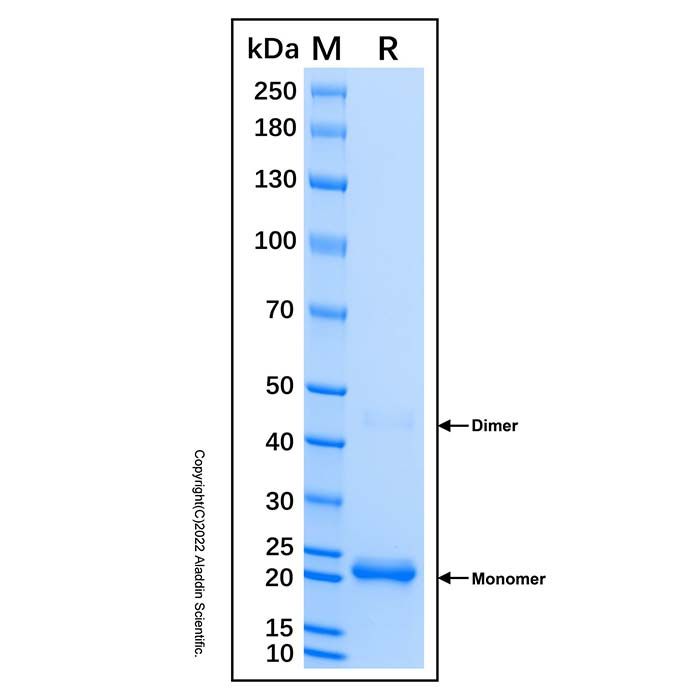
Recombinant Human RIPK3 Protein (rp186577) - SDS-PAGE 3 μg/lane of Recombinant Human RIPK3 Protein was resolved with SDS-PAGE under reducing (R) and visualized by Coomassie® Blue staining, showing a band at 20.5 & 45.0 kDa. The observation of RIPK3 Protein as both dimers and monomers under reducing (R) conditions suggests that a portion of the protein forms dimers. This dimerization may be mediated by (or stabilized by) disulfide bonds (Uniprot: Q9Y572).
Documentation
📋 Safety Data Sheet (SDS)
Comprehensive hazard, handling, storage, and regulatory compliance document.
We use cookies to ensure the website functions properly and, where permitted, to improve your experience. You can manage your preferences at any time in Settings. Learn more in our Cookie Policy.
Shall we send you a message when we have discounts available?
Remind me later
Thank you! Please check your email inbox to confirm.
Products are supplied to verified businesses, institutions, and qualified professionals for research and development use only. Not for use in humans, animals, diagnosis, or therapy.