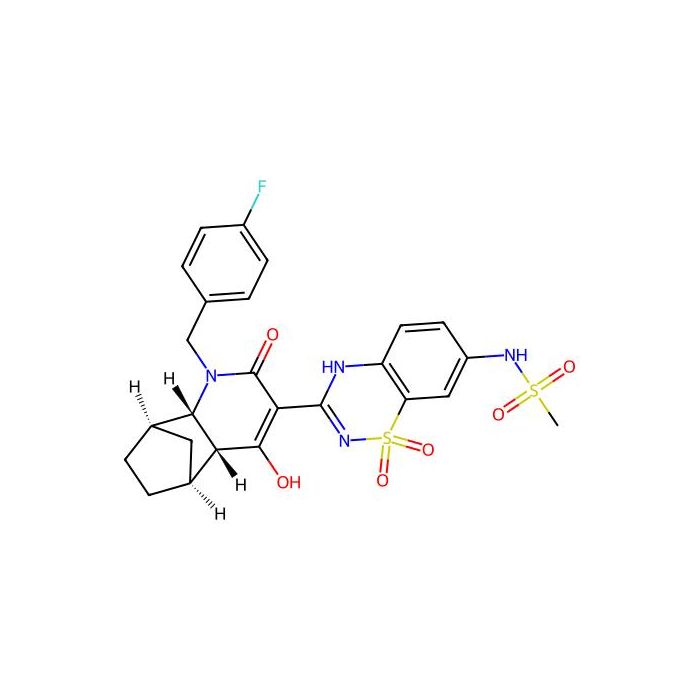
This compound belongs to the class of organic compounds known as 1,2,4-benzothiadiazine-1,1-dioxides. These are aromatic heterocyclic compounds containing a 1,2,4-benzothiadiazine ring system with two S=O bonds at the 1-position.
External Descriptors
Not available
1. Djoumbou Feunang Y, Eisner R, Knox C, Chepelev L, Hastings J, Owen G, Fahy E, Steinbeck C, Subramanian S, Bolton E, Greiner R, and Wishart DS. ClassyFire: Automated Chemical Classification With A Comprehensive, Computable Taxonomy. Journal of Cheminformatics, 2016, 8:61.
Zertifikate (CoA, COO, BSE/TSE und Analyse-Diagramm)
C of A & Other Certificates(BSE/TSE, COO):
Analytical Chart:
Chemische und physikalische Eigenschaften
Molekulargewicht
560.600 g/mol
XLogP3
1.700
Hydrogen Bond Donor Count
3
Hydrogen Bond Acceptor Count
9
Rotatable Bond Count
5
Exact Mass
560.12 Da
Monoisotopic Mass
560.12 Da
Topological Polar Surface Area
162.000 Ų
Heavy Atom Count
38
Formal Charge
0
Complexity
1270.000
Isotope Atom Count
0
Defined Atom Stereocenter Count
4
Undefined Atom Stereocenter Count
0
Defined Bond Stereocenter Count
0
Undefined Bond Stereocenter Count
0
The total count of all stereochemical bonds
0
Covalently-Bonded Unit Count
1
Lösungsrechner
Molarity Calculator
Determine the necessary mass, volume, or concentration for preparing a solution.
Dilution Calculator
Determine the dilution needed to prepare a stock solution.
Reconstitution Calculator
Bewertungen
Kundenbewertungen
Application Protocols
Product Data: No tested or recommended protocols are provided for this item.
General guidance (non-validated, for planning only):
Prepare a sterile-filtered DMSO stock (e.g., 10–20 mM), aliquot, and store at −20°C protected from light.
For biochemical assays, titrate into assay buffer to a final DMSO content consistent across wells (commonly ≤0.1–1% v/v). Include appropriate positive/negative controls.
Validate concentration by analytical means (e.g., LC–MS with external calibration) prior to critical studies.
Note: The above are generic planning notes and do not constitute item-specific, validated protocols.
Biological Roles
Literature context (no clinical claims):
Setrobuvir has been reported in the scientific literature as a non-nucleoside inhibitor (NNI) of the hepatitis C virus NS5B RNA-dependent RNA polymerase, acting at an allosteric site to modulate polymerase activity in biochemical assays. Such NNIs are used as tool compounds for elucidating viral polymerase mechanisms, binding dynamics, and resistance mutations in vitro.
Research utility:
Serves as a benchmark inhibitor in enzymology experiments to calibrate assay windows, explore time-dependence and reversibility, and assess cofactor/metal ion effects on polymerase activity.
Facilitates structure–activity relationship (SAR) analyses across NNI chemotypes and supports investigation of cross-resistance patterns among NS5B variants in recombinant systems.
Systems biology and cheminformatics (general):
Inclusion in curated datasets enables comparison of physicochemical property space, ligand efficiency metrics, and predicted ADME profiles of NS5B inhibitors.
Note: The Product Data do not provide biological activity specifications. The above describes general, literature-reported biochemical roles for Setrobuvir as a research tool compound. This product is for research use only and is not intended for human or veterinary applications.
Buffer Applications
Applicability:
Setrobuvir is not a buffering agent and is not used to establish or maintain pH. Therefore, classical buffer recipes (e.g., phosphate, HEPES, Tris) are not directly applicable to this compound.
Practical guidance for assay buffers (general):
When introducing Setrobuvir from DMSO stocks into aqueous assay buffers (e.g., HEPES, Tris, or phosphate at pH 7–8 for polymerase assays), maintain consistent final DMSO across control and treated samples (commonly ≤0.1–1% v/v).
Include suitable detergent (e.g., 0.01–0.05% Tween-20) only if necessary to prevent nonspecific adsorption; verify it does not affect the enzymatic readout.
Filter buffers (0.2 µm) and equilibrate to the assay temperature to minimize drift.
Note: No item-specific buffer compatibility is provided in the Product Data; optimize empirically for your assay system.
Green Alternatives
Context:
Setrobuvir is a specialty research compound rather than a process solvent or commodity reagent; “green alternatives” pertain mainly to the choice of handling solvents and formulation vehicles.
Greener handling considerations (general):
Prefer ethanol or water/ethanol cosolvent systems over DMF/NMP where chemical stability allows.
For analytics, acetonitrile (readily recoverable by distillation) may be preferred to DMF for LC sample prep.
Minimize DMSO concentration in aqueous assays consistent with performance to reduce solvent load and facilitate waste handling.
Use microscale preparations and pre-aliquoting to limit freeze–thaw waste.
Example comparison (general guidance):
DMSO vs Ethanol for stock preparation:
DMSO: excellent solubilizer, fully miscible with water; higher environmental burden, difficult to remove.
Ethanol: renewable, lower toxicity; may offer lower solubility for highly lipophilic molecules and can precipitate on aqueous dilution.
Waste minimization:
Segregate halogenated and non-halogenated organic waste streams.
Employ closed-vial dilution and on-instrument dilution to reduce solvent consumption.
Note: No item-specific solvent mandate is provided; select greener options compatible with the compound’s stability and assay requirements.
Pharmaceutical Uses
Status and scope:
This product is supplied strictly for research use only. It is not intended for use in humans or animals, and it is not a drug substance or excipient offering for clinical or manufacturing use.
Typical research-related uses (non-clinical):
Reference standard for analytical method development (e.g., LC–MS quantitation) in discovery settings.
Tool compound in preclinical formulation screening (solubility enhancement strategies, cosolvent systems, and stability assessments under various pH/oxidative conditions).
Control article in in vitro ADME/Tox assays (e.g., metabolic stability, plasma protein binding), where permitted under institutional guidelines.
Documentation:
For any regulated, non-clinical use (e.g., GLP), obtain and archive the lot-specific CoA and any available supporting analytical data (purity, identity, residual solvents, water content). If pharmacopeial monographs do not exist for this compound, internal specifications should be established and justified.
Physical Properties
Item-specific physical properties (Product Data):
Appearance: Not specified for this item; refer to CoA/Spec Sheet.
Molecular weight: Not specified for this item; refer to CoA/Spec Sheet.
Molecular formula: Not specified for this item; refer to CoA/Spec Sheet.
Melting point / Boiling point / Density / Refractive index / pKa / logP / UV-Vis cutoff: Not specified for this item; refer to CoA/Spec Sheet.
Solubility: Not specified for this item; refer to CoA/Spec Sheet.
Setrobuvir is commonly handled in research settings as a hydrophobic small molecule. Stock solutions are typically prepared in DMSO at mM concentrations for biochemical assays, then diluted into aqueous buffers maintaining ≤0.1–1% DMSO, depending on assay tolerance (literature/generic practice).
Aqueous solubility of such NNIs is usually low; co-solvents (DMSO, DMF) or cosurfactants may be employed for kinetic and binding studies (literature/generic practice). Light sensitivity and slow oxidative degradation are general risks for polyaromatic drug-like molecules; protect from light and air as prudent practice unless the CoA specifies otherwise.
Notes:
Do not treat the above as specifications. For exact, validated values and acceptance criteria, use the CoA/Specification Sheet supplied with the lot.
Quality and Grades
Item-specific grade/purity (from Product Data):
Grade/Purity: Not specified for this item; refer to CoA/Spec Sheet.
Guidance on interpreting grade (general):
When provided, a research-grade small molecule typically includes identity confirmation (e.g., NMR/HRMS and/or HPLC purity). Some lots may include residual solvent limits, water content (e.g., Karl Fischer), and assay/purity by HPLC or LC–MS. In the absence of a stated grade, rely on the CoA for the definitive acceptance criteria and purity profile.
Stabilizers and form:
No stabilizer is listed in the Product Data. If a stabilizer or salt form is present, it should be declared on the label/CoA; this can affect solubility, assay response, and storage.
Recommended verification on receipt (good practice):
Record lot/batch, check HPLC chromatogram and purity, confirm identity by MS or 1H NMR if critical to your workflow, and document storage initiation at the recommended temperature.
Suitability:
For analytical method development, bioassay controls, and medicinal chemistry SAR work, confirm the lot’s purity, counterion (if any), residual solvent levels, and water content per your internal specifications.
Reaction and Applications
Applicability to synthetic reactions:
Setrobuvir is supplied as a finished small molecule for research use, not primarily as a synthetic reagent or catalyst. It is not typically employed as a solvent or coupling partner in standard organic reactions.
Research applications (general/literature context):
Employed as a reference compound in biochemical assays probing the activity of hepatitis C virus (HCV) RNA-dependent RNA polymerase (NS5B), including enzyme kinetics and inhibitor benchmarking.
Used in resistance profiling, structure–activity relationship (SAR) comparisons, and as a control in screening cascades for non-nucleoside NS5B inhibitor chemotypes.
Analytical method development: serves as a system suitability standard for LC–MS assay validation (e.g., retention behavior, fragmentation patterns) in discovery workflows.
Practical considerations:
Prepare accurately quantified DMSO stocks using volumetric or gravimetric methods; verify concentration by UV (if chromophore known) or LC–MS against a calibration curve.
Maintain consistent final DMSO percentages across control and test wells in enzyme assays to avoid solvent-induced artifacts.
Note: No item-specific reactivity or application notes are provided in the Product Data; the above represents general, literature-informed usage of this compound class.
Reaction Conditions
Not a general reagent:
Setrobuvir is not commonly used as a reagent or catalyst; therefore, there are no standard “reaction conditions” associated with its use.
If preparing analogs or tagged derivatives (general guidance):
Solvents: dry polar aprotics (e.g., DMF, DMSO, NMP) are frequently used for coupling and substitution steps; less polar solvents (DCM, THF, toluene) may be suitable depending on the functional groups.
Temperatures: 0–80°C typical for solution-phase couplings; avoid conditions that risk scaffold degradation (strong acids/bases, prolonged high heat) until stability is established.
Bases/coupling agents: DIPEA, TEA, or inorganic bases; carbodiimides (EDC/HOBt), uronium reagents (HATU/HBTU) for amide couplings when appropriate to the scaffold.
Workup/purification: silica gel chromatography with gradient elution (DCM/MeOH or heptane/EtOAc systems) or preparative HPLC for highly polar/lipophilic species.
Note: These are generic, literature-informed practices for small-molecule derivatization. They are not item-specific specifications.
Safety and Handling
GHS information (from Product Data):
Signal Word: Not specified for this item; refer to SDS.
Hazard Statements (H-codes): Not specified for this item; refer to SDS.
GHS Classification/Pictograms: Not specified for this item; refer to SDS.
General laboratory precautions (best practice):
Handle in a fume hood with standard PPE: lab coat, safety glasses, and appropriate chemically resistant gloves (e.g., nitrile). Avoid inhalation of dusts/aerosols and contact with skin or eyes. Wash thoroughly after handling.
Avoid generating dust; use antistatic measures if weighing fine powders. Protect from prolonged exposure to light and ambient humidity unless otherwise indicated.
Incompatibilities (general):
Avoid strong oxidizers and strong acids/bases unless compatibility is known. Use dry, oxygen-limited conditions for long-term storage and preparation of concentrated stock solutions when feasible.
First-aid overview (consult SDS for full guidance):
Eye/skin contact: Rinse with water for at least 15 minutes; remove contaminated clothing. Seek medical attention as needed.
Inhalation: Move to fresh air. If symptoms persist, seek medical attention.
Ingestion: Rinse mouth; do not induce vomiting unless directed by medical personnel. Seek medical attention.
Regulatory note: For research use only. Not for human or veterinary use. Always defer to the product’s SDS for authoritative safety information.
Solvent Selection
Compound class context (general):
Setrobuvir is a lipophilic, heteroatom-containing small molecule. Such compounds are commonly managed via concentrated stock solutions in DMSO for biochemical and cell-free assays.
Primary: anhydrous DMSO (typical 10–50 mM stocks).
Secondary: DMF or NMP where DMSO is incompatible.
Volatile co-solvents for rapid drying or formulation screening: acetonitrile, methanol, or ethanol (subject to compound stability).
Aqueous systems: use co-solvent approaches and evaluate assay tolerance to DMSO (commonly ≤0.1–1% v/v final).
Polarity/miscibility considerations (general):
DMSO, DMF, and NMP are highly polar, aprotic, and fully miscible with water, enabling controlled titration into aqueous buffers without precipitation if kept within solubility limits.
When to choose alternatives:
If minimizing DMSO is essential, consider ethanol or PEG-400 cosolvent systems for formulation research. For analytical sample prep, acetonitrile often improves LC–MS compatibility and peak shape.
Practical tips:
Filter stock solutions (0.2 µm PTFE) if particulate is observed.
Document the exact solvent lot and water content; hygroscopic uptake can alter apparent solubility and assay performance.
Note: Item-specific solubility and solvent compatibility are not specified; verify experimentally or consult the CoA.
General reconstitution guidance (for hydrophobic small molecules; not item-specific specs):
Allow vial to equilibrate to room temperature in a desiccated environment before opening to minimize condensation.
Prepare concentrated stock solutions in anhydrous DMSO under inert atmosphere if feasible. Typical working stocks: 10–50 mM, depending on solubility.
Vortex and, if needed, sonicate briefly to ensure complete dissolution. If particulates persist, warm gently (≤40°C) and/or filter through 0.2 µm PTFE.
Aliquot stocks into single-use portions to avoid repeated freeze–thaw cycles. Store aliquots at −20°C (or per your validated stability data) protected from light.
Record preparation date, solvent, and concentration on each aliquot; periodically re-check concentration/purity by LC–MS or HPLC.
Stability notes:
Item-specific stability data are not provided. As a precaution, minimize exposure to moisture, air, and light; avoid prolonged storage at room temperature. For long-term studies, establish stability-indicating assays.
Water solubility and buffer use:
If aqueous working solutions are required, dilute DMSO stock into buffer with vigorous mixing to the desired final concentration, ensuring the final DMSO content remains within assay tolerance.
Structure and Identity
Item-specific identifiers (from Product Data):
Product Name: Setrobuvir
CAS: 1071517-39-9
PubChem CID: 135565932
InChIKey: 61286 (as provided)
SMILES: Not specified for this item; refer to CoA/Spec Sheet.
Molecular formula: Not specified for this item; refer to CoA/Spec Sheet.
Molecular weight: Not specified for this item; refer to CoA/Spec Sheet.
Structural description (general/literature):
Setrobuvir (also known in literature as ANA-598) is reported as a small-molecule, non-nucleoside inhibitor (NNI) of the HCV RNA-dependent RNA polymerase (NS5B). It is a heteroatom-rich, polyaromatic compound designed for allosteric binding to NS5B. Detailed atom-level structure, stereochemistry, and ring system annotations should be confirmed from primary literature or structural databases.
2D structure in words (general guidance):
The literature describes a multi-ring aromatic framework incorporating heteroatoms (e.g., N, O, and/or S) consistent with drug-like, lipophilic NNIs. Multiple aromatic rings and polar functional groups confer a balance of hydrophobic binding and solubility modulation. Exact functional group identities and stereochemical elements must be verified in authenticated references.
Note: Where item-specific fields are not provided in the Product Data, consult the Certificate of Analysis (CoA) or official specification sheet for definitive identity attributes.
Synthetic Utility
General note:
Setrobuvir is typically utilized as a finished tool compound rather than as a synthetic building block. As such, it has limited direct application as a reagent or intermediate in routine synthesis.
Medicinal chemistry context (general):
Derivatives and analogs can be explored for SAR studies around the core scaffold reported in the literature for NS5B inhibition. Typical medicinal chemistry modifications may include ring substitutions, heteroatom variation, and bioisosteric replacements to probe binding and physicochemical properties.
Analytical/synthetic support:
If derivatization is pursued for probe development (e.g., biotinylated or fluorescent conjugates), standard coupling tactics (amide formation, carbamate/urea installation) may be considered, contingent on available functional handles in the scaffold described in primary literature. Reaction conditions and protecting-group strategies must be tailored to the exact structure and functionality present.
Note: No item-specific functional group or synthetic handle information is provided in the Product Data. Consult structural literature and perform feasibility studies before attempting modifications.
Target Specificity
Product Data: No target specificity information is provided for this item.
Therefore, target name, binding site/epitope, species selectivity, and kinetic parameters are not specified for this item; refer to CoA/Spec Sheet or primary literature if needed for your research context.
Häufig gestellte Fragen
How should this product be stored?
Store at ?20 °C. Freezer storage is required to maintain the specified shelf life.
How is this product shipped?
This product ships in an insulated container with ice pads. Unpack on arrival and transfer it to the storage condition stated above.
What are the CAS number, molecular formula and molecular weight?
The CAS Number is 1071517-39-9. InChIKey DEKOYVOWOVJMPM-RLHIPHHXSA-N.
What documentation is provided?
Available product documentation, including Certificates of Analysis (COA), Safety Data Sheets (SDS), and specification sheets, is shown in the product document area. Document availability and access follow the current site policy.
Wir verwenden Cookies, um die ordnungsgemäße Funktion der Website sicherzustellen und, soweit zulässig, Ihr Nutzererlebnis zu verbessern. Sie können Ihre Einstellungen jederzeit unter „Einstellungen“ verwalten. Weitere Informationen finden Sie in unserer Cookie-Richtlinie.
Shall we send you a message when we have discounts available?
Remind me later
Thank you! Please check your email inbox to confirm.
Products are supplied to verified businesses, institutions, and qualified professionals for research and development use only. Not for use in humans, animals, diagnosis, or therapy.