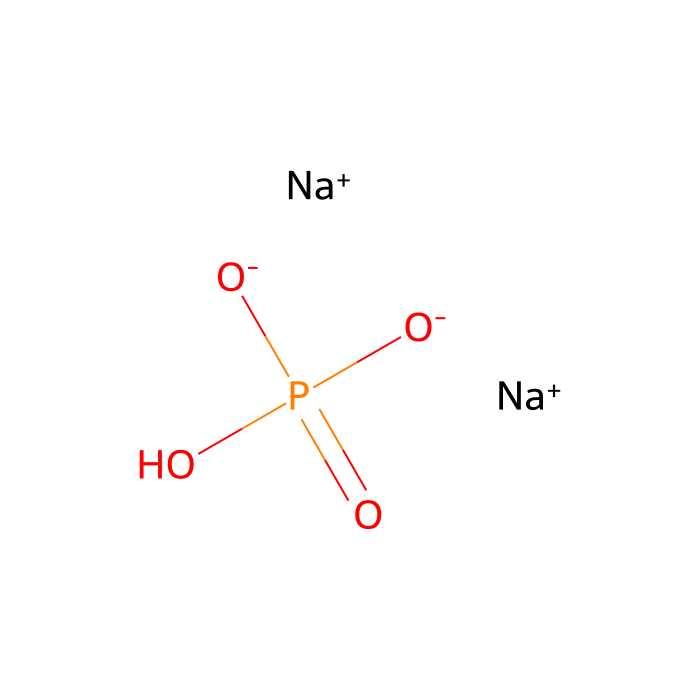
Sodium phosphate dibasic - ≥98% , CAS No.7558-79-4

CAS: 7558-79-4 Cat. No.: S498529 Summenformel: Na2HPO4 Molekulargewicht: 141.96 EG-Nummer: 231-448-7
Zu bestellen verfügbar
QUALITÄT & REINHEIT ≥98%
Synonyms
Disodium hydrogen orthophosphate|Disodium phosphoric acid|OSMOPREP COMPONENT SODIUM PHOSPHATE, DIBASIC ANHYDROUS|Sodium phosphate, dibasic|Disodium Hydrogen Phosphate Submicron|Fleet enema|Disodium hydrophosphate|Sodium phosphate, dibasic (anhydrous)|SODIUM PHOSPHATE DIBASIC [WHO-DD]|SODIUM PHOSPHATE, DIBASIC, ANHYDROUS [II]|Dibasic sodium phosphate anhydrous|Disodium hydrogen phosphate, anhydrous|disodium hydrogenphosphate|disodium hydrogen-phosphate|Disodium phospahte|DISODIUM PHOSPHATE [HSDB]|Sodium phosphate (NaHPO4)|Acetest|Disodiumhydrogenphosphate|Soda phosphate|Disodium hydrogen orthophosphate;Sodium hydrogen phosphate|Sodium hydrogenphosphate|sodium hydrogen-phosphate|Disodium hydrogenorthophosphate|Disodium monohydrogen phosphate|DISODIUM PHOSPHATE [EP MONOGRAPH]|SODIUM PHOSPHATE, DIBASIC, ANHYDROUS|Sodium phosphate,dibasic,anhydrous|Sodiumphosphatedibasic|INS NO.339(II)|Disodium acid orthophosphate|Sodium phosphate dibasic, Trace metals grade|Sodium phosphate, exsiccated|Water Supply QC Check Sample: o-Phosphate Nutrients|DSP|SODIUM PHOSPHATE,DIBASIC,ANHYDROUS [VANDF]|VISICOL COMPONENT SODIUM PHOSPHATE, DIBASIC ANHYDROUS|Disodium hydrogen phosphate|di-sodium hydrogen phosphate|Disodium phosphate anhydrous|sodium hydrogen orthophosphate|INS-339(II)|Sodium acid phosphate, anhydrous|Sodium monohydrogen phosphate (2:1:1)|Sodium phosphate dibasic, biochemical grade|SODIUM PHOSPHATE, DIBASIC, ANHYDROUS [ORANGE BOOK]|SODIUM PHOSPHATE, DIBASIC [MI]|Disodium orthophosphate|Natriumphosphat [German]|secondary Sodium phosphate|sec-Sodium phosphate|Sodium phosphate dibasic|phosphoric acid, disodium salt, anhydrous|DISODIUM PHOSPHATE|DISODIUM PHOSPHATE [INCI]|Phosphoric acid, disodium salt|Disodium acid phosphate|Phosphoric acid, sodium salt (1:2)|Sodium hydrogen phosphate, anhydrous|SODIUM PHOSPHATE, DIBASIC ANHYDROUS|Phosphate of soda|Sodium hydrogen phosphate|disodium;hydrogen phosphate|Exsiccated sodium phosphate|Sodium Phosphate dibasic anhydrous|Disodium hydrogen monophosphate|Hydrogen disodium phosphate|phosphoric acid disodium salt|SODIUM PHOSPHATE [FHFI]|FEMA Number 2398|Sodium monohydrogen phosphate
Storage
Room temperature
Shipped In
Normal
★
Größe
Deutschland (EU)
USA*
Preis
Menge
500g
S498529-500g
1 Auf Lager
—
10,33€
Enter a quantity for the sizes you want to add.

Spezifikationen

Synonyme
Disodium hydrogen orthophosphate | Disodium phosphoric acid | OSMOPREP COMPONENT SODIUM PHOSPHATE, DIBASIC ANHYDROUS | Sodium phosphate, dibasic | Disodium Hydrogen Phosphate Submicron | Fleet enema | Disodium hydrophosphate | Sodium phosphate, dibasic (anhydrous) | SODIUM PHOSPHATE DIBASIC [WHO-DD] | SODIUM PHOSPHATE, DIBASIC, ANHYDROUS Show more
Spezifikationen & Reinheit
≥98%
Storage
Room temperature
Verschickt in
Normal
Reinheit
≥98%
Namen und Kennungen
Pubchem Sid
SMILES
OP(=O)([O-])[O-].[Na+].[Na+]
IUPAC Name
disodium;hydrogen phosphate
InChIKey
BNIILDVGGAEEIG-UHFFFAOYSA-L
InChI
1S/2Na.H3O4P/c;;1-5(2,3)4/h;;(H3,1,2,3,4)/q2*+1;/p-2
Isomere SMILES
OP(=O)([O-])[O-].[Na+].[Na+]
Alternative CAS-Nummer
7778-77-0
Molekulargewicht
141.96
Reaxys
11343459
Reaxys-RN_link_address
https://www.reaxys.com/reaxys/secured/hopinto.do?context=S&query=IDE.XRN=11343459&ln=

Erweiterte Daten

Taxonomic Classification

Taxonomy Tree

KingdomInorganic compounds
SuperclassMixed metal/non-metal compounds
KlasseAlkali metal oxoanionic compounds
SubclassAlkali metal phosphates
Intermediate Tree Nodes Not available
Direct ParentAlkali metal phosphates
Alternative Parents Inorganic sodium salts  Inorganic oxides  
Molecular FrameworkNot available
Substituents Alkali metal phosphate - Inorganic sodium salt - Inorganic oxide - Inorganic salt
BeschreibungThis compound belongs to the class of inorganic compounds known as alkali metal phosphates. These are inorganic compounds in which the largest oxoanion is phosphate, and in which the heaviest atom not in an oxoanion is an alkali metal.
External Descriptors sodium phosphate
3D-Struktur
Interaktives chemisches Strukturmodell


Zertifikate (CoA, COO, BSE/TSE und Analyse-Diagramm)
C of A & Other Certificates(BSE/TSE, COO):
Analytical Chart:

Find and download the COA for your product by matching the lot number on the packaging.

16 results found

Lot NumberCertificate TypeDatumArtikel
F2604741F2604741Certificate of AnalysisJun 06, 2026 S498529
F2604742F2604742Certificate of AnalysisJun 06, 2026 S498529
J2514716J2514716Certificate of AnalysisOct 20, 2025 S498529
J2514717J2514717Certificate of AnalysisOct 20, 2025 S498529
F2513739F2513739Certificate of AnalysisJun 14, 2025 S498529
F2513740F2513740Certificate of AnalysisJun 14, 2025 S498529
K2406141K2406141Certificate of AnalysisNov 08, 2024 S498529
K2406142K2406142Certificate of AnalysisNov 07, 2024 S498529
I2429327I2429327Certificate of AnalysisOct 11, 2024 S498529
I2429328I2429328Certificate of AnalysisOct 11, 2024 S498529
C2321688C2321688Certificate of AnalysisMar 24, 2023 S498529
C2321735C2321735Certificate of AnalysisMar 24, 2023 S498529
D2418088D2418088Certificate of AnalysisMar 24, 2023 S498529
E2428107E2428107Certificate of AnalysisMar 24, 2023 S498529
G2430043G2430043Certificate of AnalysisMar 24, 2023 S498529
L2305164L2305164Certificate of AnalysisMar 24, 2023 S498529
Chemische und physikalische Eigenschaften
EmpfindlichkeitMoisture sensitive.
Molekulargewicht141.96
XLogP3
Hydrogen Bond Donor Count1
Hydrogen Bond Acceptor Count4
Rotatable Bond Count0
Exact Mass141.941 Da
Monoisotopic Mass141.941 Da
Topological Polar Surface Area83.400 Ų
Heavy Atom Count7
Formal Charge0
Complexity46.500
Isotope Atom Count0
Defined Atom Stereocenter Count0
Undefined Atom Stereocenter Count0
Defined Bond Stereocenter Count0
Undefined Bond Stereocenter Count0
The total count of all stereochemical bonds0
Covalently-Bonded Unit Count3
Sicherheit und Gefahren (GHS)
Piktogramm(e)
GHS05,   GHS07
Signal
Danger
Gefahrenhinweise

H302:Harmful if swallowed

H315:Causes skin irritation

H318:Causes serious eye damage

H319:Causes serious eye irritation

H335:May cause respiratory irritation

Sicherheitshinweise

P261:Avoid breathing dust/fume/gas/mist/vapors/spray.

P264:Wash hands [and …] thoroughly after handling.

P273:Avoid release to the environment.

P280:Wear protective gloves/protective clothing/eye protection/face protection.

P281:Use personal protective equipment as required.

P302+P352:IF ON SKIN: wash with plenty of water.

P304+P340:IF INHALED: Remove person to fresh air and keep comfortable for breathing.

P305+P351+P338:IF IN EYES: Rinse cautiously with water for several minutes. Remove contact lenses if present and easy to do - continue rinsing.

Reaxys
11343459
Reaxys-RN_link_address
https://www.reaxys.com/reaxys/secured/hopinto.do?context=S&query=IDE.XRN=11343459&ln=
FAQs und Artikel
Common Types of Buffer Solutions
Differences Between Transformation and Transfection
How to Choose a Hydrogen Evolution (HER) Catalyst: Kinetic Barriers in Water Electrolysis, AWE/PEM/AEM Pathways, and a Materials-Family Roadmap (with a Product Map)
TEMPO-Catalyzed Oxidation Quick Reference (Alcohol Oxidation Focus): Three Regeneration Routes (NaOCl / Cu–O₂ / PIDA) + Selection & Troubleshooting
Installing a Redox Switch on Biomolecules: Principles, Conjugation Essentials, and an Application Guide for ATTO MB2 NHS ester
A Review of Ten Commonly Used Techniques for Detection, Quantification, and Interaction Analysis in Nucleic Acid Research
Selection of Common Research Salts: A Task Map for Alkali Metal Salts & Alkaline Earth Metal Salts (with Product Tables 1–6)
Methodological essentials for mineralization visualization: Alizarin Red S staining vs. Von Kossa silver staining
Recent Advances in Methods for Measuring Starch-Related Indices in Plants and Their Application-Oriented Selection
Phycocyanin: A Review of Sources, Structural Features, Production Processes, Applications, and Claimed Benefits
Amino Acid Oxidases: Oxygen-Dependent Oxidative Deamination Systems and Their Analytical and Applied Uses
Diaphorase: NAD(P)H-Dependent Electron-Transfer Activity and Its Applications in Detection and Research
Glutathione (GSH) Quantification: Method Systems, Experimental Workflows, and Key Quality-Control Considerations
Haptoglobin (Hp): A Key Carrier in the Free Hemoglobin Clearance–Detoxification Axis, with Assays and Applications
Lipase (Triacylglycerol Hydrolase): Interfacial Catalysis, Selectivity Classes, and Assay/Application Systems
Glucose Content Determination: A Systematic Review of Detection Principles, Method Validation, and Research Application Frameworks
Bromelain: Enzymological Properties and Key Points for Food, Pharmaceutical, and Industrial Applications
Chlorophyll: Structural Features, Physicochemical Properties, and Key Points for Research and Industrial Applications
AmpC β-Lactamases (Cephalosporinases): Mechanisms of Production, Diagnostic Pathways, and Research and Clinical Applications
Chitinases: Substrate-Specific Degradation Mechanisms, Enzymatic Properties, and Application Directions
Whey Protein: Composition Profile, Manufacturing Routes, and Key Product-Type Essentials
From Sucrose to Monosaccharides: Key Enzymatic Nodes and Regulatory Logic in Sugar Conversion
Acetyl-Group Metabolic Enzyme Network and In Vitro Enzymology Analysis
Structural Characteristics, Operational Methods, and Separation Applications of Dextran Gels
Selection Strategy for PBS, TBS, PBST, and TBST Washing Systems in IHC
Preparation Methods and Precautions for Silane Coupling Agent Primer Solutions
From Functional Groups to Experimental Decision-Making: Protein Crosslinker Selection and Experimental Essentials
The Chemical Basis of Natural Lacquer Durability: Urushiol Structure, Oxidative Polymerization Film Formation, and Coating Film Properties
Practical Guide to TSA Tyramide Signal Amplification: How to Select Reagents, Optimize the Workflow, and Reduce Background When Detection Signals Are Weak for Low-Abundance Targets
Signal Transduction Mechanism of Graphene Biosensors: From Molecular Recognition to Electrical/Optical Signal Readout and Materials Selection
Comparison of Bilirubin Detection Methods: Application Selection of the Diazo Method, Vanadate Oxidation Method, Bilirubin Oxidase Method, and HPLC
Plant Tissue and Cell Wall Staining Methods: Selection of Light Green, Safranin, Fast Green, and Composite Staining Systems
1,8-Naphthyridine-Based Aldose Reductase Inhibitors: Scaffold Construction, In Vitro Inhibitory Activity, and Directions for Structural Optimization
Citations of This Product
Lösungsrechner
Bewertungen

Kundenbewertungen

Dürfen wir Sie über Rabattaktionen informieren?

Später erinnern

Vielen Dank! Bitte überprüfen Sie Ihren E-Mail-Posteingang, um zu bestätigen.

Hoppla! Benachrichtigungen sind deaktiviert.