Determine the necessary mass, volume, or concentration for preparing a solution.
| Activity Type | Relation | Activity value | Units | Action Type | Journal | PubMed Id | doi | Assay Aladdin ID |
|---|

≥99% for sensitive chromatographic and analytical workflows requiring minimal baseline interference.
Store at -20°C Ships Ice chest + Ice pads Check lot-specific COA for exact specifications.
SDS, COA, datasheet, and spec sheet available for download. Lot-specific COA accessible via lot number lookup.
Cited in 0 peer-reviewed publications across chromatography, organic synthesis, and cross-coupling reactions.
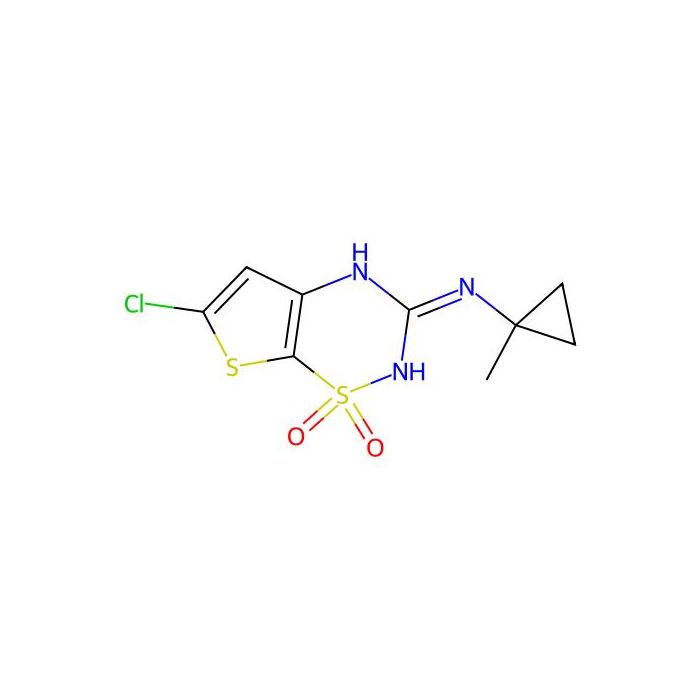
Tifenazoxide (NN414) is a potent, orally active and SUR1/Kir6.2 selective K ATP channels opener. Tifenazoxide has antidiabetic effect, can inhibit glucose stimulated insulin release in vitro and in vivo, and has a beneficial effect on glucose homeostasis
In Vitro
Tifenazoxide (NN414) hyperpolarises βTC3 cell membranes, and inhibits insulin release from βTC6, from isolated rat islets and from human islets at least a 100-fold more potent than Diazoxide. The EC 50 values for Tifenazoxide and diazoxide are 0.45 and 31 µM, respectively in the patch-clamp assay. Tifenazoxide (100 µM) activates Kir6.2/SUR1 channels, but not Kir6.2/SUR2A or Kir6.2/SUR2 channels, expressed in Xenopus oocytes both in whole-cell and inside-out macropatch recordings. Tifenazoxide is a potent inhibitor of glucose stimulated insulin release from βTC6 cells (IC 50 = 0.15 µM). MCE has not independently confirmed the accuracy of these methods. They are for reference only.
In Vivo
Tifenazoxide (NN414; 1.5 mg/kg; oral administration; twice daily; for 3 weeks; male VDF Zucker ( fa/fa ) rat) treatment for 3 weeks in VDF rats reduces basal hyperglycemia, improves glucose tolerance, and reduces hyperinsulinemia during an oral glucose tolerance test (OGTT) and improves insulin secretory responsiveness ex vivo . MCE has not independently confirmed the accuracy of these methods. They are for reference only. Animal Model: Male Vancouver diabetic fatty (VDF) Zucker rat Dosage: 1.5 mg/kg Administration: Oral administration; twice daily; for 3 weeks Result: Basal glucose was significantly reduced with the fall averaging 0.64 mM after 3 weeks of treatment.
Form:Solid
IC50& Target:K ATP channels
Comprehensive hazard, handling, storage, and regulatory compliance document.
Download SDS →Lot-specific quality data. Enter your lot number to retrieve the exact COA.
Look up COA →Full quality attributes and acceptance criteria for this grade.
View spec sheet →Taxonomy Tree
| Kingdom | Organic compounds |
|---|---|
| Superclass | Organoheterocyclic compounds |
| Klasse | Thiophenes |
| Subclass | 2,3,5-trisubstituted thiophenes |
| Intermediate Tree Nodes | Not available |
| Direct Parent | 2,3,5-trisubstituted thiophenes |
| Alternative Parents | Aryl chlorides Organosulfonic acids and derivatives Heteroaromatic compounds Guanidines Azacyclic compounds Organopnictogen compounds Organochlorides Organic oxides Hydrocarbon derivatives |
| Molecular Framework | Aromatic heteropolycyclic compounds |
| Substituents | 2,3,5-trisubstituted thiophene - Aryl chloride - Aryl halide - Organic sulfonic acid or derivatives - Organosulfonic acid or derivatives - Heteroaromatic compound - Guanidine - Azacycle - Organic nitrogen compound - Hydrocarbon derivative - Organic oxide - Organonitrogen compound - Organochloride - Organohalogen compound - Organopnictogen compound - Organic oxygen compound - Aromatic heteropolycyclic compound |
| Beschreibung | This compound belongs to the class of organic compounds known as 2,3,5-trisubstituted thiophenes. These are organic compounds containing a thiophene that is trisubstituted at the C-2, C3- and C5-positions. |
| External Descriptors | Not available |
| Activity Type | Relation | Activity value | Units | Action Type | Journal | PubMed Id | doi | Assay Aladdin ID |
|---|
| Activity Type | Relation | Activity value | Units | Action Type | Journal | PubMed Id | doi | Assay Aladdin ID |
|---|
| Activity Type | Relation | Activity value | Units | Action Type | Journal | PubMed Id | doi | Assay Aladdin ID |
|---|
| Löslichkeit | DMSO : 100 mg/mL (342.72 mM; Need ultrasonic) |
|---|---|
| Molekulargewicht | 291.800 g/mol |
| XLogP3 | 1.900 |
| Hydrogen Bond Donor Count | 2 |
| Hydrogen Bond Acceptor Count | 4 |
| Rotatable Bond Count | 1 |
| Exact Mass | 290.99 Da |
| Monoisotopic Mass | 290.99 Da |
| Topological Polar Surface Area | 107.000 Ų |
| Heavy Atom Count | 17 |
| Formal Charge | 0 |
| Complexity | 469.000 |
| Isotope Atom Count | 0 |
| Defined Atom Stereocenter Count | 0 |
| Undefined Atom Stereocenter Count | 0 |
| Defined Bond Stereocenter Count | 0 |
| Undefined Bond Stereocenter Count | 0 |
| The total count of all stereochemical bonds | 0 |
| Covalently-Bonded Unit Count | 1 |