
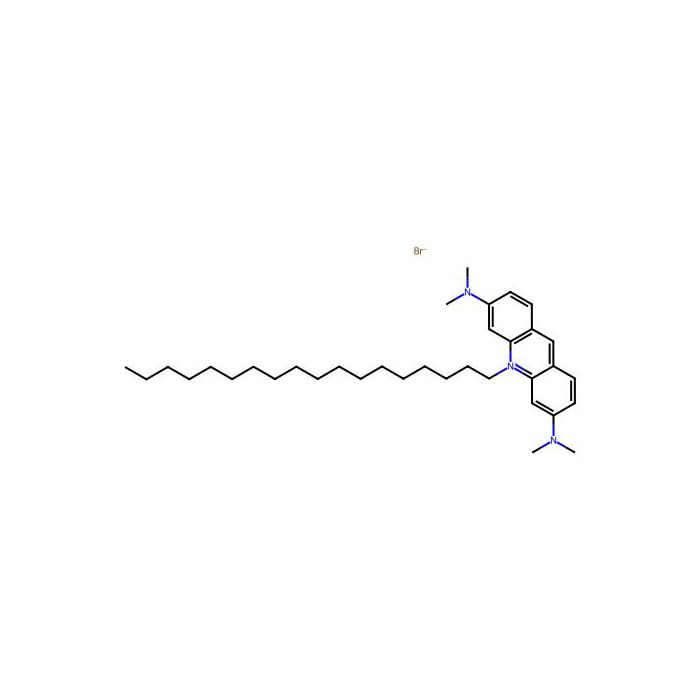
Determine the necessary mass, volume, or concentration for preparing a solution.
10-Octadecylacridine orange bromide , CAS No.75168-16-0
AVAILABLE TO ORDER
Storage
Store at -20°C
Shipped In
Ice chest + Ice pads
for sensitive chromatographic and analytical workflows requiring minimal baseline interference.
Store at -20°C Ships Ice chest + Ice pads Check lot-specific COA for exact specifications.
SDS, COA, datasheet, and spec sheet available for download. Lot-specific COA accessible via lot number lookup.
Cited in 0 peer-reviewed publications across chromatography, organic synthesis, and cross-coupling reactions.
10-Octadecylacridine orange (bromide) is a multifunctional dye. Dyes are important tools in biological experiments. They can help researchers observe and analyze cell structures, track biomolecules, evaluate cell functions, distinguish cell types, detect biomolecules, study tissue pathology and monitor microorganisms. Their applications range from basic scientific research to clinical A wide range of diagnostics. Dyes are also widely used in traditional fields such as textile dyeing, as well as in emerging fields such as functional textile processing, food pigments and dye-sensitized solar cells.
| Canonical Smiles | CCCCCCCCCCCCCCCCCC[N+]1=C2C=C(C=CC2=CC3=C1C=C(C=C3)N(C)C)N(C)C.[Br-] |
|---|---|
| IUPAC Name | 3-N,3-N,6-N,6-N-tetramethyl-10-octadecylacridin-10-ium-3,6-diamine;bromide |
| InChIKey | ZMGWUNXBPDTDHY-UHFFFAOYSA-M |
| INCHI | 1S/C35H56N3.BrH/c1-6-7-8-9-10-11-12-13-14-15-16-17-18-19-20-21-26-38-34-28-32(36(2)3)24-22-30(34)27-31-23-25-33(37(4)5)29-35(31)38;/h22-25,27-29H,6-21,26H2,1-5H3;1H/q+1;/p-1 |
| Isomeric SMILES | CCCCCCCCCCCCCCCCCC[N+]1=C2C=C(C=CC2=CC3=C1C=C(C=C3)N(C)C)N(C)C.[Br-] |
| PubChem CID | 11330854 |
| Molecular Weight | 598.74 |
Comprehensive hazard, handling, storage, and regulatory compliance document.
Download SDS →Lot-specific quality data. Enter your lot number to retrieve the exact COA.
Look up COA →Full quality attributes and acceptance criteria for this grade.
View spec sheet →Taxonomy Tree
| Kingdom | Organic compounds |
|---|---|
| Superclass | Organoheterocyclic compounds |
| Class | Quinolines and derivatives |
| Subclass | Benzoquinolines |
| Intermediate Tree Nodes | Not available |
| Direct Parent | Acridines |
| Alternative Parents | Aminoquinolines and derivatives Dialkylarylamines Pyridinium derivatives Benzenoids Heteroaromatic compounds Azacyclic compounds Organic bromide salts Hydrocarbon derivatives Organic cations |
| Molecular Framework | Aromatic heteropolycyclic compounds |
| Substituents | Acridine - Aminoquinoline - Dialkylarylamine - Tertiary aliphatic/aromatic amine - Pyridine - Pyridinium - Benzenoid - Heteroaromatic compound - Tertiary amine - Azacycle - Organic nitrogen compound - Amine - Organic salt - Organic bromide salt - Organonitrogen compound - Hydrocarbon derivative - Organic cation - Aromatic heteropolycyclic compound |
| Description | This compound belongs to the class of organic compounds known as acridines. These are organic compounds containing the acridine moiety, a linear tricyclic heterocycle which consists of two benzene rings joined by a pyridine ring. |
| External Descriptors | Not available |