
Determine the necessary mass, volume, or concentration for preparing a solution.
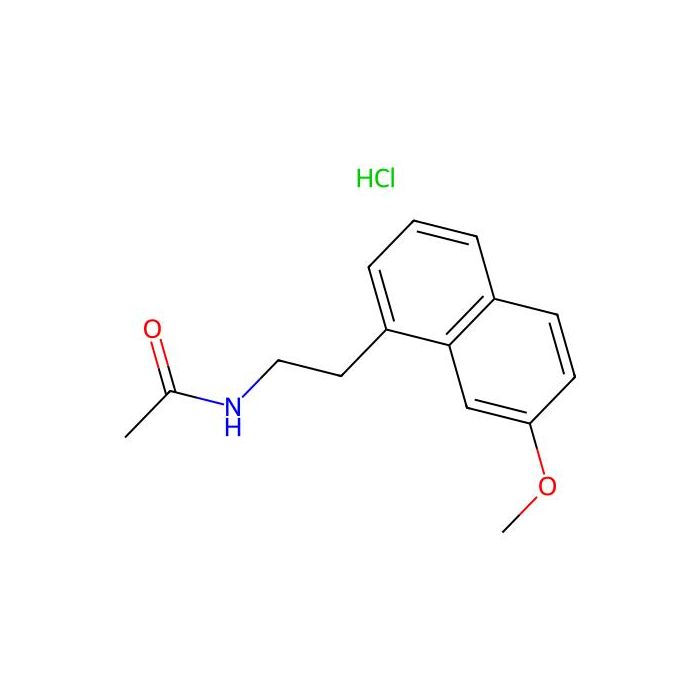
Agomelatine hydrochloride - ≥99% , CAS No.1176316-99-6
AVAILABLE TO ORDER
GRADE & PURITY ≥99%
Storage
Store at 2-8°C,Desiccated
Shipped In
Wet ice
≥99% for sensitive chromatographic and analytical workflows requiring minimal baseline interference.
Store at 2-8°C,Desiccated Ships Wet ice Check lot-specific COA for exact specifications.
SDS, COA, datasheet, and spec sheet available for download. Lot-specific COA accessible via lot number lookup.
Cited in 0 peer-reviewed publications across chromatography, organic synthesis, and cross-coupling reactions.
Agomelatine hydrochloride (S-20098 hydrochloride) is a specific agonist of MT1 and MT2 receptors with K i s of 0.1, 0.06, 0.12, and 0.27 nM for CHO-hMT1, HEK-hMT1, CHO-hMT2, and HEK-hMT2, respectively Agomelatine hydrochloride is a selective 5-HT2C receptor antagonist with pK i s of 6.4 and 6.2 at native (porcine) and cloned, human 5-HT2C receptors, respectively .
In Vitro
Agomelatine (S 20098) acts as a full agonist of MT1 and MT2 receptors with EC 50 s of 1.6±0.4, 0.10±0.04 nM for CHO hMT1 CHO-hMT2 (hΜΤ1 and hΜΤ2 receptors expressed in CHO or HEK cell membranes). Agomelatine (S20098) also interacts with h5-HT2B receptors (6.6), whereas it shows low affinity at native (rat)/cloned, human 5-HT2A (<5.0/5.3) and 5-HT1A (<5.0/5.2) receptors, and negligible (<5.0) affinity for other 5-HT receptors. MCE has not independently confirmed the accuracy of these methods. They are for reference only.
In Vivo
Agomelatine (25, 50, or 75 mg/kg; i.p.) has antioxidant activity in Strychnine (75 mg/kg, i.p.) or Pilocarpine (400 mg/kg, i.p.) induced seizure models in mice. Agomelatine dose not have any antioxidant effects on parameters of oxidative stress produced by Pentylenetetrazole (PTZ) or Picrotoxin (PTX) induced seizure models when compared to controls. MCE has not independently confirmed the accuracy of these methods. They are for reference only. Animal Model: Female Swiss mice (20-30 g) were administered PTZ (85 mg/kg, i.p.), PTX (7 mg/kg, i.p.), strychnine (75 mg/kg, i.p.), Pilocarpine (400 mg/kg, i.p.), respectivelyDosage: 25, 50, or 75 mg/kg Administration: Administered intraperitoneally (i.p.) Result: All dosages showed a significant decrease in thiobarbituric acid reactive substances (TBARS) levels and nitrite content in all brain areas when compared to controls in the Pilocarpine induced seizure model. All dosages decreased TBARS levels in all brain areas, and at low doses (25 or 50 mg/kg) decreased nitrite contents, but only at 25 or 50 mg/kg showed a significant increase in catalase activity in three brain areas when compared to controls in the Strychnine-induced seizure model. Did not have any antioxidant effects on parameters of oxidative stress produced by PTX- or PTZ-induced seizure models when compared to controls.
Form:Solid
IC50& Target:5-HT 2C Receptor 6.4 (pKi, native porcine) 5-HT 2C Receptor 6.2 (pKi, human) hMT1 0.1 (Ki, CHO Cells) hMT1 0.06 (Ki, HEK Cells) hMT2 0.12 (Ki, CHO Cells) hMT2 0.27 (Ki, HEK Cells)
| Canonical Smiles | CC(=O)NCCC1=CC=CC2=C1C=C(C=C2)OC.Cl |
|---|---|
| IUPAC Name | N-[2-(7-methoxynaphthalen-1-yl)ethyl]acetamide;hydrochloride |
| InChIKey | ZJVMEXOLMFNQPX-UHFFFAOYSA-N |
| INCHI | 1S/C15H17NO2.ClH/c1-11(17)16-9-8-13-5-3-4-12-6-7-14(18-2)10-15(12)13;/h3-7,10H,8-9H2,1-2H3,(H,16,17);1H |
| Isomeric SMILES | CC(=O)NCCC1=CC=CC2=C1C=C(C=C2)OC.Cl |
| PubChem CID | 66980040 |
| Molecular Weight | 279.76 |
Comprehensive hazard, handling, storage, and regulatory compliance document.
Download SDS →Lot-specific quality data. Enter your lot number to retrieve the exact COA.
Look up COA →Full quality attributes and acceptance criteria for this grade.
View spec sheet →Taxonomy Tree
| Kingdom | Organic compounds |
|---|---|
| Superclass | Organic acids and derivatives |
| Class | Carboxylic acids and derivatives |
| Subclass | Carboxylic acid derivatives |
| Intermediate Tree Nodes | Carboxylic acid amides - Acetamides |
| Direct Parent | N-acetyl-2-arylethylamines |
| Alternative Parents | Naphthalenes Anisoles Alkyl aryl ethers Secondary carboxylic acid amides Organonitrogen compounds Organic oxides Hydrochlorides Hydrocarbon derivatives Carbonyl compounds |
| Molecular Framework | Aromatic homopolycyclic compounds |
| Substituents | N-acetyl-2-arylethylamine - Naphthalene - Anisole - Phenol ether - Alkyl aryl ether - Benzenoid - Secondary carboxylic acid amide - Ether - Hydrocarbon derivative - Organooxygen compound - Organonitrogen compound - Organic oxide - Organic nitrogen compound - Carbonyl group - Organic oxygen compound - Hydrochloride - Aromatic homopolycyclic compound |
| Description | This compound belongs to the class of organic compounds known as n-acetyl-2-arylethylamines. These are compounds containing an acetamide group that is N-linked to an arylethylamine. |
| External Descriptors | Not available |
| Solubility | DMSO : ≥ 100 mg/mL (357.45 mM) H2O : <0.1 mg/mL (insoluble) |
|---|---|
| Molecular Weight | 279.760 g/mol |
| XLogP3 | |
| Hydrogen Bond Donor Count | 2 |
| Hydrogen Bond Acceptor Count | 2 |
| Rotatable Bond Count | 4 |
| Exact Mass | 279.103 Da |
| Monoisotopic Mass | 279.103 Da |
| Topological Polar Surface Area | 38.300 Ų |
| Heavy Atom Count | 19 |
| Formal Charge | 0 |
| Complexity | 280.000 |
| Isotope Atom Count | 0 |
| Defined Atom Stereocenter Count | 0 |
| Undefined Atom Stereocenter Count | 0 |
| Defined Bond Stereocenter Count | 0 |
| Undefined Bond Stereocenter Count | 0 |
| The total count of all stereochemical bonds | 0 |
| Covalently-Bonded Unit Count | 2 |