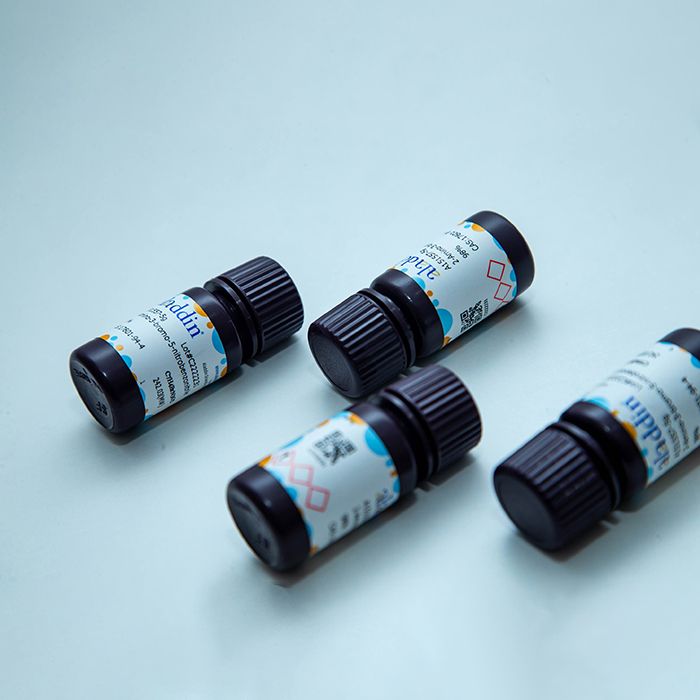
for sensitive chromatographic and analytical workflows requiring minimal baseline interference.
🌡
Storage & shipping
Store at 2-8°C,Desiccated Ships Wet ice Check lot-specific COA for exact specifications.
📋
Quality documents
SDS, COA, datasheet, and spec sheet available for download. Lot-specific COA accessible via lot number lookup.
📚
Literature proof
Cited in 0 peer-reviewed publications across chromatography, organic synthesis, and cross-coupling reactions.
Overview
Product introduction:
NHS-LC-Biotin is a long-chain, NHS-ester activated biotinylation reagent for labeling primary amines (e.g., protein lysines), whose membrane permeability enables it to be used for general intracellular labeling.
Features of EZ-Link NHS-LC-Biotin:
• Protein labeling—biotinylate antibodies or other proteins for detection or purification using streptavidin probes or resins • Membrane-permeable—can be used to label inside cells (intracellular) • Amine-reactive—reacts with primary amines (-NH2), such as the side-chain of lysines (K) or the amino-termini of polypeptides • Irreversible—forms permanent amide bonds; spacer arm cannot be cleaved • Solubility—must be dissolved in DMSO or DMF before further dilution in aqueous buffers • Medium length—spacer arm (total length added to target) is 22.4 angstroms; it consists of the biotin valeric acid group extended by a 6-atom chain
NHS-LC-Biotin is succinimidyl-6-(biotinamido)hexanoate. It is one of three similar EZ-Link NHS-Biotin Reagents that enable simple and efficient biotinylation of antibodies, proteins and any other primary amine-containing biomolecules in solution. Differing only in their spacer arm lengths, the three NHS-ester reagents offer researchers the possibility of optimizing labeling and detection experiments where steric hindrance of biotin binding is an important factor. Because they are uncharged and contain simple alkyl-chain spacer arms, these biotin compounds are membrane-permeable and useful for intracellular labeling.
We manufacture biotin reagents to ensure the highest possible overall product integrity, consistency and performance for the intended research applications.
N-Hydroxysulfosuccinimide (NHS) esters of biotin are the most popular type of biotinylation reagent. NHS-activated biotins react efficiently with primary amino groups (-NH2) in alkaline buffers to form stable amide bonds. Proteins (e.g., antibodies) typically have several primary amines that are available as targets for labeling, including the side chain of lysine (K) residues and the N-terminus of each polypeptide.
Varieties of biotin NHS-ester reagents differ in length, solubility, cell permeability and cleavability. Non-sulfonated NHS-biotins are cell permeable but must be dissolved in organic solvent such as DMSO or DMF. Sulfo-NHS biotins (and those with pegylated spacers) are directly water soluble but not membrane permeable. Varieties containing disulfide bonds can be cleaved using reducing agents, enabling the biotin group to be disconnected from the labeled protein.
• Spacer:Mid-Length
• Cell Permeability:Cell-Permeant
Specifications
Storage
Store at 2-8°C, Desiccated
Shipped In
Wet ice
This product requires cold chain shipping. Ground and other economy services are not available.
Product Properties
Reactivity
Amine
Documentation
📋 Safety Data Sheet (SDS)
Comprehensive hazard, handling, storage, and regulatory compliance document.
We use cookies to ensure the website functions properly and, where permitted, to improve your experience. You can manage your preferences at any time in Settings. Learn more in our Cookie Policy.
Shall we send you a message when we have discounts available?
Remind me later
Thank you! Please check your email inbox to confirm.
Products are supplied to verified businesses, institutions, and qualified professionals for research and development use only. Not for use in humans, animals, diagnosis, or therapy.