
Determine the necessary mass, volume, or concentration for preparing a solution.
| Activity Type | Activity Value -log(M) | Mechanism of Action | Activity Reference | Publications (PubMed IDs) |
|---|
Moligand™, 10mM in DMSO Moligand™ for sensitive chromatographic and analytical workflows requiring minimal baseline interference.
Store at -80°C Ships Dry ice packs + Cold packs Check lot-specific COA for exact specifications.
SDS, COA, datasheet, and spec sheet available for download. Lot-specific COA accessible via lot number lookup.
Cited in 3 peer-reviewed publications across chromatography, organic synthesis, and cross-coupling reactions.
Information
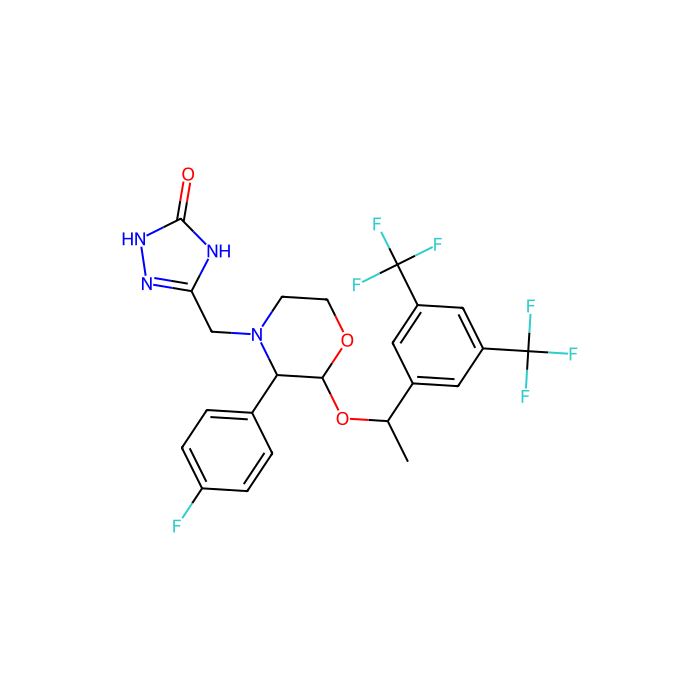
Aprepitant (MK-0869, L-754030) is a potent and selectiveneurokinin-1 receptorantagonist withIC50of 0.1 nM. Aprepitant reduces levels of pro-inflammatory cytokines includingG-CSF,IL-6,IL-8andTNFα. Aprepitant inhibitsHIVinfection of human macrophages.
In vitro
Aprepitant antagonizes the effects of substance P by binding to NK-1 receptors primarily in the CNS, but also in the periphery. Aprepitant, at concentrations of 0.1 nM displaces 50% of substance P from hNK1 receptors transfected in CHO or COS cells. In radioligand binding assays, Aprepitant is 3000-fold selective for the human cloned NK1 receptor versus the human cloned NK3 receptor and >50,000-fold selective over the human cloned NK2 receptor. In a range of assays at other human cloned G–protein coupled receptors, Aprepitant retains >50,000-fold selectivity for the human cloned NK1 receptor. Aprepitant is inactive in human monoamine oxidase A and B assays and at human serotonin 5–HT1A, 5–HT2A, 5–HT2c, 5–HT3, 5–HT5, 5–HT6, and 5–HT7 receptors (IC50>3 μM). In the PANLABS panel of radioligand binding screens using native animal tissues, Aprepitant inhibits [3H]substance P binding to native NK1 receptors in rat submaxillary gland; there are no significant interactions of Aprepitant with any other native animal G–protein coupled receptors or ion channels examined in the PANLABS screen. Aprepitant is inactive in monoamine uptake site (NE, 5–HT, DA) counterscreens using human and animal tissues (IC50> 3 μM)
In vivo
Aprepitant crosses the blood–brain barrier and occupied NK-1 receptors in the brain. Aprepitant has been shown to inhibit both acute and delayed emesis induced by cytotoxic chemotherapeutic such as cisplatin by blocking substance P. Aprepitant (3 mg/kg i.v. or p.o.) inhibits the emetic response to cisplatin (10 mg/kg i.v.). The anti-emetic protection afforded by Aprepitant (0.1 mg/kg i.v.) is enhanced by combined treatment with either dexamethasone (20 mg/kg i.v.) or the 5–HT3 receptor antagonist ondansetron (0.1 mg/kg i.v.). In a model of acute and delayed emesis, ferrets are dosed with cisplatin (5 mg/kg i.p.) and the retching and vomiting response recorded for 72 h. Pretreatment with Aprepitant (4–16 mg/kg p.o.) dose-dependently inhibits the emetic response to cisplatin. Once daily treatment with Aprepitant (2 and 4 mg/kg p.o.) completely prevents retching and vomiting in all ferrets tested. Further when daily dosing began at 24 h after cisplatin injection, when the acute phase of emesis had already become established, Aprepitant (4 mg/kg p.o. at 24 and 48 h after cisplatin) prevents retching and vomiting in three out of four ferrets. Aprepitant also plays a key part in transmission of pain impulses from the peripheral receptors to the CNS and is involved in various behavioural, neurochemical and cardiovascular responses to stress.
Cell Data
cell lines:
Concentrations:
Incubation Time:
Powder Purity:≥99%
| ALogP | 4.2 |
|---|
| Isomeric SMILES | C[C@H](C1=CC(=CC(=C1)C(F)(F)F)C(F)(F)F)O[C@@H]2[C@@H](N(CCO2)CC3=NNC(=O)N3)C4=CC=C(C=C4)F |
|---|---|
| Molecular Weight | 534.43 |
| Reaxy-Rn | 14529316 |
| Reaxys-RN_link_address | https://www.reaxys.com/reaxys/secured/hopinto.do?context=S&query=IDE.XRN=14529316&ln= |
Comprehensive hazard, handling, storage, and regulatory compliance document.
Download SDS →Lot-specific quality data. Enter your lot number to retrieve the exact COA.
Look up COA →Full quality attributes and acceptance criteria for this grade.
View spec sheet →| Activity Type | Activity Value -log(M) | Mechanism of Action | Activity Reference | Publications (PubMed IDs) |
|---|
| Activity Type | Activity Value -log(M) | Mechanism of Action | Activity Reference | Publications (PubMed IDs) |
|---|
| Solubility | Solubility (25°C) In vitro Water: 32 mg/mL warmed with 50ºC Water: bath (99.76 mM); DMSO: 21 mg/mL (65.47 mM); Ethanol: 4 mg/mL (12.47 mM); |
|---|---|
| Specific Rotation[α] | 69° (C=1,MeOH) |
| Melt Point(°C) | 252 °C |
| 1. Zhen Wang, Jing Zou, Le Zhang, Hongru Liu, Bei Jiang, Yi Liang, Yuzhe Zhang. (2023) Comprehensive analysis of the progression mechanisms of CRPC and its inhibitor discovery based on machine learning algorithms. Frontiers in Genetics, [PMID:37476415] [10.3389/fgene.2023.1184704] |
| 2. Changming Wang, Haiwang Ji, Hanwen Wang, Ziyun Chen, Lan Zhou, Yan Yang, Yucui Jiang, Guang Yu, Ling Jiang, Zongxiang Tang. (2025) Unraveling the neuroimmune mechanisms in cancer-induced bone pain: New horizons for therapeutic intervention of the two-phase paradigm. PROCEEDINGS OF THE NATIONAL ACADEMY OF SCIENCES OF THE UNITED STATES OF AMERICA, 122 (34): (e2503779122). [PMID:40828016] [10.1073/pnas.2503779122] |
| 3. Tao Zhang, Xu Zhang, Yu Luo, Yuan Xu, Taoming Hu, Deyan Wang, Qianru Wang, Wen Xiong, Xiurong Gao. (2026) Preparation and in vitro/in vivo evaluation of aprepitant nano/micron suspension for long-acting sustained-release subcutaneous injection. JOURNAL OF DRUG DELIVERY SCIENCE AND TECHNOLOGY, [PMID:] [10.1016/j.jddst.2026.108192] |
Our grade selection guide covers purity, stabilizer status, and application suitability for all variants in our catalog.
View Moligand™ grade guide →