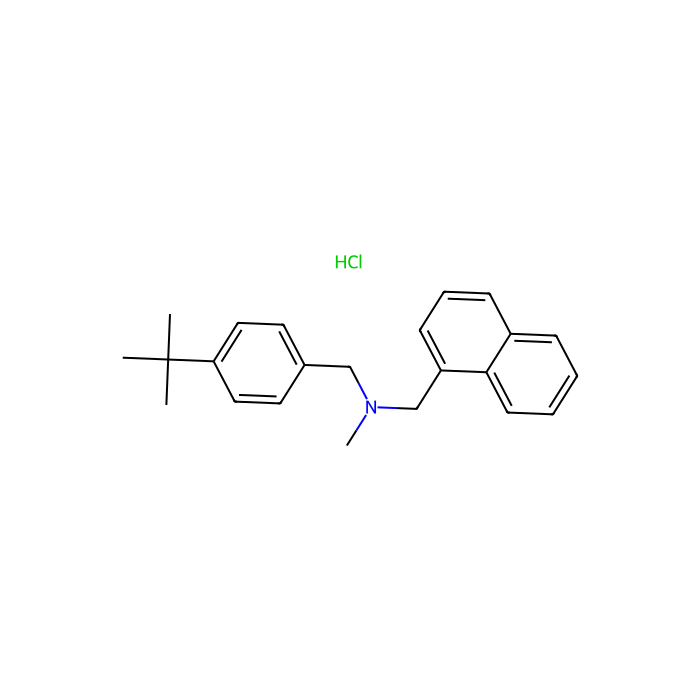
10mM in DMSO for sensitive chromatographic and analytical workflows requiring minimal baseline interference.
🌡
Storage & shipping
Store at -80°C Ships Dry ice packs + Cold packs Check lot-specific COA for exact specifications.
📋
Quality documents
SDS, COA, datasheet, and spec sheet available for download. Lot-specific COA accessible via lot number lookup.
📚
Literature proof
Cited in 0 peer-reviewed publications across chromatography, organic synthesis, and cross-coupling reactions.
Overview
Information
Butenafine HCl Butenafine HCl (KP-363) is a synthetic benzylamine antifungal, works by inhibiting the synthesis of sterols by inhibiting squalene epoxidase. In vitro
Butenafine HCl shows minimum inhibitory concentrations ranging from 0.03–1.0 µg/mL against 30 isolates representing different dermatophyte species. Butenafine shows limited activity against C. albicans and no activity against M. furfur against 10 isolates of two species of yeasts. Butenafine HCl shows activity against β-hemolytic Streptococcus Group A and Corynebacterium but failed to inhibit S. aureus against 25 isolates representing different Gram-positive bacteria species. Butenafine fails to show activity against any of the Gram-negative strains tested. Butenafine interferes with fungal ergosterol biosynthesis by inhibiting the conversion of squalene into squalene epoxide which is catalyzed by squalene epoxidase. Butenafine shows activity against KD-04 and KD-305 with minimum inhibitory concentrations of 12 ng/mL.
In vivo
Butenafine (1%, once daily) shows excellent efficacy against dermatophytosis in male hartley strain guinea pigs, and the effect is superior to those of naftifine, tolnaftate, clotrimazole, and bifonazole. Butenafine (1%) exhibits excellent prophylactic efficacy against experimental T. mentagrophytes infection when apply once at 24 or 48 h before infection. After 16 weeks, 80% of patients using medicated cream incorporating 2% butenafine HCl are cured, as opposed to none in the placebo group. Four patients in the active treatment group experience subjective mild inflammation without discontinuing treatment. During follow-up, no relapse occurres in cured patients and no improvement is seen in medication-resistant and placebo participants. Butenafine (1% cream) applied once daily for 4 weeks results in an effective clinical response and mycologic cure of tinea pedis during treatment in patients with positive fungal cultures. Butenafine hydrochloride (1% cream) alone is extremely effective for the treatment of hyperkeratotic-type tinea pedis patients. Cell Data
cell lines:KATO III, DU145, PC3, LNCaP, MDA-MB-231, MDA-MB-468, MDA-MB-453, MCF-7, MCF-10A, HeLa and HCT-116
We use cookies to ensure the website functions properly and, where permitted, to improve your experience. You can manage your preferences at any time in Settings. Learn more in our Cookie Policy.
Shall we send you a message when we have discounts available?
Remind me later
Thank you! Please check your email inbox to confirm.
Products are supplied to verified businesses, institutions, and qualified professionals for research and development use only. Not for use in humans, animals, diagnosis, or therapy.