
Determine the necessary mass, volume, or concentration for preparing a solution.
| Activity Type | Activity Value -log(M) | Mechanism of Action | Activity Reference | Publications (PubMed IDs) |
|---|
10mM in DMSO for sensitive chromatographic and analytical workflows requiring minimal baseline interference.
Store at -80°C Ships Dry ice packs + Cold packs Check lot-specific COA for exact specifications.
SDS, COA, datasheet, and spec sheet available for download. Lot-specific COA accessible via lot number lookup.
Cited in 0 peer-reviewed publications across chromatography, organic synthesis, and cross-coupling reactions.
Information
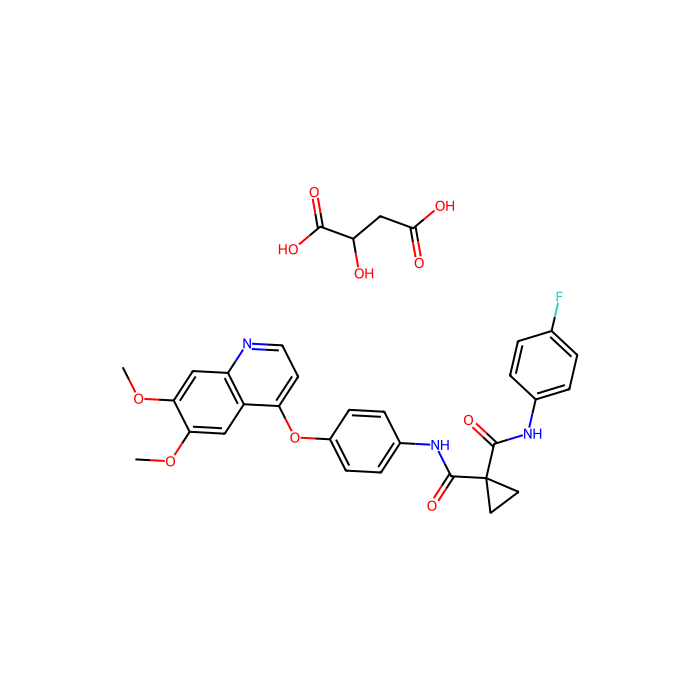
Cabozantinib malate (XL184) is the malate of Cabozantinib, a potentVEGFR2inhibitor withIC50of 0.035 nM and also inhibits c-Met, Ret (c-Ret), Kit (c-Kit), Flt-1/3/4, Tie2, and AXL withIC50of 1.3 nM, 4 nM, 4.6 nM, 12 nM/11.3 nM/6 nM, 14.3 nM and 7 nM in cel
In vitro
Cabozantinib has weak inhibitory activity against RON and PDGFRβ with IC50 of 124 nM and 234 nM, respectivey, and has low activity against FGFR1 with IC50 of 5.294 μM. Cabozantinib at low concentration (0.1-0.5 μM) is sufficient to induce marked inhibition of constitutive and inducible Met phosphorylation and its resultant downstream signaling in MPNST cells, and inhibit HGF-induced MPNST cell migration and invasion. Cabozantinib also induces marked inhibition of Met and VEGFR2 phosphorylation in cytokine-stimulated human umbilical vein endothelial cells (HUVECs). Although Cabozantinib has no significant effect on MPNST cell growth at 0.1 μM, Cabozantinib at 5-10 μM significantly inhibits the MPNST cell growth.
In vivo
Cabozantinib treatment at 30 mg/kg in RIP-Tag2 mice with spontaneous pancreatic islet tumors disrupts 83% of the tumor vasculature, reduces pericytes and empty basement membrane sleeves, causes widespread intratumoral hypoxia and extensive tumor cell apoptosis, and slows regrowth of the tumor vasculature after drug withdrawal, more significantly compared with XL999 that blocks VEGFR but not c-Met, leading to only 43% reduction in vascularity, suggesting that concurrent inhibition of VEGFR and other functionally relevant receptor tyrosine kinases (RTK) amplifies angiogenesis inhibition. Cabozantinib also decreases invasiveness of primary tumors and reduces metastasis. Cabozantinib at 30 mg/kg/day significantly abrogates human MPNST xenografts growth and metastasis in SCID mice. Administration of Cabozantinib induces dose-dependent inhibition of tumor growth in breast, lung, and glioma tumor models, in association with decreased tumor and endothelial cell proliferation as well as increased apoptosis. A single oral dose of Cabozantinib is sufficient to induce sustained tumor growth inhibition in MDA-MB-231 tumor-bearing mice and C6 tumor-bearing rats at 100 mg/kg and 10 mg/kg, respectively.
Cell Data
cell lines:
Concentrations:Dissolved in DMSO, final concentrations ~10 μM
Incubation Time:48 hours
Powder Purity:≥99%
| Isomeric SMILES | COC1=CC2=C(C=CN=C2C=C1OC)OC3=CC=C(C=C3)NC(=O)C4(CC4)C(=O)NC5=CC=C(C=C5)F.C([C@@H](C(=O)O)O)C(=O)O |
|---|---|
| PubChem CID | 25102846 |
| Molecular Weight | 635.59 |
Comprehensive hazard, handling, storage, and regulatory compliance document.
Download SDS →Lot-specific quality data. Enter your lot number to retrieve the exact COA.
Look up COA →Full quality attributes and acceptance criteria for this grade.
View spec sheet →| Activity Type | Activity Value -log(M) | Mechanism of Action | Activity Reference | Publications (PubMed IDs) |
|---|
| Activity Type | Activity Value -log(M) | Mechanism of Action | Activity Reference | Publications (PubMed IDs) |
|---|
| Solubility | Solubility (25°C) In vitro DMSO: 30 mg/mL (92.09 mM); Water: Insoluble; Ethanol: Insoluble; |
|---|