Determine the necessary mass, volume, or concentration for preparing a solution.
≥98% for sensitive chromatographic and analytical workflows requiring minimal baseline interference.
Protected from light,Store at -20°C,Argon charged,Desiccated Ships Ice chest + Ice pads Check lot-specific COA for exact specifications.
SDS, COA, datasheet, and spec sheet available for download. Lot-specific COA accessible via lot number lookup.
Cited in 17 peer-reviewed publications across chromatography, organic synthesis, and cross-coupling reactions.
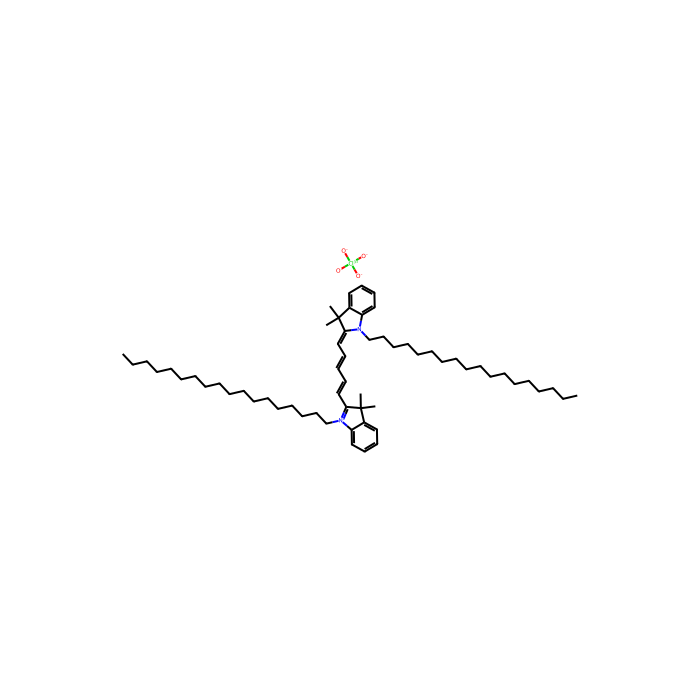
DiD, DiO, DiI, DiR and DiS dyes are a family of lipophilic fluorescent dyes that can be used to stain cell membranes and other fat-soluble biological structures. When combined with the cell membrane, the fluorescence intensity is greatly enhanced, and this type of dye has a high quenching constant and excited state lifetime. Once the cells are stained, this type of dye spreads across the cell membrane, and the optimal concentration can stain the entire cell membrane. Their fluorescence colors are clearly distinguished: DiI (orange fluorescence), DiO (green fluorescence), DiD (red fluorescence) and DiR (dark red fluorescence) which allows them to be used for multicolor imaging and flow analysis of living cells. DiI and DiO can use standard FITC and TRITC filters respectively. DiD can be excited by a 633 nm He-Ne laser, has a longer excitation and emission wavelength than DiI, and is more valuable in cell and tissue staining. DiR's infrared fluorescence can penetrate cells and tissues and be used for tracking in in vivo imaging.
Instructions
1. DiD, DiO, DiI, DiR and DiS cell membrane staining solution preparation
(1) Configure DMSO or EtOH storage solution: Use DMSO or EtOH to configure the storage solution with a concentration of 1 to 5 mM.
Note: Store the unused storage solution at -20°C, avoid repeated freezing and thawing.
(2) Preparation of working solution: Dilute the stock solution with a suitable buffer (such as serum-free medium, HBSS or PBS) to prepare a working solution with a concentration of 1 to 5 µM.
Note: The final concentration of the working solution is prepared according to the experience of different cells and experiments. The best conditions can be found from ten times the recommended concentration. To
2. Suspension cell staining
(1) The suspended cell density is 1 × 10⁶/mL and added to the working solution.
(2) Incubate cells at 37°C for 2-20 minutes. The optimal culture time varies for different cells.
(3) Centrifuge the stained cell tube at 1000-1500 rpm for 5 minutes.
(4) Pour the supernatant, and slowly add the pre-warmed 37°C culture solution again.
(5) Repeat steps (3) and (4) twice or more.
3. Staining of mucosal cells
(1) The cells that adhere to the wall are cultured in a sterile laboratory.
(2) Remove the cover glass from the culture medium, aspirate the excess medium, and place the cover glass in a humid environment.
(3) Add 100μL of dye working solution to one corner of the cover glass, and shake gently to make the dye evenly cover all cells.
(4) Cultivate the cells at 37°C for 2-20 minutes. The optimal culture time is different for different cells.
(5) Blot the dye working solution, wash the cover glass 2 to 3 times with the culture solution, cover all the cells with pre-warmed culture medium each time, incubate for 5-10 minutes, and then blot the culture medium.
4. Microscope inspection
(1) DiI filter selection XF32-Omega, 31002-Chroma
(2) Simultaneous detection of multicolor dyes, the filter is set as follows:
a) DiI and DiO = Omega XF52, Chroma 51004;
b) DiI and DiD = Omega XF92, Chroma 51007;
c) DiI, DiO and DiD = Omega XF93, Chroma 61005
5. Flow cytometry detection
DiD, DiO, DiI, DiR and DiS stained cells can be detected by classic FL1, FL2, FL3 and FL4 flow cytometry, respectively.
| Canonical Smiles | CCCCCCCCCCCCCCCCCCN1C2=CC=CC=C2C(C1=CC=CC=CC3=[N+](C4=CC=CC=C4C3(C)C)CCCCCCCCCCCCCCCCCC)(C)C.[O-]Cl(=O)(=O)=O |
|---|---|
| IUPAC Name | 2-[5-(3,3-dimethyl-1-octadecylindol-1-ium-2-yl)penta-2,4-dienylidene]-3,3-dimethyl-1-octadecylindole;perchlorate |
| InChIKey | ZQSBJPAQPRVNHU-UHFFFAOYSA-M |
| INCHI | 1S/C61H99N2.ClHO4/c1-7-9-11-13-15-17-19-21-23-25-27-29-31-33-35-44-52-62-56-48-42-40-46-54(56)60(3,4)58(62)50-38-37-39-51-59-61(5,6)55-47-41-43-49-57(55)63(59)53-45-36-34-32-30-28-26-24-22-20-18-16-14-12-10-8-2;2-1(3,4)5/h37-43,46-51H,7-36,44-45,52-53H2,1-6H3;(H,2,3,4,5)/q+1;/p-1 |
| Isomeric SMILES | CCCCCCCCCCCCCCCCCCN1C2=CC=CC=C2C(C1=CC=CC=CC3=[N+](C4=CC=CC=C4C3(C)C)CCCCCCCCCCCCCCCCCC)(C)C.[O-]Cl(=O)(=O)=O |
| PubChem CID | 2762629 |
| Molecular Weight | 959.903 |
Comprehensive hazard, handling, storage, and regulatory compliance document.
Download SDS →Lot-specific quality data. Enter your lot number to retrieve the exact COA.
Look up COA →Full quality attributes and acceptance criteria for this grade.
View spec sheet →Find and download the COA for your product by matching the lot number on the packaging.
| Lot Number | Certificate Type | Date | Item |
|---|---|---|---|
| Certificate of Analysis | Apr 29, 2026 | D266406 | |
| Certificate of Analysis | Apr 29, 2026 | D266406 | |
| Certificate of Analysis | Apr 29, 2026 | D266406 | |
| Certificate of Analysis | Apr 21, 2026 | D266406 | |
| Certificate of Analysis | Apr 02, 2026 | D266406 | |
| Certificate of Analysis | Apr 02, 2026 | D266406 | |
| Certificate of Analysis | Apr 02, 2026 | D266406 | |
| Certificate of Analysis | Mar 18, 2026 | D266406 | |
| Certificate of Analysis | Mar 18, 2026 | D266406 | |
| Certificate of Analysis | Jun 11, 2025 | D266406 | |
| Certificate of Analysis | Jun 11, 2025 | D266406 | |
| Certificate of Analysis | Jul 13, 2024 | D266406 | |
| Certificate of Analysis | Mar 22, 2024 | D266406 | |
| Certificate of Analysis | Dec 12, 2023 | D266406 | |
| Certificate of Analysis | Dec 15, 2022 | D266406 | |
| Certificate of Analysis | Dec 15, 2022 | D266406 |
| Solubility | Soluble in DMSO, DMF |
|---|---|
| Sensitivity | light sensitive;Air sensitive;Heat sensitive |
| 1. Huaqiang Fang, Li Huang, Fanzhen Lv, Binbin Hu, Huijie Liu, Zhixin Huang, Yue Sun, Weimin Zhou, Xiaolei Wang. (2022) Dual-responsive targeted atherosclerosis therapy through a multi-effective nanoplatform with anti-inflammatory, lipid-regulating and autophagy. CHEMICAL ENGINEERING JOURNAL, [PMID:] [10.1016/j.cej.2022.140067] |
| 2. Zhao Xuan, Huang Chengyuan, Su Meiling, Ran Yu, Wang Ying, Yin Zongning. (2021) Reactive Oxygen Species–Responsive Celastrol-Loaded Bilirubin Nanoparticles for the Treatment of Rheumatoid Arthritis. AAPS Journal, 24 (1): (1-13). [PMID:34907482] [10.1208/s12248-021-00636-3] |
| 3. Yunyan Chen, Mengfei Guo, Ding Qu, Yuping Liu, Jian Guo, Yan Chen. (2020) Furin-responsive triterpenine-based liposomal complex enhances anticervical cancer therapy through size modulation. DRUG DELIVERY, [PMID:33179521] [10.1080/10717544.2020.1827086] |
| 4. Liming He, Donghao Fan, Wenlang Liang, Qin Wang, Jiyu Fang. (2020) Matrix Metalloproteinase-Responsive PEGylated Lipid Nanoparticles for Controlled Drug Delivery in the Treatment of Rheumatoid Arthritis. ACS Applied Bio Materials, [PMID:35025370] [10.1021/acsabm.0c00242] |
| 5. Kaiyu Wang, Yiteng Lei, Donglin Xia, Peipei Xu, Tao Zhu, Zhongying Jiang, Yuqiang Ma. (2019) Neutrophil membranes coated, antibiotic agent loaded nanoparticles targeting to the lung inflammation. COLLOIDS AND SURFACES B-BIOINTERFACES, [PMID:31887646] [10.1016/j.colsurfb.2019.110755] |
| 6. Xiaoyuan Guo, Guojian Wu, Hong Wang, Lukui Chen. (2018) Pep-1&borneol–Bifunctionalized Carmustine-Loaded Micelles Enhance Anti-Glioma Efficacy Through Tumor-Targeting and BBB-Penetrating. JOURNAL OF PHARMACEUTICAL SCIENCES, [PMID:30537472] [10.1016/j.xphs.2018.11.046] |
| 7. Ding Qu, Lixiang Wang, Yue Qin, Mengfei Guo, Jian Guo, Mengmeng Huang, Yuping Liu, Congyan Liu, Hui Li, Yan Chen. (2018) Non-triggered sequential-release liposomes enhance anti-breast cancer efficacy of STS and celastrol-based microemulsion. Biomaterials Science, 6 (12): (3284-3299). [PMID:30346001] [10.1039/C8BM00796A] |
| 8. Jiale Chen, Pan Ran, Yizhao Xu, Mouna Khouchani, Xin Li, Ling Jian, Takoui Abdelmajid, Nadia Aittahssaint, Qian Yang, Jingyi Li, Long Zhao. (2025) Biomimetic multifunctional nanoparticles for improved radiotherapy and immunotherapy in cancer treatment. Materials Today Bio, [PMID:40225127] [10.1016/j.mtbio.2025.101698] |
| 9. Li Bingyi, He Mei, Xu Zichen, Zhang Qianting, Zhang Liyuan, Zhao Shuang, Cao Yu, Mou Nianlian, Wang Yi, Wang Guixue. (2024) Biomimetic ROS-responsive hyaluronic acid nanoparticles loaded with methotrexate for targeted anti-atherosclerosis. Regenerative Biomaterials, [PMID:39411198] [10.1093/rb/rbae102] |
| 10. Guo Hong, Li Xia, Mao Dengxuan, Wang Hong, Wei Liangyin, Qu Ding, Qin Xiaoying, Li Xiaoqi, Liu Yuping, Chen Yan. (2024) Homologous-magnetic dual-targeted metal-organic framework to improve the Anti-hepatocellular carcinoma efficacy of PD-1 inhibitor. JOURNAL OF NANOBIOTECHNOLOGY, 22 (1): (1-20). [PMID:38658950] [10.1186/s12951-024-02469-6] |
| 11. Jiaqi Liu, Hongmei Liu, Shan Huang, Hong Peng, Jiamei Li, Kerong Tu, Sumin Tan, Rou Xie, Lei Lei, Qin Yue, Huile Gao, Lulu Cai. (2024) Multiple Treatment of Triple-Negative Breast Cancer Through Gambogic Acid-Loaded Mesoporous Polydopamine. Small, [PMID:38446095] [10.1002/smll.202309583] |
| 12. Meng Yan, Yuan Zhong, Sheng Ni, Shirong Zhang, Yingying Jiang, Li Zhu, Kun Zhang, Kaiyong Cai, Kai Qu, Chuanwei Li, Wei Wu. (2025) CCR2-Engineered Macrophage Membrane-Coated Metal-Polyphenol Nanozyme to Enhance Antioxidation Activity for Inhibiting the Atherosclerotic Progression. Advanced Healthcare Materials, [PMID:40974123] [10.1002/adhm.202502151] |
| 13. Jiahao Li, Yushuang Wei, Qin Lai, Xiangyang Li, Yu Wang, Xun Wang, Yinghua Chen, Hong Liu, Kai Yang, Bing Yuan. (2025) Efficacy of a resveratrol nanoformulation prepared by a facile solvent-free method. Nanoscale, [PMID:40336370] [10.1039/D5NR00691K] |
| 14. Mengjun Wang, Shuo Zhang, Siyan Liu, Linyu Nian, Suilou Wang, Chongjiang Cao. (2025) Inulin and metal-phenolic network single-cell encapsulation: Boosting the tolerance and intestinal colonization capability of Bifidobacterium lactis. FOOD HYDROCOLLOIDS, [PMID:] [10.1016/j.foodhyd.2025.111619] |
| 15. Anqi Xia, Wenhui Yuan, Shanshan Xu, Ting Wu, Wenlu Yan, Ying Cao, Yaping Li, Qi Yin. (2025) A prebiotic inulin derivative-containing liposome for oral berberine delivery improves the orthotopic colorectal cancer chemotherapy. Nanoscale, [PMID:40504565] [10.1039/D5NR01337B] |
| 16. Zhihao Zhao, Ke Ling, Jun Yan, Zhexiang Wang, Chuntao Chen, Dongping Sun, Jian Liu. (2025) Nano-carriers mediate reciprocally chained promotion between ROS and mitochondrial calcium overload for enhanced antitumor therapy. Acta Biomaterialia, [PMID:40516840] [10.1016/j.actbio.2025.06.009] |
| 17. Lin Li, Yanyan Wu, Weiwei Wang, Kejing Wang, Lin Chen. (2025) Delivery of a GPX4 Inhibitor by SN38 Prodrug Nanoassemblies for Amplified Antitumor Efficacy Based on Ferroptotic Chemotherapy. ChemMedChem, [PMID:41056556] [10.1002/cmdc.202500667] |