Determine the necessary mass, volume, or concentration for preparing a solution.
Moligand™, 10mM in DMSO Moligand™ for sensitive chromatographic and analytical workflows requiring minimal baseline interference.
Store at -80°C Ships Dry ice packs + Cold packs Check lot-specific COA for exact specifications.
SDS, COA, datasheet, and spec sheet available for download. Lot-specific COA accessible via lot number lookup.
Cited in 0 peer-reviewed publications across chromatography, organic synthesis, and cross-coupling reactions.
Information
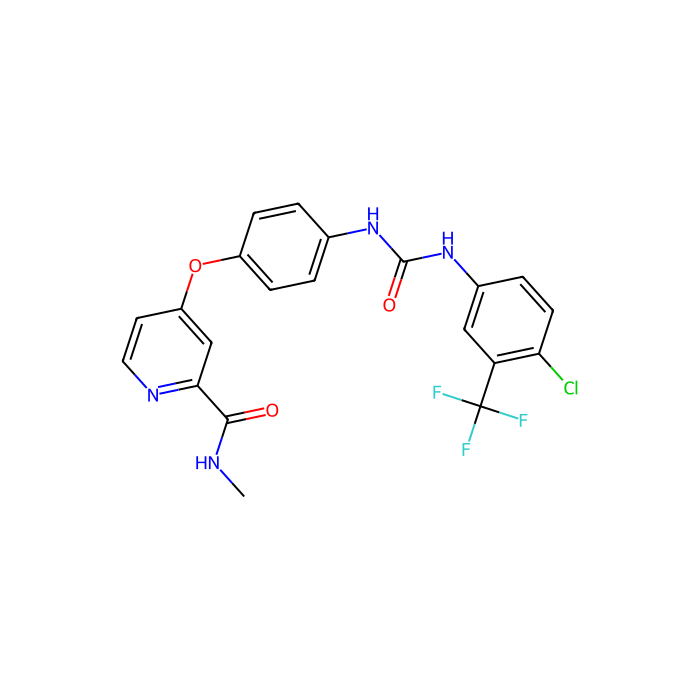
Donafenib (Sorafenib D3, Bay 43-9006 D3, CM-4307) is the deuterium labeled Sorafenib. Sorafenib is a multikinase inhibitor IC50s of 6 nM, 15 nM, 20 nM and 22 nM forRaf-1,mVEGFR-2,mVEGFR-3andB-RAF, respectively.
Targets
Raf-1 (Cell-free assay); mVEGFR-2 (Cell-free assay); mVEGFR-3 (Cell-free assay); B-Raf (Cell-free assay) 6 nM; 15 nM; 20 nM; 22 nM
In vitro
BAY 43-9006 suppresses both wild-type and V599E mutant BRAF activity in vitro. In addition, BAY 43-9006 demonstrates significant activity against several receptor tyrosine kinases involved in neovascularization and tumor progression, including vascular endothelial growth factor receptor (VEGFR)-2, VEGFR-3, platelet-derived growth factor receptor β, Flt-3, and c-KIT. In cellular mechanistic assays, BAY 43-9006 demonstrates inhibition of the mitogen-activated protein kinase pathway in colon, pancreatic, and breast tumor cell lines expressing mutant KRAS or wild-type or mutant BRAF, whereas non–small-cell lung cancer cell lines expressing mutant KRAS are insensitive to inhibition of the mitogen-activated protein kinase pathway by BAY 43-9006. Potent inhibition of VEGFR-2, platelet-derived growth factor receptor β, and VEGFR-3 cellular receptor autophosphorylation is also observed for BAY 43-9006.
In vivo
Once daily oral dosing of BAY 43-9006 demonstrates broad-spectrum antitumor activity in colon, breast, and non–small-cell lung cancer xenograft models. Immunohistochemistry demonstrates a close association between inhibition of tumor growth and inhibition of the extracellular signal-regulated kinases (ERKs) 1/2 phosphorylation in two of three xenograft models examined, consistent with inhibition of the RAF/MEK/ERK pathway in some but not all models. Additional analyses of microvessel density and microvessel area in the same tumor sections using antimurine CD31 antibodies demonstrates significant inhibition of neovascularization in all three of the xenograft models.
Cell Research(from reference)
Cell lines:MDA-MB-231, Colo-205, HT-29, DLD-1, NCI-H460, A549 cell lines
Concentrations:0.01 μM, 0.03 μM, 0.1 μM, 0.3 μM, 1 μM, 3 μM
Incubation Time:120 min
| ALogP | 4.175 |
|---|---|
| hba_count | 4 |
| HBD Count | 3 |
| Rotatable Bond | 7 |
| Canonical Smiles | CNC(=O)C1=NC=CC(=C1)OC2=CC=C(C=C2)NC(=O)NC3=CC(=C(C=C3)Cl)C(F)(F)F |
|---|---|
| IUPAC Name | 4-[4-[[4-chloro-3-(trifluoromethyl)phenyl]carbamoylamino]phenoxy]-N-(trideuteriomethyl)pyridine-2-carboxamide |
| InChIKey | MLDQJTXFUGDVEO-FIBGUPNXSA-N |
| INCHI | 1S/C21H16ClF3N4O3/c1-26-19(30)18-11-15(8-9-27-18)32-14-5-2-12(3-6-14)28-20(31)29-13-4-7-17(22)16(10-13)21(23,24)25/h2-11H,1H3,(H,26,30)(H2,28,29,31)/i1D3 |
| Isomeric SMILES | [2H]C([2H])([2H])NC(=O)C1=NC=CC(=C1)OC2=CC=C(C=C2)NC(=O)NC3=CC(=C(C=C3)Cl)C(F)(F)F |
| Molecular Weight | 467.84 |
| Reaxy-Rn | 9666200 |
| Reaxys-RN_link_address | https://www.reaxys.com/reaxys/secured/hopinto.do?context=S&query=IDE.XRN=9666200&ln= |
Comprehensive hazard, handling, storage, and regulatory compliance document.
Download SDS →Lot-specific quality data. Enter your lot number to retrieve the exact COA.
Look up COA →Full quality attributes and acceptance criteria for this grade.
View spec sheet →Taxonomy Tree
| Kingdom | Organic compounds |
|---|---|
| Superclass | Organic oxygen compounds |
| Class | Organooxygen compounds |
| Subclass | Ethers |
| Intermediate Tree Nodes | Not available |
| Direct Parent | Diarylethers |
| Alternative Parents | Trifluoromethylbenzenes N-phenylureas Pyridinecarboxamides Phenoxy compounds Phenol ethers 2-heteroaryl carboxamides Chlorobenzenes Aryl chlorides Heteroaromatic compounds Ureas Secondary carboxylic acid amides Azacyclic compounds Hydrocarbon derivatives Organic oxides Carbonyl compounds Organochlorides Organofluorides Alkyl fluorides Organonitrogen compounds |
| Molecular Framework | Aromatic heteromonocyclic compounds |
| Substituents | Diaryl ether - N-phenylurea - Trifluoromethylbenzene - Pyridinecarboxamide - Pyridine carboxylic acid or derivatives - 2-heteroaryl carboxamide - Phenoxy compound - Phenol ether - Halobenzene - Chlorobenzene - Aryl chloride - Aryl halide - Monocyclic benzene moiety - Benzenoid - Pyridine - Heteroaromatic compound - Carboxamide group - Secondary carboxylic acid amide - Urea - Azacycle - Carboxylic acid derivative - Organoheterocyclic compound - Organonitrogen compound - Alkyl halide - Alkyl fluoride - Carbonyl group - Hydrocarbon derivative - Organic oxide - Organic nitrogen compound - Organofluoride - Organochloride - Organohalogen compound - Aromatic heteromonocyclic compound |
| Description | This compound belongs to the class of organic compounds known as diarylethers. These are organic compounds containing the dialkyl ether functional group, with the formula ROR', where R and R' are aryl groups. |
| External Descriptors | Not available |
| DMSO(mg / mL) Max Solubility | 94 |
|---|---|
| DMSO(mM) Max Solubility | 200.923392612859 |
| Water(mg / mL) Max Solubility | <1 |
| Molecular Weight | 467.800 g/mol |
| XLogP3 | 4.100 |
| Hydrogen Bond Donor Count | 3 |
| Hydrogen Bond Acceptor Count | 7 |
| Rotatable Bond Count | 5 |
| Exact Mass | 467.105 Da |
| Monoisotopic Mass | 467.105 Da |
| Topological Polar Surface Area | 92.400 Ų |
| Heavy Atom Count | 32 |
| Formal Charge | 0 |
| Complexity | 646.000 |
| Isotope Atom Count | 3 |
| Defined Atom Stereocenter Count | 0 |
| Undefined Atom Stereocenter Count | 0 |
| Defined Bond Stereocenter Count | 0 |
| Undefined Bond Stereocenter Count | 0 |
| The total count of all stereochemical bonds | 0 |
| Covalently-Bonded Unit Count | 1 |
Our grade selection guide covers purity, stabilizer status, and application suitability for all variants in our catalog.
View Moligand™ grade guide →