
Determine the necessary mass, volume, or concentration for preparing a solution.
| Activity Type | Activity Value -log(M) | Mechanism of Action | Activity Reference | Publications (PubMed IDs) |
|---|
Moligand™, 10mM in DMSO Moligand™ for sensitive chromatographic and analytical workflows requiring minimal baseline interference.
Store at -80°C Ships Dry ice packs + Cold packs Check lot-specific COA for exact specifications.
SDS, COA, datasheet, and spec sheet available for download. Lot-specific COA accessible via lot number lookup.
Cited in 7 peer-reviewed publications across chromatography, organic synthesis, and cross-coupling reactions.
Information
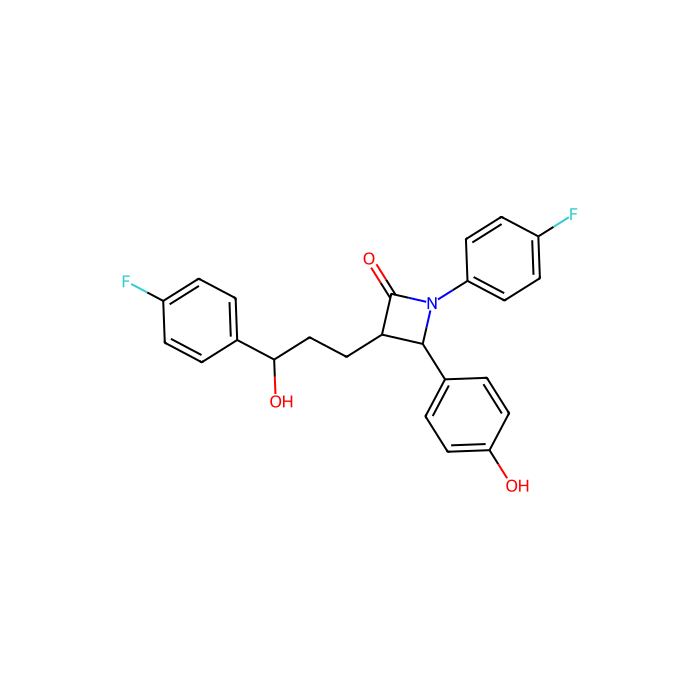
Ezetimibe (SCH-58235) Ezetimibe (SCH-58235) is a potent, selective, cholesterol absorption inhibitor, used to lower cholesterol.
In vitro
Ezetimibe produces a significant reduction in total cholesterol, LDL cholesterol, and triglycerides as well as a small but significant increase in HDL cholesterol. Ezetimibe reduces cholesterol transport by 31% in Caco-2 cells, but not retinol transport. Ezetimibe results in a significant decrease in mRNA expression for the surface receptors SR-BI, Niemann-Pick type C1 Like 1 protein (NPC1L1), and ATP-binding cassette transporter, subfamily A (ABCA1) and for the nuclear receptors retinoid acid receptor (RAR)gamma, sterol-regulatory element binding proteins (SREBP)-1 and -2, and liver X receptor (LXR)beta as assessed by real-time PCR analysis in Caco-2 cells.
In vivo
Ezetimibe reduces plasma cholesterol levels from 964 to 374 mg/dL, from 726 to 231 mg/dL, and from 516 to 178 mg/dL in the western, low-fat, and cholesterol-free diet mice, respectively. Ezetimibe reduces aortic atherosclerotic lesion surface area from 20.2% to 4.1% in the western diet group and from 24.1% to 7.0% in the low-fat cholesterol diet mice. Ezetimibe reduces carotid artery atherosclerotic lesion cross-sectional area by 97% in the western and low-fat cholesterol groups and by 91% in the cholesterol-free mice. Ezetimibe inhibits cholesterol absorption, reduces plasma cholesterol, increases high density lipoprotein levels, and inhibits the progression of atherosclerosis under western, low-fat, and cholesterol-free dietary conditions in apoE-/- mice. Ezetimibe potently inhibits the transport of cholesterol across the intestinal wall, thereby reducing plasma cholesterol in preclinical animal models of hypercholesterolemia. Ezetimibe eliminates exocrine pancreatic function from the intestine while maintaining bile flow, is established in the rat. Ezetimibe reduces plasma cholesterol and hepatic cholesterol accumulation in cholesterol-fed hamsters with an ED(50) of 0.04 mg /kg.
Cell Data
cell lines:
Concentrations:
Incubation Time:
Powder Purity:≥99%
| ALogP | 4 |
|---|
| Isomeric SMILES | C1=CC(=CC=C1[C@@H]2[C@H](C(=O)N2C3=CC=C(C=C3)F)CC[C@@H](C4=CC=C(C=C4)F)O)O |
|---|---|
| Alternate CAS | 163222-33-1 |
| MeSH Entry Terms | (1-(4-fluorophenyl)-(3R)-(3-(4-fluorophenyl)-(3S)-hydroxypropyl)-(4S)-(4-hydroxyphenyl)-2-azetidinone);58235, SCH;ezetimib;ezetimibe;Ezetrol;SCH 58235;SCH-58235;SCH58235;Zetia |
| Molecular Weight | 409.43 |
| Reaxy-Rn | 11745669 |
| Reaxys-RN_link_address | https://www.reaxys.com/reaxys/secured/hopinto.do?context=S&query=IDE.XRN=11745669&ln= |
Comprehensive hazard, handling, storage, and regulatory compliance document.
Download SDS →Lot-specific quality data. Enter your lot number to retrieve the exact COA.
Look up COA →Full quality attributes and acceptance criteria for this grade.
View spec sheet →| Activity Type | Activity Value -log(M) | Mechanism of Action | Activity Reference | Publications (PubMed IDs) |
|---|
Find and download the COA for your product by matching the lot number on the packaging.
| Lot Number | Certificate Type | Date | Item |
|---|---|---|---|
 L2214620 L2214620 | Certificate of Analysis | Jul 22, 2026 | E408174 |
| Solubility | Solubility (25°C) In vitro Ethanol: mg/mL |
|---|---|
| Melt Point(°C) | 327.2 - 330.8 °C |
| 1. Chao Meng, Lingye Zhou, Lin Huang, Qi Gu, Xinyue Du, Cheng Wang, Fanglan Liu, Chunhua Xia. (2023) Chlorogenic acid regulates the expression of NPC1L1 and HMGCR through PXR and SREBP2 signaling pathways and their interactions with HSP90 to maintain cholesterol homeostasis. PHYTOMEDICINE, [PMID:38103317] [10.1016/j.phymed.2023.155271] |
| 2. Qiuyao Du, Yunfeng Zhang, Jifen Wang, Bingjie Liu. (2020) Simultaneous determination and quantitation of hypolipidemic drugs in fingerprints by UPLC-Q-TRAP/MS. JOURNAL OF CHROMATOGRAPHY B-ANALYTICAL TECHNOLOGIES IN THE BIOMEDICAL AND LIFE SCIENCES, [PMID:33991956] [10.1016/j.jchromb.2020.122496] |
| 3. Yao Pan, Ze-Yuan Deng, Xuan Chen, Bing Zhang, Yawei Fan, Hongyan Li. (2020) Synergistic antioxidant effects of phenolic acids and carotenes on H2O2-induced H9c2 cells: Role of cell membrane transporters. FOOD CHEMISTRY, [PMID:33059273] [10.1016/j.foodchem.2020.128000] |
| 4. Ziyao Liu, Xiaohui Zhan, Minggang Yang, Qi Yang, Xianghui Xu, Fang Lan, Yao Wu, Zhongwei Gu. (2016) A magnetic-dependent protein corona of tailor-made superparamagnetic iron oxides alters their biological behaviors. Nanoscale, 8 (14): (7544-7555). [PMID:26949199] [10.1039/C5NR08447D] |
| 5. Juan Zhou, Yi-Qiao Xu, Sheng-Ya Guo, Chun-Qi Li. (2014) Rapid analysis of hypolipidemic drugs in a live zebrafish assay. JOURNAL OF PHARMACOLOGICAL AND TOXICOLOGICAL METHODS, [PMID:25497901] [10.1016/j.vascn.2014.12.002] |
| 6. Wenyue Yu, Yangyu Zhou, Ya Liu, Huan Guo, Lihui Huang, Jinrong Bai, Yue Xiao, Yanping Wu, Kai Zhong, Yina Huang, Hong Gao. (2025) Gut Microbial Catabolism of Prebiotic Theabrownin Yields Bioactive Metabolites for Gut Health and Lipid Homeostasis. JOURNAL OF AGRICULTURAL AND FOOD CHEMISTRY, [PMID:41085220] [10.1021/acs.jafc.5c10211] |
| 7. Xiaoxue He, Tian Liu, Mingjia Sun, Linsheng Wu, Yinghou Wang, Jingdong Xiao, Jin Sun, Qikun Jiang. (2026) Ginsenoside-Engineered Lipid Nanoparticles in Microbeads Enable Oral siRNA Delivery and Targeted Therapy for Ulcerative Colitis. ADVANCED FUNCTIONAL MATERIALS, [PMID:] [10.1002/adfm.202525241] |
Our grade selection guide covers purity, stabilizer status, and application suitability for all variants in our catalog.
View Moligand™ grade guide →