GRADE & PURITYMoligand™?Moligand™ — Aladdin's line of ligands and bioactive small molecules. Use for receptor, pathway, and binding studies needing defined small-molecule tools.≥98%
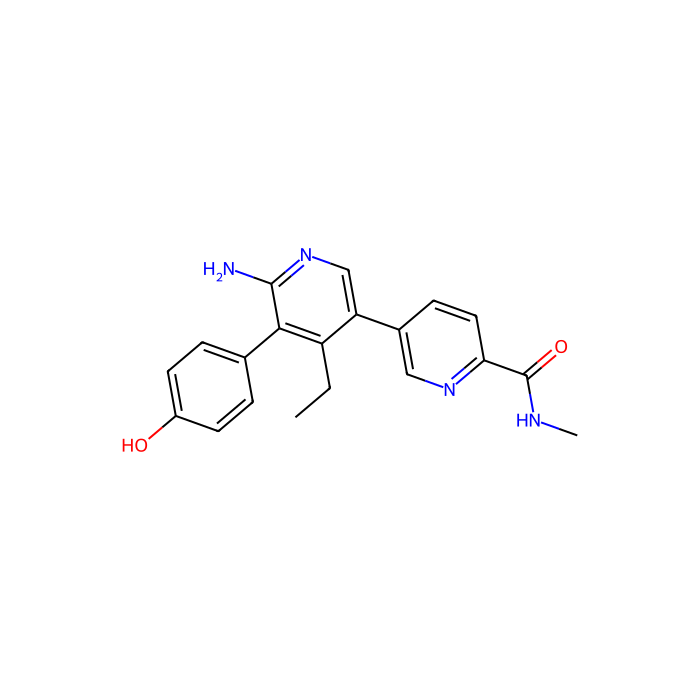
GNE-6776 is a potent, non-covalent, selective and orally bioavailable inhibitor of USP7 with IC50 of 1.34 μM and 0.61 μM for full length USP7 and USP7 catalytic domain, respectively.
Storage
Store at -20°C,Argon charged
Shipped In
Ice chest + Ice pads
This product requires cold chain shipping. Ground and other economy services are not available.
This compound belongs to the class of organic compounds known as bipyridines and oligopyridines. These are organic compounds containing two pyridine rings linked to each other.
External Descriptors
Not available
1. Djoumbou Feunang Y, Eisner R, Knox C, Chepelev L, Hastings J, Owen G, Fahy E, Steinbeck C, Subramanian S, Bolton E, Greiner R, and Wishart DS. ClassyFire: Automated Chemical Classification With A Comprehensive, Computable Taxonomy. Journal of Cheminformatics, 2016, 8:61.
Determine the necessary mass, volume, or concentration for preparing a solution.
Dilution Calculator
Determine the dilution needed to prepare a stock solution.
Reconstitution Calculator
Reviews
Customer Reviews
Application Protocols
No vendor-validated protocols are provided for this specific item. The following general procedures are commonly used for small-molecule screening compounds.
Preparation of DMSO stock (general)
Bring vial to room temperature in a desiccator. Open under inert gas if possible (argon/nitrogen) given the argon-charged packaging. Accurately weigh or back-calculate by qNMR if hygroscopicity/solvate content is unknown. Dissolve in dry DMSO to 10–50 mM. Vortex and, if needed, sonicate briefly. Filter through 0.22 μm PTFE for particulate removal.
Plate formatting (general)
Aliquot into 96/384-well plates using acoustic or pin tools. Seal plates with solvent-resistant films; store at −20 °C with desiccant. Minimize freeze–thaw by single-use aliquots. Track DMSO hydration over time.
Assay dilution (general)
Transfer to assay at final DMSO ≤0.1–1% v/v. Include vehicle controls matched to the highest DMSO % and, where relevant, detergent controls to mitigate aggregation artifacts.
QC checkpoints (general)
Confirm identity/purity per CoA on first use and after extended storage. Re-test solubility and potency if precipitates or color changes are observed.
These are general guidelines; adapt to your assay modality and consult the SDS for safe handling.
Biological Roles
Item-specific biological role
No endogenous or target-specific biological function is provided for GEN-6776. It is designated for research use only as part of a screening/ligand library. Any mechanism-of-action, target engagement, or pathway involvement has not been disclosed.
General considerations for library compounds (literature-general)
Such molecules may serve as chemical probes or starting points in hit identification and structure–activity relationship (SAR) development after screening. Follow-up profiling (counterscreens, off-target panels, solubility and stability measurements) determines suitability as a probe.
Critical determinants of apparent bioactivity include aggregation propensity, redox activity, fluorescence/absorbance interference, and covalency. Employ orthogonal assays and aggregation controls (e.g., 0.01% nonionic detergent where appropriate) to differentiate true actives from assay interference.
ADME/PK and safety (general)
No ADME/PK data are provided for this item. If translational studies are anticipated, early evaluation of microsomal stability, permeability (PAMPA/Caco-2), and plasma protein binding is common, but outside the scope of this catalog listing.
What is not specified here
Specific targets, pathways, organismal roles, and biochemical binding data: Not specified for this item; refer to your screening results or request additional vendor information under CDA as applicable.
Buffer Applications
This item is not a buffering reagent. However, practical notes for incorporating small molecules into buffered assay systems are provided below.
General guidance (literature-general)
Prepare concentrated DMSO stock (e.g., 10–50 mM), then dilute into assay buffer to a final DMSO typically ≤0.1–1% v/v, balancing solubility and biological tolerance.
Common assay buffers: HEPES (pH 7.0–7.5), Tris (pH 7.4–8.0), PBS (pH ~7.4). Choose based on target stability and assay readout compatibility.
Pre-wet plasticware with buffer or include low levels of nonionic detergent (e.g., 0.01% Tween-20) if nonspecific adsorption is a concern.
For ionizable compounds, consider pH-adjusted buffers to maintain the desired protonation state; monitor for precipitation upon dilution by light scattering or visual inspection.
Not specified for this item
Any buffer-specific compatibility constraints, pKa values, or solubility limits: Not specified for this item; refer to CoA/Spec Sheet and conduct a micro-solubility test in your chosen buffer matrix.
Green Alternatives
Given the lack of disclosed structure, green considerations focus on solvent and process choices during handling and formulation of this library compound.
Greener solvent swaps (general guidance)
Replace chlorinated solvents (DCM, chloroform) with ethyl acetate, 2-MeTHF, or methyl tert-butyl ether (MTBE) where solubility permits.
Prefer ethanol or isopropanol over methanol where compatible with assay/analytics due to lower toxicity profiles.
For LC workflows, consider water/ethanol or water/ACN over water/MeOH if it maintains resolution and reduces toxicity.
Stock solution practices (general)
High-concentration DMSO stocks minimize solvent volumes and waste; aliquot to avoid repeated thawing. For large screens, centralize distribution to reduce single-use plastics and dead volumes.
Energy and atmosphere
Because this item is supplied argon-charged, consolidate operations in a glove bag/glovebox session or use Schlenk techniques to reduce multiple purge cycles and compressed gas use.
Trade-offs (balanced view)
2-MeTHF and CPME offer greener profiles than THF/DCM but may not support very polar solutes. ACN has favorable UV transparency and lower viscosity than MeOH but comes with its own EHS considerations. Choose the least hazardous solvent that meets performance.
Item-specific green metrics (biodegradability, E-factor in synthesis, life-cycle data) are not specified for this item.
Pharmaceutical Uses
Catalog status
Research use only. No pharmacopoeial monograph or excipient designation is provided for GEN-6776.
Formulation context (general, non-clinical)
In preclinical discovery, similar small molecules may be formulated as DMSO stocks for in vitro assays, or in simple vehicles (e.g., PEG/solubilizer/cyclodextrin systems) for exploratory in vivo studies performed under institutional approvals. Such uses require internal qualification of purity, stability, and dose-form feasibility.
What is not specified for this item
Any clinical indication, therapeutic claims, GMP status, impurity profile per ICH Q3A/B, residual solvent Class 1–3 limits, or stability data under ICH conditions: Not specified for this item; refer to CoA/Spec Sheet.
Quality-by-Design considerations (general)
If transitioning a research compound toward development, establish a well-defined salt/crystalline form, solid-state characterization (XRPD/DSC/TGA), and robust analytical methods; none of these are provided here and would need to be developed by the user.
No medical or clinical claims are made. This product is not for diagnostic or therapeutic use.
Physical Properties
Item-specific physical constants are not disclosed in the current record.
Item-specific values (from Product Data)
Appearance: Not specified for this item; refer to CoA/Spec Sheet.
Molecular weight: Not specified for this item; refer to CoA/Spec Sheet.
Literature/computed values (general guidance)
Boiling point, melting point, density, refractive index, pKa, logP/cLogP, water and organic solubility: Not available here for this CAS/CID. Request the CoA or structure file to obtain calculated physicochemical properties (e.g., via ALOGPS, ChemAxon, RDKit) relevant to formulation and assay design.
Practical implications for handling (general)
In the absence of a specified form, treat as a typical small-molecule screening solid (or film) until confirmed; prepare primary stocks in dry, oxygen-free solvent when feasible.
For unknown ionization state, exploratory solubility tiers can be tested: DMSO (neat), then co-solvent dilution into aqueous buffer; for bases/acids, evaluate pH-adjusted media (pH 2–3 for strong bases; pH 9–10 for acids) as general solubilization strategies.
Analytical characterization (recommended)
Verify identity and purity via provided CoA methods (commonly LC–MS and HPLC/UPLC). Supplementary orthogonal checks such as qNMR, HRMS, and DSC can be used where your workflows require exact quantitation or polymorph control.
Authoritative values and acceptance criteria should be taken solely from the item’s CoA/Spec Sheet.
Quality & Grades
Item-specific grade (from Product Data)
Grade/Purity: Moligand™ (item-specific). This denotes inclusion in a discovery-oriented, small-molecule/ligand screening collection.
What Moligand™ typically implies (general explanation; not a specification)
Intended for research and screening use only, not for human or veterinary use.
Provided to support medicinal chemistry, target ID, and SAR workflows. Purity and identity are controlled per internal specifications suitable for screening; exact limits are reported on the item’s CoA.
What is not specified here
Exact assay purity (e.g., HPLC area %), residual solvents, water/peroxide content, elemental limits, and UV cutoff: Not specified for this item; refer to CoA/Spec Sheet.
Stabilizers or salt form: Not specified for this item; refer to CoA/Spec Sheet.
Recommended qualification on receipt (best practices)
Review CoA methodologies (LC–MS/HPLC) and acceptance criteria.
If quantitative biology is planned, consider qNMR for mass-balance purity and establish extinction coefficients as needed.
For structure-dependent assays, verify batch-to-batch consistency (fingerprint LC–MS, HRMS, optionally 1H NMR) and register the lot in your ELN/LIMS with the full identifiers (CAS, CID, complete InChIKey/SMILES).
Fit for purpose notes
If used as a reference/positive control, define your internal purity threshold and requalification interval. For fragment/ligand screening, pay attention to solubility, aggregation propensity, and PAINS flags once the structure is available.
Reaction & Applications
This product is listed as a Moligand™ small-molecule/ligand screening member rather than a general-purpose synthetic reagent. Accordingly, its primary use is in discovery biology and cheminformatics rather than named-reaction stoichiometry. Nevertheless, several application modes are common for such compounds:
Discovery and screening (general)
Biochemical and biophysical assays: evaluate binding/functional modulation against protein targets; suitable for orthogonal readouts (fluorescence, luminescence, SPR, DSF, MST) subject to compound optical/stability profiles.
Cellular assays: test phenotypic effects at low micromolar to nanomolar ranges with careful control of DMSO %, aggregation, and off-target liabilities.
Informatics: SAR/QSAR model building, substructure alerts (e.g., PAINS), and property-based triage once the structure is available.
Orthogonal characterization (general)
Confirm identity/purity by LC–MS/HPLC (per CoA). If used as a reference tool compound, consider HRMS and NMR to document batch fidelity.
If used synthetically (conditional, general)
In the rare case the molecule is repurposed as a building block, standard reaction choices (amidation, cross-coupling, SNAr/SN2, etc.) would depend entirely on its functional groups, which are not disclosed here. Plan conditions only after structural confirmation.
Not provided for this item
Any specific biological target, pathway, or reaction role is not provided in the Product Data.
Reaction Conditions
Specific reaction conditions cannot be prescribed without a disclosed structure or intended transformation.
Not specified for this item
Preferred solvents, catalysts, temperatures, or yields: Not specified for this item; refer to CoA/Spec Sheet.
General, literature-based guidance (conditional)
If using the compound as a substrate/building block, select solvents and catalysts according to the functional groups involved (e.g., polar aprotic solvents for SNAr/SN2; toluene/1,4-dioxane/2-MeTHF for cross-coupling; EDCI/HOBt or HATU in DMF/DCM for amidations).
Temperature windows typically range from 0–25 °C for sensitive couplings to 60–110 °C for robust cross-couplings; inert atmosphere (N2/Ar) recommended given the item is supplied argon-charged.
Reaction monitoring by LC–MS/HPLC is advised, with attention to potential isomerization or oxidation if the compound contains sensitive motifs (e.g., aldehydes, enolizable centers, thioethers).
Use these notes only after structural confirmation; otherwise, employ the compound primarily in screening applications as intended.
Safety & Handling
Safety information specific to this item is not fully specified in the current record. Always consult the SDS for definitive guidance.
Item-specific safety data (from Product Data)
GHS classification: Not specified for this item; refer to SDS.
Signal word / H-statements / pictograms: Not specified for this item; refer to SDS.
Storage conditions: Store at −20 °C, Argon charged (item-specific). This implies sensitivity to air and/or moisture and possibly to oxidation.
Shipping: Ice chest + ice pads (cold chain).
General laboratory precautions (applicable good practice)
PPE: lab coat, safety glasses, and suitable chemical-resistant gloves. Handle in a fume hood to avoid inhalation exposure to dusts/vapors/aerosols.
Incompatibilities (general): Avoid strong oxidizers/reducers and acids/bases until confirmed compatible. Because the item is argon-charged, minimize exposure to air and humidity; keep containers tightly sealed. Purge headspace with inert gas after each use.
First aid overview: Eye/skin contact—rinse with water for at least 15 minutes; remove contaminated clothing. Inhalation—move to fresh air. Ingestion—rinse mouth; seek medical attention. Follow site SOPs and SDS instructions.
Spill/cleanup: Avoid dust generation, absorb with inert material, and place in chemical waste per institutional policy.
Stability considerations
Work swiftly at ambient temperature; recap and re-inert promptly. Prepare single-use aliquots to reduce freeze–thaw cycles.
Definitive hazard classification and exposure limits must come from the product SDS.
Solvent Selection
Without a disclosed structure, solvent selection should follow a tiered screening approach common for Moligand-class small molecules.
Polarity/miscibility strategy (general)
Primary stock solvent: Anhydrous DMSO is the default for compound libraries due to broad solvency and biological compatibility at low final %.
Secondary options: DMF, NMP (for challenging solutes); MeOH, EtOH, ACN for moderately polar compounds; EtOAc, toluene, and dichloromethane for nonpolar/neutral species in synthetic contexts.
Aqueous vehicles: Use co-solvent strategies (e.g., 0.1–1% DMSO v/v in assay buffer) or pH adjustment if the compound is ionizable.
Practical tips (general)
Warm gently (25–40 °C) and vortex/sonicate to assist dissolution. Avoid prolonged heating or light exposure until stability is confirmed.
Filter sterile stocks through 0.22 μm PTFE/RC filters if needed for cell-free assays. For cell-based work, sterile DMSO stocks should be aliquoted and frozen.
Small comparison (literature-general)
DMSO vs DMF: DMSO is typically preferred for bioassays (lower cytotoxicity at ≤0.5–1% v/v); DMF may dissolve some hydrophobes better but is less favored in live-cell systems.
ACN vs MeOH: ACN provides lower proticity and UV background (useful for LC); MeOH can aid dissolution for H-bonding solutes but may disrupt some proteins.
Not specified for this item
Exact solubility values and solvent preferences: Not specified for this item; refer to CoA/Spec Sheet or perform a micro-solubility screen.
Storage & Reconstitution
Item-specific storage (from Product Data)
Store at −20 °C, argon charged. Shipments are provided cold (ice chest + ice pads). Maintain the cold chain on receipt.
General storage best practices (applicable)
Keep tightly sealed in an inert atmosphere (argon or nitrogen). If repeatedly accessed, transfer to a crimped or screw-cap vial with PTFE liner and backfill with inert gas after each use.
Protect from moisture and, if structure suggests photolability (unknown here), protect from light as a precaution.
Create small, single-use aliquots to avoid freeze–thaw and headspace air exchange. Record open dates and headspace purge events in your LIMS.
Reconstitution (general guidance)
Preferred: anhydrous DMSO for primary stock unless contraindicated by your assay or by compound-specific data. Alternative dry solvents (DMF, ACN, ethanol) may be used based on solubility and stability screening.
Allow vial to equilibrate to room temperature before opening to minimize condensation. Open in dry atmosphere; purge headspace; weigh quickly.
Target stock concentrations commonly 10–50 mM for screening libraries. Verify complete dissolution; gentle warming and brief sonication can assist.
Stability checks
Inspect for discoloration, gas evolution, or precipitation upon thaw/dilution. Periodically confirm purity by LC–MS/HPLC if stored >6–12 months.
Any specific shelf life, hydrate/solvate form, or stabilizers are not specified for this item; refer to the CoA/Spec Sheet.
Structure & Identity
Brief overview: GEN-6776 (SKU G413680) is listed in our small-molecule/compound library (Moligand grade). Item-specific structural identifiers are limited in the current product record.
Item-specific identifiers (from Product Data)
CAS: 2009273-71-4
PubChem CID: 122531750
InChIKey: 356638 (as provided; truncated/atypical format — verify against CoA/SDS)
SMILES: Not specified for this item; refer to CoA/Spec Sheet.
Molecular formula: Not specified for this item; refer to CoA/Spec Sheet.
Molecular weight: Not specified for this item; refer to CoA/Spec Sheet.
Structural features (general statement)
Detailed functional groups, ring systems, heteroatoms, and stereochemistry: Not available in the current listing. Please consult the Certificate of Analysis (CoA) or request technical support for structural disclosure aligned to your project’s need-to-know.
2D structure description (narrative)
A precise 2D description cannot be provided without the canonical structure. If you have the SMILES or SDF from your screening set, we can assist with computed descriptors (HBA/HBD, rotatable bonds, TPSA, cLogP) and substructure flags (PAINS, REOS) on request.
Notes:
When integrating into cheminformatics platforms, map the CAS and CID to your registry; confirm the full InChIKey and SMILES from the CoA to avoid mis-annotation in SAR datasets.
Synthetic Utility
This Moligand™ item is positioned as a screening compound rather than a general synthetic building block.
Item-specific reactivity
Functional groups and handles are not disclosed; therefore, no item-specific synthetic roles can be stated. Any derivatization strategy must await structural confirmation (CoA/structure file).
General guidance if repurposed synthetically (literature-general)
If aryl/heteroaryl halides are present: cross-coupling (Suzuki–Miyaura, Buchwald–Hartwig, Negishi, Sonogashira) could be applicable.
If amines/acids/alcohols are present: amide coupling (HATU/EDC/COMU), urea/carbamate formation, esterification (Steglich, Fischer), or alkylation/acylation may be options.
If electrophilic warheads exist (e.g., acrylamides): conjugate additions or protein-reactive probe design become relevant but must be verified to avoid unintended covalency in assays.
Analytical control (general)
Track conversions by LC–MS and qNMR; in cases of multiple basic/acidic sites, monitor counterion content and salt stoichiometry.
Not specified for this item
Any defined synthetic transformations, protecting-group strategy, or reactivity profile: Not specified; rely on the structure and CoA for planning.
Target Specificity
Item-specific target data
No target, pathway, or selectivity information is provided for GEN-6776 in the Product Data.
General notes (screening context)
Target specificity, if any, must be determined empirically through biochemical/cellular screens followed by orthogonal validation and counterscreens to assess selectivity against related target families.
Early profiling against frequent-off-target panels (e.g., CYPs, hERG, kinases as relevant) is recommended once a primary activity is observed, but such data are not part of this catalog entry.
Not specified for this item
Species reactivity, binding constants (Kd, Ki), IC50/EC50, mechanism of action, or phenotype specificity: Not specified for this item; refer to your internal screening results.
Frequently Asked Questions
What are the CAS number, molecular formula and molecular weight?
The CAS Number is 2009273-71-4, the molecular formula is C20H20N4O2, and the molecular weight is 348.4 g/mol. InChIKey UCYSSYGGXOFJKK-UHFFFAOYSA-N.
What is the purity of this product?
This product is supplied at ≥98% purity (chemical assay). Lot-specific values are stated on the Certificate of Analysis.
What is Moligand??
Moligand? is one of Aladdin Scientific's premium product lines, formulated for high-purity applications across multiple workflows. Compared to standard grades in the same workflow, Moligand? products typically offer tighter specifications, more rigorous QC, and stronger lot-to-lot consistency.
How should this product be stored?
Store at ?20 °C under argon. It is supplied under an argon blanket; reseal under inert gas after each use.
How is this product shipped?
This product ships in an insulated container with ice pads. Unpack on arrival and transfer it to the storage condition stated above.
What documentation is provided?
Available product documentation, including Certificates of Analysis (COA), Safety Data Sheets (SDS), and specification sheets, is shown in the product document area. Document availability and access follow the current site policy.
Need help choosing the grade?
Our grade selection guide covers purity, stabilizer status, and application suitability for all variants in our catalog.
We use cookies to ensure the website functions properly and, where permitted, to improve your experience. You can manage your preferences at any time in Settings. Learn more in our Cookie Policy.
Shall we send you a message when we have discounts available?
Remind me later
Thank you! Please check your email inbox to confirm.
Products are supplied to verified businesses, institutions, and qualified professionals for research and development use only. Not for use in humans, animals, diagnosis, or therapy.

 I2628213