≥98% for sensitive chromatographic and analytical workflows requiring minimal baseline interference.
🌡
Storage & shipping
Store at 2-8°C,Desiccated Ships Wet ice Check lot-specific COA for exact specifications.
📋
Quality documents
SDS, COA, datasheet, and spec sheet available for download. Lot-specific COA accessible via lot number lookup.
📚
Literature proof
Cited in 0 peer-reviewed publications across chromatography, organic synthesis, and cross-coupling reactions.
Overview
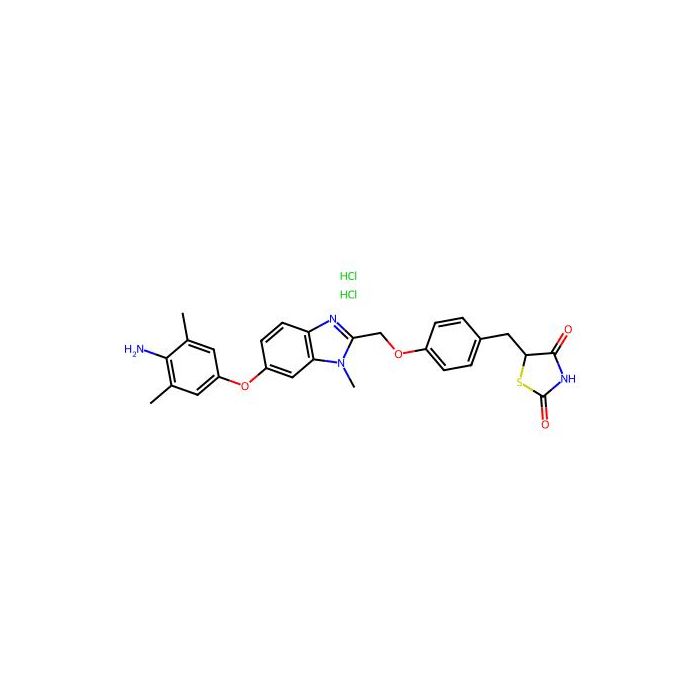
Inolitazone dihydrochloride (Efatutazone dihydrochloride) is a novel high-affinity PPARγ agonist that is dependent upon PPARγ for its biological activity with IC 50 of 0.8 nM for growth inhibition.
In Vitro
Inolitazone dihydrochloride (Efatutazone dihydrochloride) upregulates the cell cycle kinase inhibitor, p21 WAF1/CIP1 . Silencing p21 WAF1/CIP1 rendered cells insensitive to Inolitazone. A 10 nM dose of Inolitazone activates PPARγ:RXRα-dependent transcription as demonstrated in a transient transfection assay utilizing a PPRE response element fused to a luciferase reporter gene (PPRE3-tk-luc). DRO cells are treated in culture with Inolitazone, Rosiglitazone, or Troglitazone at the indicated concentrations. DRO cells are transiently transfected with PPRE3-tk-luc to examine effective concentrations at which EC 50 occurs. The EC 50 s are 1 nM (Inolitazone), 65 nM (Rosiglitazone) and 631 nM (Troglitazone). Similarly, the calculated inhibitory concentration at IC 50 is 0.8 nM for Inolitazone, 75 nM for Rosiglitazone, and 1412 nM for Troglitazone. Inolitazone specifically activates PPARγ, but not PPARα or PPARδ. Exposure of 10 nM Inolitazone following transient transfection with the appropriate PPAR isoform (γ, α, or δ) and PPAR response element linked to a luciferase reporter in RIE rat small intestinal cell line, which does not express PPARs, yields increased luciferase activity only in the presence of PPARγ and PPRE3-tk-luc. DRO cells are growth inhibited by 10 nM Inolitazone (RS5444) through a PPARγ-dependent mechanism. MCE has not independently confirmed the accuracy of these methods. They are for reference only.
In Vivo
Inolitazone dihydrochloride (Efatutazone dihydrochloride) plus Paclitaxel demonstrate additive antiproliferative activity in cell culture and minimal ATC tumor growth. When Inolitazone is administered in the diet to athymic nude mice prior to DRO tumor cell implantation, tumor growth is inhibited in a dose responsive fashion. At the highest dose, 0.025% Inolitazone inhibits growth on day 32 by 94.4% as compared to that of control. In this treatment group, five of 10 animals do not develop demonstrable tumors. In the 0.0025% treatment group, tumor growth is inhibited by 62.3% compared to that of control on day 32 while the 0.00025% dose demonstrated no growth inhibitory activity as compared to control. Tumors is nest allowed to establish in the mouse and began 0.025% Inolitazone treatment of mice 1 week after DRO or ARO tumor cell implantation. Inolitazone treated animals demonstrate tumor growth inhibition of 68.9% in DRO tumors and 48.3% in ARO tumors as compared to that of their respective controls on day 35 . MCE has not independently confirmed the accuracy of these methods. They are for reference only.
Inolitazone dihydrochloride (Efatutazone dihydrochloride) is a novel high-affinity PPARγ agonist that is dependent upon PPARγ for its biological activity with IC 50 of 0.8 nM for growth inhibition.
Storage
Store at 2-8°C, Desiccated
Shipped In
Wet ice
This product requires cold chain shipping. Ground and other economy services are not available.
This compound belongs to the class of organic compounds known as diarylethers. These are organic compounds containing the dialkyl ether functional group, with the formula ROR', where R and R' are aryl groups.
External Descriptors
Not available
1. Djoumbou Feunang Y, Eisner R, Knox C, Chepelev L, Hastings J, Owen G, Fahy E, Steinbeck C, Subramanian S, Bolton E, Greiner R, and Wishart DS. ClassyFire: Automated Chemical Classification With A Comprehensive, Computable Taxonomy. Journal of Cheminformatics, 2016, 8:61.
We use cookies to ensure the website functions properly and, where permitted, to improve your experience. You can manage your preferences at any time in Settings. Learn more in our Cookie Policy.
Shall we send you a message when we have discounts available?
Remind me later
Thank you! Please check your email inbox to confirm.
Products are supplied to verified businesses, institutions, and qualified professionals for research and development use only. Not for use in humans, animals, diagnosis, or therapy.