
Determine the necessary mass, volume, or concentration for preparing a solution.
| Activity Type | Activity Value -log(M) | Mechanism of Action | Activity Reference | Publications (PubMed IDs) |
|---|
≥98% for sensitive chromatographic and analytical workflows requiring minimal baseline interference.
Store at -20°C Ships Ice chest + Ice pads Check lot-specific COA for exact specifications.
SDS, COA, datasheet, and spec sheet available for download. Lot-specific COA accessible via lot number lookup.
Cited in 0 peer-reviewed publications across chromatography, organic synthesis, and cross-coupling reactions.
Information
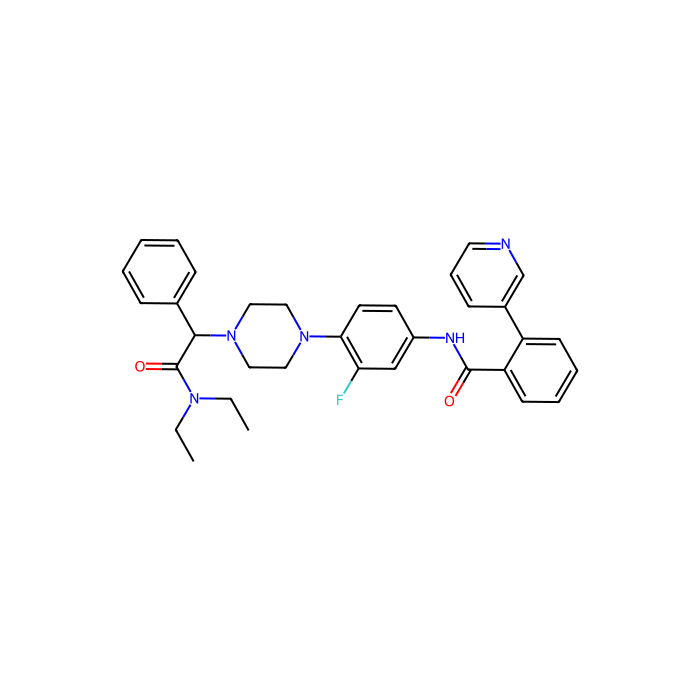
JNJ 31020028 JNJ 31020028 is a novel neuropeptide Y Y2 receptor antagonist which bound with high affinity with human and rat Y2 receptor (pIC50=8.07±0.05 for human Y2 receptor, and pIC50=8.22±0.06 for rat Y2 receptor) and >100-fold selective versus human Y1, Y4, and Y5 receptors.
Targets
rat Y2 receptor ; human Y2 receptor 8.22(pIC50); 8.07(pIC50)
In vitro
JNJ-31020028 is assayed by binding in a panel of 50 receptors, ion channels, and transporters assays including adenosine (A1, A2A, A3), adrenergic (α1, α2, β1), angiotensin (AT1), dopamine (D1, D2), bradykinin (B2), cholecystokinin (CCKA), galanin (GAL2), melatonin (ML1), muscarinic (M1, M2, M3), neurotensin (NT1), neurokinin (NK2, NK3), opiate (μ, κ, δ), serotonin (5-HT1A, 5-HT1B, 5-HT2A, 5-HT3, 5-HT5A, 5-HT6, 5-HT7), somatostatin, Vasotocin (V1a), norepinephrine transporter, dopamine transporter, and ion channels (sodium, calcium, potassium, and chloride). The Y2 antagonist at concentrations up to 10μM has no significant affinity for any receptor/transporter/ion channel (<50% inhibition at 10μM) other than the Y2 receptor. Selectivity of Y2 antagonist is further evaluated in a panel comprised of 65 kinases. JNJ-31020028 (10μM) does not inhibit any of the kinase included in the panel.
In vivo
In a variety of anxiety models, JNJ-31020028 is found to be ineffective, although it does block stress-induced elevations in plasma corticosterone, without altering basal levels, and normalized food intake in stressed animals without affecting basal food intake. JNJ-31020028 is administered to rats by the oral (10 mg/kg), intravenous (1 mg/kg), and subcutaneous (10 mg/kg) route, and pharmacokinetic parameters are determined. The compound has poor oral bioavailability (6%) but high subcutaneous bioavailability (100%). Subcutaneous dosing is the preferred route for several of the models and yields good plasma levels (Cmax 4.35 μmol/l) and fast absorption with a 0.83-h half-life. JNJ-31020028 has no significant effect on locomotor activity during the test.
| ALogP | 4.989 |
|---|---|
| hba_count | 3 |
| HBD Count | 1 |
| Rotatable Bond | 9 |
| Pubchem Sid | 504769981 |
|---|---|
| Pubchem Sid Url | https://pubchem.ncbi.nlm.nih.gov/substance/504769981 |
| Canonical Smiles | CCN(CC)C(=O)C(C1=CC=CC=C1)N2CCN(CC2)C3=C(C=C(C=C3)NC(=O)C4=CC=CC=C4C5=CN=CC=C5)F |
| IUPAC Name | N-[4-[4-[2-(diethylamino)-2-oxo-1-phenylethyl]piperazin-1-yl]-3-fluorophenyl]-2-pyridin-3-ylbenzamide |
| InChIKey | OVUNRYUVDVWTTE-UHFFFAOYSA-N |
| INCHI | 1S/C34H36FN5O2/c1-3-38(4-2)34(42)32(25-11-6-5-7-12-25)40-21-19-39(20-22-40)31-17-16-27(23-30(31)35)37-33(41)29-15-9-8-14-28(29)26-13-10-18-36-24-26/h5-18,23-24,32H,3-4,19-22H2,1-2H3,(H,37,41) |
| Isomeric SMILES | CCN(CC)C(=O)C(C1=CC=CC=C1)N2CCN(CC2)C3=C(C=C(C=C3)NC(=O)C4=CC=CC=C4C5=CN=CC=C5)F |
| Molecular Weight | 565.68 |
| Reaxy-Rn | 18963932 |
| Reaxys-RN_link_address | https://www.reaxys.com/reaxys/secured/hopinto.do?context=S&query=IDE.XRN=18963932&ln= |
Comprehensive hazard, handling, storage, and regulatory compliance document.
Download SDS →Lot-specific quality data. Enter your lot number to retrieve the exact COA.
Look up COA →Full quality attributes and acceptance criteria for this grade.
View spec sheet →Taxonomy Tree
| Kingdom | Organic compounds |
|---|---|
| Superclass | Benzenoids |
| Class | Benzene and substituted derivatives |
| Subclass | Anilides |
| Intermediate Tree Nodes | Aromatic anilides |
| Direct Parent | Benzanilides |
| Alternative Parents | N-arylpiperazines Phenylpiperazines Phenylpyridines N-piperazineacetamides Alpha amino acids and derivatives Phenylacetamides Benzamides Aniline and substituted anilines Dialkylarylamines Benzoyl derivatives N-alkylpiperazines Aralkylamines Fluorobenzenes Aryl fluorides Heteroaromatic compounds Tertiary carboxylic acid amides Trialkylamines Secondary carboxylic acid amides Azacyclic compounds Carbonyl compounds Hydrocarbon derivatives Organic oxides Organofluorides |
| Molecular Framework | Aromatic heteromonocyclic compounds |
| Substituents | Benzanilide - Phenylpiperazine - 3-phenylpyridine - N-arylpiperazine - N-piperazineacetamide - Alpha-amino acid or derivatives - Phenylacetamide - Benzoic acid or derivatives - Benzamide - Benzoyl - Aniline or substituted anilines - Tertiary aliphatic/aromatic amine - Dialkylarylamine - Halobenzene - Aralkylamine - N-alkylpiperazine - Fluorobenzene - Aryl fluoride - 1,4-diazinane - Pyridine - Piperazine - Aryl halide - Tertiary carboxylic acid amide - Heteroaromatic compound - Carboxamide group - Tertiary aliphatic amine - Amino acid or derivatives - Tertiary amine - Secondary carboxylic acid amide - Azacycle - Carboxylic acid derivative - Organoheterocyclic compound - Organic oxygen compound - Organohalogen compound - Carbonyl group - Organofluoride - Organonitrogen compound - Organooxygen compound - Amine - Organic nitrogen compound - Hydrocarbon derivative - Organic oxide - Aromatic heteromonocyclic compound |
| Description | This compound belongs to the class of organic compounds known as benzanilides. These are aromatic compounds containing an anilide group in which the carboxamide group is substituted with a benzene ring. They have the general structure RNC(=O)R', where R,R'= benzene. |
| External Descriptors | Not available |
| Activity Type | Activity Value -log(M) | Mechanism of Action | Activity Reference | Publications (PubMed IDs) |
|---|
| Activity Type | Activity Value -log(M) | Mechanism of Action | Activity Reference | Publications (PubMed IDs) |
|---|
| Activity Type | Relation | Activity value | Units | Action Type | Journal | PubMed Id | doi | Assay Aladdin ID |
|---|
| Activity Type | Relation | Activity value | Units | Action Type | Journal | PubMed Id | doi | Assay Aladdin ID |
|---|
| Activity Type | Relation | Activity value | Units | Action Type | Journal | PubMed Id | doi | Assay Aladdin ID |
|---|
| Activity Type | Relation | Activity value | Units | Action Type | Journal | PubMed Id | doi | Assay Aladdin ID |
|---|
| Activity Type | Relation | Activity value | Units | Action Type | Journal | PubMed Id | doi | Assay Aladdin ID |
|---|
Find and download the COA for your product by matching the lot number on the packaging.
| Lot Number | Certificate Type | Date | Item |
|---|---|---|---|
 C23081494 C23081494 | Certificate of Analysis | Dec 10, 2025 | J413441 |
| C23081507 | Certificate of Analysis | Dec 10, 2025 | J413441 |
| C23081510 | Certificate of Analysis | Dec 10, 2025 | J413441 |
| C23081511 | Certificate of Analysis | Dec 10, 2025 | J413441 |
| C23081512 | Certificate of Analysis | Dec 10, 2025 | J413441 |
| C23081515 | Certificate of Analysis | Dec 10, 2025 | J413441 |
| Solubility | Solubility (25°C) In vitro DMSO: 100 mg/mL (176.77 mM); Water: Insoluble; Ethanol: Insoluble; |
|---|---|
| DMSO(mg / mL) Max Solubility | 100 |
| DMSO(mM) Max Solubility | 176.778390609532 |
| Water(mg / mL) Max Solubility | <1 |
| Molecular Weight | 565.700 g/mol |
| XLogP3 | 5.300 |
| Hydrogen Bond Donor Count | 1 |
| Hydrogen Bond Acceptor Count | 6 |
| Rotatable Bond Count | 9 |
| Exact Mass | 565.285 Da |
| Monoisotopic Mass | 565.285 Da |
| Topological Polar Surface Area | 68.800 Ų |
| Heavy Atom Count | 42 |
| Formal Charge | 0 |
| Complexity | 857.000 |
| Isotope Atom Count | 0 |
| Defined Atom Stereocenter Count | 0 |
| Undefined Atom Stereocenter Count | 1 |
| Defined Bond Stereocenter Count | 0 |
| Undefined Bond Stereocenter Count | 0 |
| The total count of all stereochemical bonds | 0 |
| Covalently-Bonded Unit Count | 1 |