
Determine the necessary mass, volume, or concentration for preparing a solution.
| Activity Type | Activity Value -log(M) | Mechanism of Action | Activity Reference | Publications (PubMed IDs) |
|---|
Moligand™, 10mM in DMSO Moligand™ for sensitive chromatographic and analytical workflows requiring minimal baseline interference.
Store at -80°C Ships Dry ice packs + Cold packs Check lot-specific COA for exact specifications.
SDS, COA, datasheet, and spec sheet available for download. Lot-specific COA accessible via lot number lookup.
Cited in 2 peer-reviewed publications across chromatography, organic synthesis, and cross-coupling reactions.
Information
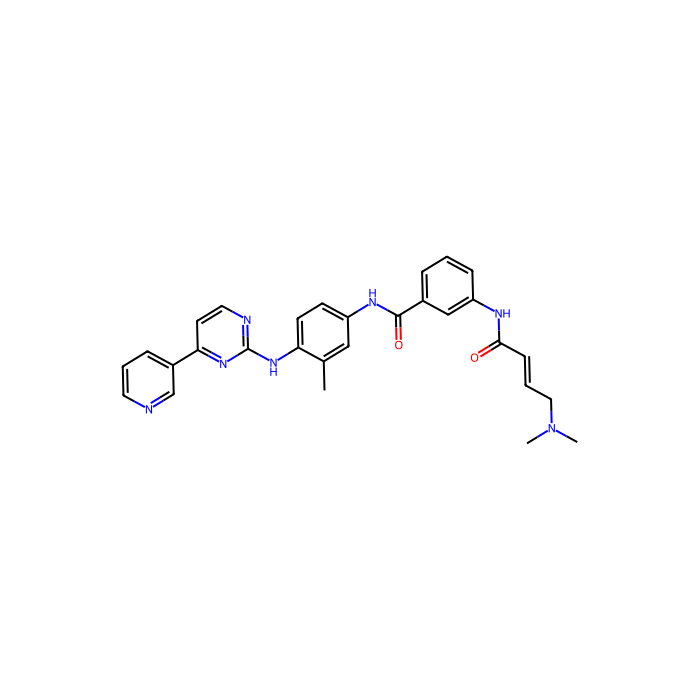
JNK-IN-8 JNK-IN-8 (JNK Inhibitor XVI) is the first irreversible JNK inhibitor for JNK1, JNK2 and JNK3 with IC50 of 4.7 nM, 18.7 nM and 1 nM, >10-fold selectivity against MNK2, Fms and no inhibition to c-Kit, Met, PDGFRβin A375 cell line.
In vitro
JNK-IN-8 inhibits c-Jun phosphorylation in HeLa and A375 cells with EC50 of 486 nM and 338 nM, respectively. JNK-IN-8 shows a dramatic improvement in selectivity and eliminated binding to IRAK1, PIK3C3, PIP4K2C, and PIP5K3. JNK-IN-8 requires Cys116 for JNK2 inhibition. JNK-IN-8 (10 mM) suppresses the IL-1β-stimulated phosphorylation of c-Jun in IL-1R cells, an established substrate of the JNKs. JNK-IN-8 covalently attaches to the JNK isoforms caused a small retardation in the electrophoretic mobility of the JNK isoforms. JNK-IN-8 is discovered to inhibit JNK kinase by broad-based kinase selectivity profiling of a library of acrylamide kinase inhibitors based on the structure of imatinib using the KinomeScan approach. JNK-IN-8 possesses distinct regiochemistry of the 1,4-dianiline and 1,3-aminobenzoic acid substructures relative to imatinib and uses an N,N-dimethyl butenoic acetamide warhead to covalently target Cys154. JNK-IN-8 adopts an L-shaped type I binding conformation to access Cys 154 located toward the lip of the ATP-binding site.
In vivo
Cell Data
cell lines:
Concentrations:
Incubation Time:
Powder Purity:≥97%
| Isomeric SMILES | CC1=C(C=CC(=C1)NC(=O)C2=CC(=CC=C2)NC(=O)/C=C/CN(C)C)NC3=NC=CC(=N3)C4=CN=CC=C4 |
|---|---|
| Molecular Weight | 507.59 |
| Reaxy-Rn | 22356001 |
| Reaxys-RN_link_address | https://www.reaxys.com/reaxys/secured/hopinto.do?context=S&query=IDE.XRN=22356001&ln= |
Comprehensive hazard, handling, storage, and regulatory compliance document.
Download SDS →Lot-specific quality data. Enter your lot number to retrieve the exact COA.
Look up COA →Full quality attributes and acceptance criteria for this grade.
View spec sheet →| Activity Type | Activity Value -log(M) | Mechanism of Action | Activity Reference | Publications (PubMed IDs) |
|---|
| Activity Type | Activity Value -log(M) | Mechanism of Action | Activity Reference | Publications (PubMed IDs) |
|---|
| Activity Type | Activity Value -log(M) | Mechanism of Action | Activity Reference | Publications (PubMed IDs) |
|---|
| Refractive Index | 1.69 |
|---|
| 1. Shuai Yang, Xinyao Qiu, Yingcheng Yang, Jing Wu, Shan Wang, Bo Zheng, Jianmin Wu, Tao Zhou, Yangqianwen Zhang, Mixue Bai, Shuowu Liu, Zihan Zhao, Yani Zhang, Yixian Wang, Jinxia Bao, Mengye Wu, Dongdong Xue, Meiyu Bao, Ji Hu, Siyun Shen, Hongyang Wang, Lei Chen. (2025) LTA4H improves the tumor microenvironment and prevents HCC progression via targeting the HNRNPA1/LTBP1/TGF-β axis. Cell Reports Medicine, [PMID:40056904] [10.1016/j.xcrm.2025.102000] |
| 2. Peng Zhang, Jianfeng Zhong, Ting Zhou, Depei Jiang, Zijing Wang, Meifang Ye, Lekun Fang, Huizhen Xiong, Honglei Chen. (2026) SKA2 promotes gastric cancer progression by regulating glutathione metabolism. iScience, 29 (4): [PMID:] [10.1016/j.isci.2026.115202] |
Our grade selection guide covers purity, stabilizer status, and application suitability for all variants in our catalog.
View Moligand™ grade guide →