
Determine the necessary mass, volume, or concentration for preparing a solution.
| Activity Type | Activity Value -log(M) | Mechanism of Action | Activity Reference | Publications (PubMed IDs) |
|---|
Moligand™, ≥99%(HPLC) Moligand™ for sensitive chromatographic and analytical workflows requiring minimal baseline interference.
Room temperature Ships Normal Check lot-specific COA for exact specifications.
SDS, COA, datasheet, and spec sheet available for download. Lot-specific COA accessible via lot number lookup.
Cited in 0 peer-reviewed publications across chromatography, organic synthesis, and cross-coupling reactions.
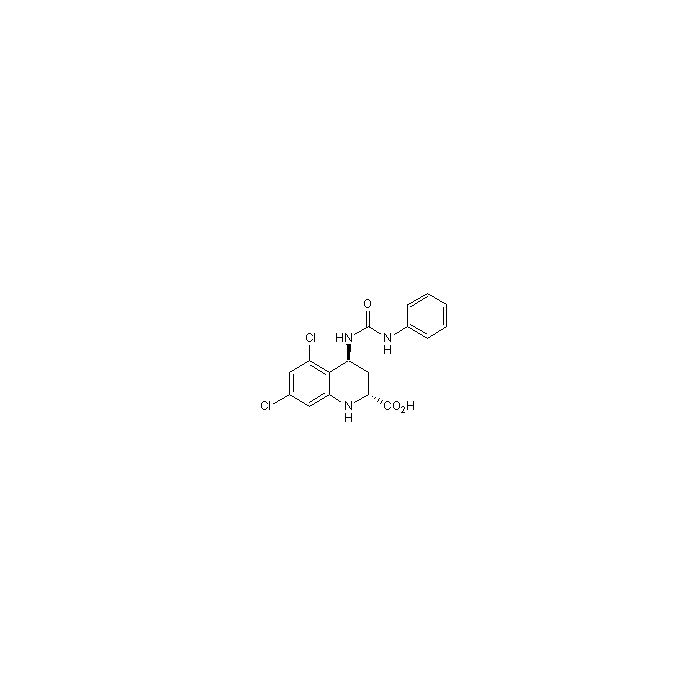
L-689560 is a potent N-methyl-D-aspartate (NMDA) receptor antagonist that inhibits GluN1 glycine binding sites. L-689560 is widely used as a radiolabeling ligand in binding studies, as well as to study the role of NMDA receptors in normal nervous system processes and diseases
| Canonical Smiles | C1C(C2=C(C=C(C=C2Cl)Cl)NC1C(=O)O)NC(=O)NC3=CC=CC=C3 |
|---|---|
| IUPAC Name | 5,7-dichloro-4-(phenylcarbamoylamino)-1,2,3,4-tetrahydroquinoline-2-carboxylic acid |
| InChIKey | UCKHICKHGAOGAP-UHFFFAOYSA-N |
| INCHI | 1S/C17H15Cl2N3O3/c18-9-6-11(19)15-12(7-9)21-14(16(23)24)8-13(15)22-17(25)20-10-4-2-1-3-5-10/h1-7,13-14,21H,8H2,(H,23,24)(H2,20,22,25) |
| Isomeric SMILES | C1C(C2=C(C=C(C=C2Cl)Cl)NC1C(=O)O)NC(=O)NC3=CC=CC=C3 |
| Molecular Weight | 380.23 |
| Reaxy-Rn | 8938021 |
| Reaxys-RN_link_address | https://www.reaxys.com/reaxys/secured/hopinto.do?context=S&query=IDE.XRN=8938021&ln= |
Comprehensive hazard, handling, storage, and regulatory compliance document.
Download SDS →Lot-specific quality data. Enter your lot number to retrieve the exact COA.
Look up COA →Full quality attributes and acceptance criteria for this grade.
View spec sheet →Taxonomy Tree
| Kingdom | Organic compounds |
|---|---|
| Superclass | Organoheterocyclic compounds |
| Class | Quinolines and derivatives |
| Subclass | Quinoline carboxylic acids |
| Intermediate Tree Nodes | Not available |
| Direct Parent | Quinoline carboxylic acids |
| Alternative Parents | Alpha amino acids N-phenylureas Hydroquinolines Secondary alkylarylamines Aralkylamines Aryl chlorides Ureas Amino acids Monocarboxylic acids and derivatives Azacyclic compounds Carboxylic acids Organochlorides Organopnictogen compounds Carbonyl compounds Organic oxides Hydrocarbon derivatives |
| Molecular Framework | Aromatic heteropolycyclic compounds |
| Substituents | Quinoline-2-carboxylic acid - Alpha-amino acid - Alpha-amino acid or derivatives - N-phenylurea - Tetrahydroquinoline - Aralkylamine - Secondary aliphatic/aromatic amine - Aryl chloride - Aryl halide - Monocyclic benzene moiety - Benzenoid - Amino acid or derivatives - Carbonic acid derivative - Amino acid - Urea - Carboxylic acid - Carboxylic acid derivative - Azacycle - Monocarboxylic acid or derivatives - Secondary amine - Organic nitrogen compound - Organohalogen compound - Organochloride - Organonitrogen compound - Carbonyl group - Organooxygen compound - Hydrocarbon derivative - Organic oxide - Organopnictogen compound - Amine - Organic oxygen compound - Aromatic heteropolycyclic compound |
| Description | This compound belongs to the class of organic compounds known as quinoline carboxylic acids. These are quinolines in which the quinoline ring system is substituted by a carboxyl group at one or more positions. |
| External Descriptors | Not available |
| Activity Type | Activity Value -log(M) | Mechanism of Action | Activity Reference | Publications (PubMed IDs) |
|---|
| Activity Type | Activity Value -log(M) | Mechanism of Action | Activity Reference | Publications (PubMed IDs) |
|---|
| Activity Type | Activity Value -log(M) | Mechanism of Action | Activity Reference | Publications (PubMed IDs) |
|---|
| Activity Type | Activity Value -log(M) | Mechanism of Action | Activity Reference | Publications (PubMed IDs) |
|---|
| Activity Type | Activity Value -log(M) | Mechanism of Action | Activity Reference | Publications (PubMed IDs) |
|---|
| Solubility | Solvent:DMSO, Max Conc. mg/mL: 9.51, Max Conc. mM: 25; Solvent:ethanol, Max Conc. mg/mL: 38.02, Max Conc. mM: 100 |
|---|---|
| Molecular Weight | 380.200 g/mol |
| XLogP3 | 3.500 |
| Hydrogen Bond Donor Count | 4 |
| Hydrogen Bond Acceptor Count | 4 |
| Rotatable Bond Count | 3 |
| Exact Mass | 379.049 Da |
| Monoisotopic Mass | 379.049 Da |
| Topological Polar Surface Area | 90.500 Ų |
| Heavy Atom Count | 25 |
| Formal Charge | 0 |
| Complexity | 502.000 |
| Isotope Atom Count | 0 |
| Defined Atom Stereocenter Count | 0 |
| Undefined Atom Stereocenter Count | 2 |
| Defined Bond Stereocenter Count | 0 |
| Undefined Bond Stereocenter Count | 0 |
| The total count of all stereochemical bonds | 0 |
| Covalently-Bonded Unit Count | 1 |
Our grade selection guide covers purity, stabilizer status, and application suitability for all variants in our catalog.
View Moligand™ grade guide →