NAD (Nicotinamide adenine dinucleotide) is a coenzyme present in all cells, existing in two forms: NAD⁺ (oxidized form) and NADH (reduced form). NAD⁺ not only serves as a coenzyme that transfers electrons in redox reactions but also acts as a substrate for many enzymes involved in intracellular reactions. NAD⁺ plays important roles in cellular and physiological functions, and its synthesis, degradation, and related products are involved in apoptosis, metabolic regulation, and gene expression regulation. A decrease in NAD⁺ is one of the major factors leading to cell death. The importance of NAD⁺ in regulating cellular redox status and its functions in modulating signaling pathways and transcription make NAD⁺ and the enzymes involved in its synthesis and consumption potential drug targets for various diseases.
This kit can detect NAD⁺, NADH, and their ratio in samples. The specific principle is as follows: Ethanol is oxidized to acetaldehyde by alcohol dehydrogenase, during which NAD⁺ is reduced to NADH. The generated NADH then reduces WST-8 to an orange-yellow formazan dye in the presence of the electron coupling reagent 1-mPMS, which has a maximum absorption peak at approximately 450 nm. The amount of formazan generated is proportional to the amount of NAD⁺ or NADH in the sample. By utilizing the opposite stability of NAD⁺ and NADH under extreme pH conditions, NAD⁺ is stabilized and extracted using an acidic extraction buffer, while NADH is stabilized and extracted using an alkaline extraction buffer. The NAD⁺/NADH ratio can also be calculated from the obtained values.
Components
N1373343 | Components | Appearance | 100 T | Storage | Quantity Per Test |
N1373343A | Alcohol Dehydrogenase | Liquid | 200 μL | -20°C, dark | 2 μL |
N1373343B | Absolute ethanol | Liquid | 200 μL | -20°C, dark | 2 μL |
N1373343C | Assay Buffer | Liquid | 20 mL | -20°C | 86 μL |
N1373343D | NADH Standard (5 mg) | Powder | 5 mg | -20°C, dark | As needed |
N1373343E | NADH Diluent | Liquid | 2 mL | -20℃ | As needed |
N1373343F | Chromogenic Solution | Liquid | 200 μL | -20°C, dark | 2 μL |
N1373343G | NADH Extraction Buffer | Liquid | 30 mL | -20℃ | As needed |
N1373343H | NAD+ Extraction Buffer | Liquid | 30 mL | -20℃ | As needed |
Usage Protocol
1. Sample Preparation
Fresh samples are recommended. If the experiment is not performed immediately, samples can be stored at –80 °C for a short period. When ready to perform the experiment, thaw samples on ice after removing from –80 °C. However, please note that this may affect sample stability, and the experimental results may be lower than expected.
1) Extraction from Tissue Samples
After washing the tissue with pre‑cooled PBS on ice, weigh approximately 20 mg of tissue, cut it into small pieces with scissors, and place it into a homogenizer.
Extraction of NAD⁺: Add 100 µL of NAD⁺ Extraction Buffer and homogenize the sample. Heat at 60 °C for 5 min. After cooling on ice, add 20 µL of Assay Buffer and 100 µL of NADH Extraction Buffer to neutralize the extract. Centrifuge at 4 °C and 14,000 rpm for 5 min, transfer the supernatant to a new centrifuge tube, and keep on ice for testing.
Extraction of NADH: Add 100 µL of NADH Extraction Buffer and homogenize the sample. Heat at 60 °C for 5 min. After cooling on ice, add 20 µL of Assay Buffer and 100 µL of NAD⁺ Extraction Buffer to neutralize the extract. Centrifuge at 4 °C and 14,000 rpm for 5 min, transfer the supernatant to a new centrifuge tube, and keep on ice for testing.
2) Extraction from Cell or Bacterial Samples
Collect cells or bacteria (recommended sample amount: 1 × 10⁶ per sample), wash with cold PBS, centrifuge at low speed for 5 min, and discard the supernatant.
Extraction of NAD⁺: Add 100 µL of NAD⁺ Extraction Buffer and perform ultrasonic disruption for 5 min (power 20% or 200 W, sonicate for 3 s, pause for 7 s, repeat 30 times). Heat at 60 °C for 5 min. After cooling on ice, add 20 µL of Assay Buffer and 100 µL of NADH Extraction Buffer to neutralize the extract. Centrifuge at 4 °C and 14,000 rpm for 5 min, transfer the supernatant to a new centrifuge tube, and keep on ice for testing.
Extraction of NADH: Add 100 µL of NADH Extraction Buffer and perform ultrasonic disruption for 5 min (power 20% or 200 W, sonicate for 3 s, pause for 7 s, repeat 30 times). Heat at 60 °C for 5 min. After cooling on ice, add 20 µL of Assay Buffer and 100 µL of NAD⁺ Extraction Buffer to neutralize the extract. Centrifuge at 4 °C and 14,000 rpm for 5 min, transfer the supernatant to a new centrifuge tube, and keep on ice for testing.
2. Preparation of Standard
1) Pipette 705 μL of NADH Diluent to fully dissolve the 5 mg NADH provided in the kit, thereby obtaining a 10 mM NADH standard. Aliquot appropriately, store at –80 °C protected from light, and avoid repeated freeze‑thaw cycles.
2) Preparation of Standard Diluent: Because the sample processing involves extraction and neutralization steps, it is necessary to use buffers of the same system to dilute the standards in order to reduce experimental error. Pipette 1.5 mL of NADH Extraction Buffer, 1.5 mL of NAD⁺ Extraction Buffer, and 300 μL of Assay Buffer to prepare the standard diluent. This diluent can be reused.
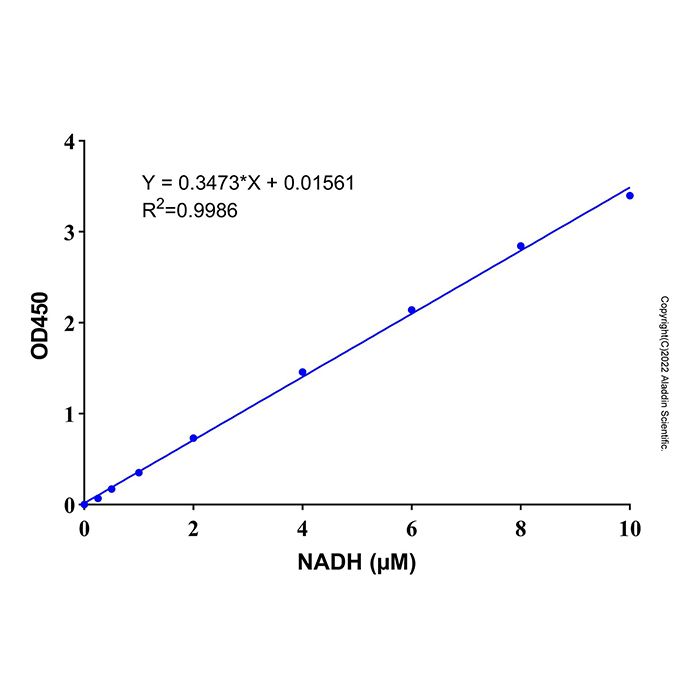
3) Setting of NADH Standard Curve: Take 2 μL of the 10 mM NADH standard and add it to 1.998 mL of Standard Diluent to dilute to 10 μM. Dilute the 10 μM NADH standard according to the table below to obtain concentrations of 0, 0.25, 0.5, 1, 2, 4, 6, 8, and 10 μM. For detection, add 20 μL of the standard per well in a 96‑well plate, which corresponds to 0, 5, 10, 20, 40, 80, 120, 160, and 200 pmol of NADH per well. Since NADH is very unstable, use it as soon as possible after preparation.
No. | Concentration (μM) | Standard (μL) | Standard Diluent (μL) |
1 | 10 | 80 | 0 |
2 | 8 | 64 | 16 |
3 | 6 | 48 | 32 |
4 | 4 | 32 | 48 |
5 | 2 | 16 | 64 |
6 | 1 | 8 | 72 |
7 | 0.5 | 4 | 76 |
8 | 0.25 | 2 | 78 |
NC | 0 | 0 | 80 |
3. Preparation of Working Solutions
1) Preparation of Alcohol Dehydrogenase Working Solution
Pipette 2 μL of Alcohol Dehydrogenase and 2 μL of absolute ethanol into 86 μL of Assay Buffer to obtain 90 μL of Alcohol Dehydrogenase Working Solution. Each standard or sample requires 90 μL of Alcohol Dehydrogenase Working Solution. Prepare an appropriate amount according to the number of standards and samples to be tested, and use it freshly prepared.
2) Preparation of Chromogenic Working Solution
Pipette 2 μL of Chromogenic Solution into 8 μL of Assay Buffer to obtain 10 μL of Chromogenic Working Solution. Each standard or sample requires 10 μL of Chromogenic Working Solution. Prepare an appropriate amount according to the number of standards and samples to be tested, and use it freshly prepared.
4. Sample Measurement
1) Refer to the table below to set up blank control wells, standard wells, and sample wells in a 96 well plate. After adding the Alcohol Dehydrogenase Working Solution, mix thoroughly. Incubate at 37 °C in the dark for 5 minutes to convert NAD⁺ in the sample to NADH.
Reagent | Blank Well | Standard Well | Sample Well |
Sample | - | - | 20 μL |
Different concentrations of standard | - | 20 μL | - |
Assay Buffer | 20 μL | - | - |
Alcohol Dehydrogenase Working Solution | 90 μL | 90 μL | 90 μL |
2) Take the diluted Chromogenic Working Solution, add 10 μL to each well, mix, and incubate at 37 °C in the dark for 15‑20 minutes. Measure the absorbance at 450 nm. If the color development is weak, the incubation time may be appropriately extended to 30‑60 minutes.
5. Result Calculation
Calculate ΔAsample = Asample – Ablank, and ΔAstandard = Astandard – Ablank. Plot a standard curve with the standard concentration as the Xaxis and ΔAstandard as the Yaxis. Substitute ΔAsample into the equation to obtain the X value (µM). Calculate the NAD⁺ or NADH content in the sample according to the following formulas:
1) Calculated by sample mass:
NAD⁺ or NADH (nmol/g fresh weight) = (X × Vsample) ÷ (W × Vsample ÷ Vextraction) × n = 0.22 × X ÷ W × n
2) Calculated by sample protein concentration:
NAD⁺ or NADH (nmol/mg prot) = (X × Vsample) ÷ (Vsample × Cpr) × n = X ÷ Cpr × n
3) Calculated by cell or bacteria number:
NAD⁺ or NADH (nmol/10⁴) = (X × Vsample) ÷ (N × Vsample ÷ Vextraction) × n = 0.22 × X ÷ N × n
Where:
X: NADH concentration obtained from the standard curve (1 µM = 1 nmol/mL);
Vsample: sample volume added, 0.02 mL;
Vextraction: total extraction volume (0.22 mL);
Cpr: protein concentration of the sample (mg/mL);
W: sample mass (g);
N: cell or bacteria number, in units of 10⁴ (e.g., for 1×10⁶ cells, N = 100);
n: dilution factor.
Precautions
1. When measuring only the amount of NAD⁺ or NADH in samples, one kit can perform 100 tests; when measuring the NAD⁺/NADH ratio, one kit can perform 50 tests.
2. Before formal testing, it is recommended to perform a preliminary experiment using 2–3 samples with expected large differences.
3. After preparing the NADH solution, aliquot appropriately and store at –80 °C. Avoid repeated freeze‑thaw cycles for all reagents.
4. Alcohol dehydrogenase is unstable; do not leave it at room temperature for extended periods.

 ZJ26F0535686