
Determine the necessary mass, volume, or concentration for preparing a solution.
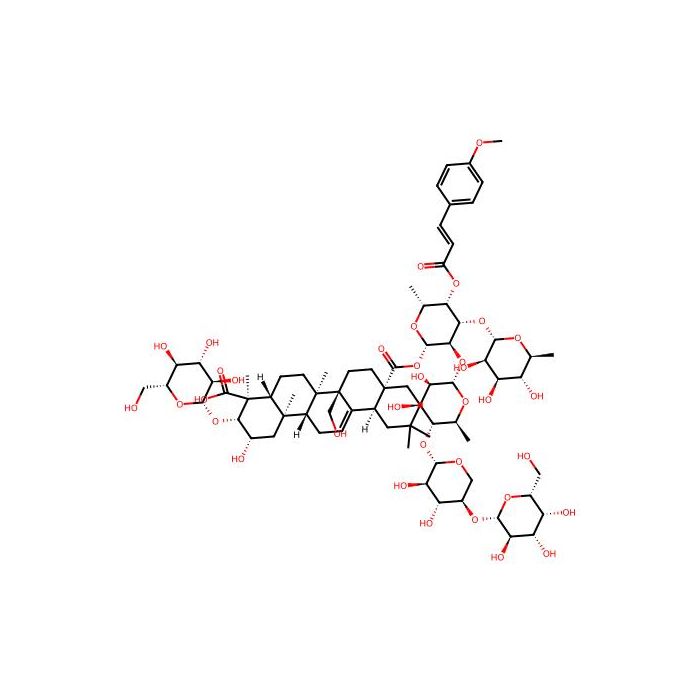
Onjisaponin B - ≥99% , CAS No.35906-36-6
AVAILABLE TO ORDER
GRADE & PURITY ≥99%
Storage
Store at -20°C
Shipped In
Ice chest + Ice pads
≥99% for sensitive chromatographic and analytical workflows requiring minimal baseline interference.
Store at -20°C Ships Ice chest + Ice pads Check lot-specific COA for exact specifications.
SDS, COA, datasheet, and spec sheet available for download. Lot-specific COA accessible via lot number lookup.
Cited in 0 peer-reviewed publications across chromatography, organic synthesis, and cross-coupling reactions.
Onjisaponin B is a natural product derived from Polygala tenuifolia. Onjisaponin B enhances autophagy and accelerates the degradation of mutant α-synuclein and huntingtin in PC-12 cells, and exbibits potential therapeutic effects on Parkinson disease and Huntington disease.
Form:Solid
| Canonical Smiles | CC1C(C(C(C(O1)OC2C(C(OC(C2OC3C(C(C(C(O3)C)OC4C(C(C(CO4)OC5C(C(C(C(O5)CO)O)O)O)O)O)O)O)OC(=O)C67CCC(CC6C8=CCC9C(C8(CC7)CO)(CCC1C9(CC(C(C1(C)C(=O)O)OC1C(C(C(C(O1)CO)O)O)O)O)C)C)(C)C)C)OC(=O)C=CC1=CC=C(C=C1)OC)O)O)O |
|---|---|
| IUPAC Name | (2S,3R,4S,4aR,6aR,6bR,8aS,12aS,14aR,14bR)-8a-[(2S,3R,4S,5S,6R)-3-[(2S,3R,4S,5R,6S)-5-[(2S,3R,4R,5R)-3,4-dihydroxy-5-[(2S,3R,4S,5R,6R)-3,4,5-trihydroxy-6-(hydroxymethyl)oxan-2-yl]oxyoxan-2-yl]oxy-3,4-dihydroxy-6-methyloxan-2-yl]oxy-5-[(E)-3-(4-methoxyphenyl)prop-2-enoyl]oxy-6-methyl-4-[(2S,3R,4R,5R,6S)-3,4,5-trihydroxy-6-methyloxan-2-yl]oxyoxan-2-yl]oxycarbonyl-2-hydroxy-6b-(hydroxymethyl)-4,6a,11,11,14b-pentamethyl-3-[(2R,3R,4S,5S,6R)-3,4,5-trihydroxy-6-(hydroxymethyl)oxan-2-yl]oxy-1,2,3,4a,5,6,7,8,9,10,12,12a,14,14a-tetradecahydropicene-4-carboxylic acid |
| InChIKey | QSTBHNPMHXYCII-KJCIHCEPSA-N |
| INCHI | 1S/C75H112O35/c1-30-44(81)48(85)53(90)63(99-30)107-59-58(105-43(80)17-12-33-10-13-34(97-9)14-11-33)32(3)101-67(60(59)108-64-56(93)51(88)57(31(2)100-64)106-62-52(89)47(84)40(28-98-62)104-65-54(91)49(86)45(82)38(26-76)102-65)110-69(96)74-21-20-70(4,5)24-36(74)35-15-16-41-71(6)25-37(79)61(109-66-55(92)50(87)46(83)39(27-77)103-66)73(8,68(94)95)42(71)18-19-72(41,7)75(35,29-78)23-22-74/h10-15,17,30-32,36-42,44-67,76-79,81-93H,16,18-29H2,1-9H3,(H,94,95)/b17-12+/t30-,31-,32+,36-,37-,38+,39+,40+,41+,42+,44-,45-,46+,47-,48+,49-,50-,51-,52+,53+,54+,55+,56+,57-,58-,59-,60+,61-,62-,63-,64-,65-,66-,67-,71+,72+,73-,74-,75-/m0/s1 |
| Isomeric SMILES | C[C@H]1[C@@H]([C@H]([C@H]([C@@H](O1)O[C@H]2[C@H]([C@H](O[C@H]([C@@H]2O[C@H]3[C@@H]([C@@H]([C@H]([C@@H](O3)C)O[C@H]4[C@@H]([C@H]([C@@H](CO4)O[C@H]5[C@@H]([C@H]([C@H]([C@H](O5)CO)O)O)O)O)O)O)O)OC(=O)[C@@]67CC[C@@]8(C(=CC[C@H]9[C@]8(CC[C@@H]1[C@@]9(C[C@@H]([C@@H]([C@@]1(C)C(=O)O)O[C@H]1[C@@H]([C@H]([C@@H]([C@H](O1)CO)O)O)O)O)C)C)[C@@H]6CC(CC7)(C)C)CO)C)OC(=O)/C=C/C1=CC=C(C=C1)OC)O)O)O |
| PubChem CID | 21669942 |
| Molecular Weight | 1573.7 |
Comprehensive hazard, handling, storage, and regulatory compliance document.
Download SDS →Lot-specific quality data. Enter your lot number to retrieve the exact COA.
Look up COA →Full quality attributes and acceptance criteria for this grade.
View spec sheet →Taxonomy Tree
| Kingdom | Organic compounds |
|---|---|
| Superclass | Lipids and lipid-like molecules |
| Class | Prenol lipids |
| Subclass | Terpene glycosides |
| Intermediate Tree Nodes | Triterpene glycosides |
| Direct Parent | Triterpene saponins |
| Alternative Parents | Triterpenoids Oligosaccharides 12-alpha-hydroxysteroids Fatty acyl glycosides Cinnamic acid esters O-glycosyl compounds Tricarboxylic acids and derivatives Styrenes Anisoles Methoxybenzenes Phenoxy compounds Alkyl aryl ethers Fatty acid esters Oxanes Enoate esters Cyclic alcohols and derivatives Secondary alcohols Polyols Carboxylic acids Acetals Oxacyclic compounds Hydrocarbon derivatives Primary alcohols Carbonyl compounds Organic oxides |
| Molecular Framework | Aromatic heteropolycyclic compounds |
| Substituents | Triterpene saponin - Triterpenoid - Oligosaccharide - 12-hydroxysteroid - 15-hydroxysteroid - Hydroxysteroid - 12-alpha-hydroxysteroid - Steroid - Fatty acyl glycoside - Cinnamic acid or derivatives - Cinnamic acid ester - O-glycosyl compound - Glycosyl compound - Tricarboxylic acid or derivatives - Phenol ether - Styrene - Anisole - Phenoxy compound - Methoxybenzene - Fatty acid ester - Alkyl aryl ether - Monocyclic benzene moiety - Fatty acyl - Benzenoid - Oxane - Enoate ester - Alpha,beta-unsaturated carboxylic ester - Cyclic alcohol - Secondary alcohol - Carboxylic acid ester - Polyol - Acetal - Carboxylic acid derivative - Carboxylic acid - Organoheterocyclic compound - Ether - Oxacycle - Organooxygen compound - Organic oxygen compound - Primary alcohol - Hydrocarbon derivative - Organic oxide - Carbonyl group - Alcohol - Aromatic heteropolycyclic compound |
| Description | This compound belongs to the class of organic compounds known as triterpene saponins. These are glycosylated derivatives of triterpene sapogenins. The sapogenin moiety backbone is usually based on the oleanane, ursane, taraxastane, bauerane, lanostane, lupeol, lupane, dammarane, cycloartane, friedelane, hopane, 9b,19-cyclo-lanostane, cycloartane, or cycloartanol skeleton. |
| External Descriptors | Not available |
| Solubility | DMSO : 100 mg/mL (63.55 mM; Need ultrasonic) |
|---|---|
| Molecular Weight | 1573.700 g/mol |
| XLogP3 | -1.800 |
| Hydrogen Bond Donor Count | 18 |
| Hydrogen Bond Acceptor Count | 35 |
| Rotatable Bond Count | 22 |
| Exact Mass | 1572.7 Da |
| Monoisotopic Mass | 1572.7 Da |
| Topological Polar Surface Area | 545.000 Ų |
| Heavy Atom Count | 110 |
| Formal Charge | 0 |
| Complexity | 3230.000 |
| Isotope Atom Count | 0 |
| Defined Atom Stereocenter Count | 39 |
| Undefined Atom Stereocenter Count | 0 |
| Defined Bond Stereocenter Count | 1 |
| Undefined Bond Stereocenter Count | 0 |
| The total count of all stereochemical bonds | 1 |
| Covalently-Bonded Unit Count | 1 |