This compound belongs to the class of organic compounds known as p-chlorophenols. These are chlorophenols carrying a iodine at the C4 position of the benzene ring.
External Descriptors
Not available
1. Djoumbou Feunang Y, Eisner R, Knox C, Chepelev L, Hastings J, Owen G, Fahy E, Steinbeck C, Subramanian S, Bolton E, Greiner R, and Wishart DS. ClassyFire: Automated Chemical Classification With A Comprehensive, Computable Taxonomy. Journal of Cheminformatics, 2016, 8:61.
Determine the necessary mass, volume, or concentration for preparing a solution.
Dilution Calculator
Determine the dilution needed to prepare a stock solution.
Reconstitution Calculator
Reviews
Customer Reviews
Application Protocols
No item-specific validated protocols are provided. The following outlines general, literature-based procedures for using 13C-labeled small-molecule standards in analytical workflows. Adapt to your method and consult your lab’s SOPs.
LC-MS (isotope-dilution for PCP):
Prepare a 1.0 mg/mL stock in MeCN. Dilute to working internal standard solution (e.g., 100–1000 ng/mL) in MeCN/H2O (50:50) with 0.1% formic or acetic acid as method requires.
Spike a fixed volume of internal standard into samples, blanks, and calibrators prior to extraction.
Extract (e.g., SPE with phenyl or HLB sorbent; or LLE at pH <2 for neutral PCP into MTBE). Reconstitute in initial LC mobile phase.
Quantify using MRM or HRMS, monitoring a +6 u mass shift relative to native PCP; use co-elution to correct matrix effects.
GC-MS:
Derivatize phenolic OH if needed (e.g., BSTFA silylation). Include 13C6-PCP in the derivatization mix for matched response.
Extract into non-polar solvent (hexane/toluene), inject with appropriate liner conditions.
Quality controls:
Include procedural blanks, matrix spikes, and independent check standards.
Verify isotopic purity via HRMS to ensure distinct separation from native signal.
These are general guidelines; validate and document any protocol before routine use.
Biological Roles
No biological roles are specified for this item. The following information reflects literature knowledge about pentachlorophenol (PCP) as a chemical entity; use is restricted to research applications only.
General biochemical behavior (literature):
Membrane-active weak acid: PCP can shuttle protons across biological membranes in its neutral form and dissociate in the aqueous phase, disrupting proton gradients.
Mitochondrial effects: Functions as a classical uncoupler of oxidative phosphorylation in vitro by collapsing ΔpH/ΔΨ across inner mitochondrial membranes (mechanistic detail; not a use claim).
Enzyme interactions: Chlorinated phenols can interact with xenobiotic-metabolizing enzymes (e.g., conjugation to glucuronides/sulfates in mammals; dechlorination/oxidation in microbes) (literature).
Environmental fate (literature):
Partitioning: High log Kow drives sorption to organic matter and bioaccumulation potential.
Transformation: Undergoes photolysis and microbial degradation pathways, sometimes forming less-chlorinated phenols.
Isotopic tracer utility:
13C label tracking: Facilitates mass-balance studies in complex matrices via isotope ratio mass spectrometry or HRMS, distinguishing added standard from endogenous PCP.
No medical, diagnostic, or therapeutic applications are claimed or supported for this product. For any studies involving biological systems, ensure IACUC/IRB/EHS approvals and follow institutional safety procedures.
Buffer Applications
This product is a small-molecule phenolic standard and is not typically used as a buffering agent. It lacks the multi-protonation equilibria and desired buffering capacity of classical buffers.
Practical note:
For aqueous handling, pH control affects solubility: at basic pH (≥pH 9–10), the phenolate is water-soluble; at acidic to neutral pH, the neutral phenol is poorly soluble and extracts into organic solvents.
If a buffer is needed for sample preparation, typical carbonate or borate buffers (pH 9–10) are used to ionize the phenol for aqueous-phase manipulations, followed by acidification for extraction.
Refer to Reaction & Applications and Solvent Selection for more relevant guidance on handling and sample preparation.
Green Alternatives
As a highly chlorinated phenol, pentachlorophenol and its isotopologues carry environmental and health hazards. While Pentachlorophenol-¹³C6 is often indispensable as an analytical internal standard for PCP, greener choices may be possible depending on the application.
When an internal standard is required (analytical):
Necessity: For isotope-dilution quantification of PCP, a structurally identical 13C-labeled standard provides the most accurate correction; substitution compromises accuracy.
Mitigation: Use the minimum effective amount; implement rigorous containment and waste minimization.
For general phenolic chemistry or activated ester formation:
Greener aryl leaving groups: Pentafluorophenyl (PFP) esters are common but also fluorinated; consider N-hydroxysuccinimide (NHS) or 1-hydroxybenzotriazole (HOBt)-type esters where appropriate, acknowledging different reactivity and safety profiles.
Less halogenated phenols: If halogen influence is not crucial, phenol or p-nitrophenol derivatives (still hazardous) may reduce PBT concerns compared with pentachloro analogs.
Solvent choices (literature):
Prefer MeCN or EtOAc over chlorinated solvents where performance allows; for extractions, consider MTBE or 2-MeTHF as alternatives to DCM, balancing volatility, safety, and method requirements.
Comparison (general):
Objective: highest analytical accuracy → 13C6-PCP is necessary.
Objective: routine coupling chemistry → consider NHS/PFP esters, green solvents, and catalytic coupling reagents to reduce halogenated waste.
Always conduct a risk-benefit analysis and follow institutional green chemistry guidelines.
Pharmaceutical Uses
No pharmaceutical or excipient uses are specified for this item, and none are claimed. Pentachlorophenol-¹³C6 is intended for research use only.
Analytical internal standard: Employed in method development and validation (e.g., LC/GC-MS) to quantify native pentachlorophenol or related chlorophenols in raw materials, process streams, and environmental samples.
Stability studies: Can support forced-degradation or extractables/leachables assessments where chlorophenolic species are of interest, providing a labeled reference for mass balance.
Not a drug substance or excipient:
No pharmacopeial monograph is indicated for the 13C6 isotopologue.
Not intended for human or veterinary administration; for research and analytical laboratory use only.
Physical Properties
Only limited item-specific properties are provided. The following are literature/computed values for pentachlorophenol and its uniformly 13C-labeled analog; actual certificate specifications may differ.
Item-specific (from Product Data):
Appearance: Not specified for this item; refer to CoA/Spec Sheet.
Molecular Weight: Not specified for this item; refer to CoA/Spec Sheet.
Literature/computed (for PCP and ¹³C6-PCP unless noted):
Molecular formula (¹³C-labeled): ¹³C6HCl5O (literature)
Molecular weight (¹³C6): ~272.34 g/mol (computed from isotopic substitution; literature)
Water solubility: low as neutral phenol (mg·L⁻¹ range at 20–25 °C; increases at basic pH via phenolate formation; literature)
Solubility in organics: soluble in polar aprotic solvents (e.g., acetone, acetonitrile, DMF, DMSO) and moderately in less polar solvents (literature)
Vapor pressure: very low at ambient temperature (literature)
Notes:
Isotopic substitution with 13C does not materially change bulk physical behavior vs. native PCP.
For method validation or regulatory reporting, rely on the product’s CoA for exact values used in specifications.
Quality & Grades
Item-specific (from Product Data):
Grade/Purity: Not specified for this item; refer to CoA/Spec Sheet.
Context for isotopically labeled standards (general):
Isotopic enrichment: For 13C-labeled materials used as internal standards, the % 13C enrichment and isotopic distribution (uniform vs. site-specific) are critical. Typical enrichment for quantitative LC/GC-MS is ≥99 atom% for labeled positions, but this item’s enrichment is not specified—consult the CoA.
Chemical purity vs. isotopic purity: Chemical purity (e.g., ≥98%) refers to absence of chemical impurities; isotopic purity refers to fraction of molecules containing the intended 13C pattern. Both influence analytical performance.
Residual solvents/inorganics: Trace solvents, inorganic salts, or moisture can affect mass balance and response factors; check the CoA for residuals and loss on drying.
Stabilizers: None stated for this item. If present in a given lot, stabilizers will be listed on the CoA and may impact certain applications (e.g., derivatization, esterification).
Review CoA data for isotopic pattern by HRMS and for chemical purity by HPLC/GC.
Confirm absence of unlabeled PCP at levels that could bias isotope-dilution assays.
For trace-level quantitation, assess background contamination by running procedural blanks.
Reaction & Applications
Primary use of Pentachlorophenol-¹³C6 is as an isotopically labeled internal standard or tracer in analytical chemistry. Additionally, pentachlorophenol can participate in certain synthetic transformations.
Analytical applications (literature/general):
Isotope-dilution quantification: Serves as a co-eluting internal standard for native PCP in LC/GC-MS, correcting for matrix effects and recovery.
Tracer studies: Tracks partitioning, sorption, and degradation pathways of chlorophenols in environmental systems via mass shifts (Δm ≈ +6 u).
Synthetic reactivity (literature):
Activated aryl hydroxyl component: Formation of pentachlorophenyl (PCP) esters from carboxylic acids using carbodiimides (DCC/EDC) or acid chlorides; PCP esters are activated acylating agents (though pentafluorophenyl esters are more common).
Phenolate chemistry: As a weak acid, deprotonation generates nucleophilic pentachlorophenolate, which can engage in SNAr with highly activated aryl fluorides or function as a leaving group in transesterifications.
Practical tips:
For analytical standards, prepare gravimetrically in dry MeCN or MeOH; store in amber vials to prevent photolysis.
Avoid prolonged basic conditions if back-extraction of the neutral form is desired; control pH during sample prep.
When forming PCP esters, remove adventitious water (e.g., 4 Å molecular sieves) to drive coupling efficiency.
Note: When the isotopic label must be preserved, avoid conditions that could scramble the aromatic carbons (extreme temperatures or harsh rearrangements).
Reaction Conditions
General, literature-based conditions relevant to pentachlorophenol chemistry are summarized below. Adjust for scale, substrate, and desired outcome. These are not item-specific specifications.
Formation of pentachlorophenyl (PCP) esters (literature typical):
From carboxylic acids (DCC coupling): Carboxylic acid (1.0 eq), pentachlorophenol (1.2–1.5 eq), DCC (1.2–1.5 eq), catalytic DMAP (0.05–0.1 eq) in dry DCM or DMF, 0–25 °C, 2–16 h. Work up by filtration (dicyclohexylurea removal) and purification by column chromatography.
From acid chlorides: Acid chloride (1.0 eq), pentachlorophenol (1.1–1.5 eq), base (2.0 eq, e.g., pyridine or triethylamine) in DCM or toluene, 0–25 °C, 1–4 h.
Generation of pentachlorophenolate:
Base: NaH, K2CO3, or aqueous NaOH depending on solvent system. In polar aprotic solvents (DMF, DMSO), 1.0–1.5 eq base at 0–25 °C is typical.
Analytical standard preparation:
Stock solutions: 0.10–1.0 mg/mL in MeCN or MeOH; prepare gravimetrically with Class A glassware. Store in amber glass at ≤4–8 °C for medium-term stability; freeze at −20 °C for long-term.
Calibration: Use isotope-dilution protocols with constant labeled standard addition prior to extraction to correct recoveries.
Expected outcomes (illustrative literature ranges):
PCP ester formation: 60–90% isolated yield depending on substrate and conditions.
Always confirm compatibility of conditions with the 13C label if isotopic integrity must be preserved.
Safety & Handling
No item-specific GHS details are provided; consult the SDS for authoritative information. The following are general, literature-based safety considerations for pentachlorophenol (PCP) and its isotopologues used strictly for research.
Item-specific (from Product Data):
Signal word / H-statements / GHS classification / pictograms: Not specified for this item; refer to SDS.
Storage guidance: Store at room temperature, protected from light. Ship under normal conditions.
General hazards (literature):
Toxicity: PCP is acutely toxic; avoid inhalation, ingestion, and skin contact. Phenolic compounds can cause burns and systemic effects.
Environmental: Persistent, bioaccumulative, and toxic in aquatic environments; prevent release to the environment. Handle waste as hazardous.
Combustibility: Organic solid; may produce corrosive and toxic gases (HCl, CO/CO2) on combustion.
PPE and controls (good laboratory practice):
Engineering controls: Work in a certified fume hood. Use closed containers and secondary containment.
Personal protective equipment: Lab coat, chemical-resistant gloves (e.g., nitrile), splash goggles; consider double-gloving for extended handling.
Hygiene: Avoid skin contact; wash thoroughly after use. Do not eat, drink, or smoke in work areas.
First aid (overview; defer to SDS):
Skin/eye contact: Immediate decontamination with copious water; remove contaminated clothing; seek medical evaluation.
Inhalation: Move to fresh air; monitor breathing; seek medical attention.
Ingestion: Rinse mouth; do not induce vomiting; obtain medical attention.
Always consult the specific SDS and institutional EHS policies before handling.
Solvent Selection
Pentachlorophenol-¹³C6 is a weakly acidic, highly chlorinated phenolic solid with limited water solubility in its neutral form. Solvent choice strongly influences handling and analytical performance.
Polarity and ionization (literature):
pKa ~4.7–5.0: Above this pH, the phenolate is formed, greatly increasing aqueous solubility.
Hydrophobicity: Log Kow ~5 indicates strong affinity for organic phases.
Recommended solvents (use-case driven):
Stock solutions (analytical): Acetonitrile, methanol, or acetone at 0.1–1 mg/mL; for GC, non-protic solvents (hexane, toluene) or derivatized forms may be preferred.
Difficult dissolution: Small amounts of DMSO or DMF can assist; subsequently dilute with MeOH/MeCN for LC compatibility.
Aqueous work: Maintain basic pH (e.g., pH 10 carbonate buffer) to solubilize as phenolate; re-acidify if extraction of the neutral species is required.
Poorly soluble: Water (neutral pH), alkanes (unless warmed or diluted from a polar co-solvent).
Selection guidance:
LC-MS workflows: Prefer MeCN or MeOH to minimize ion suppression; consider adding 0.1–1 mM ammonium fluoride or formate for improved ionization (method dependent).
GC-MS workflows: Consider derivatization (e.g., silylation of phenol) or analysis as the pentachlorophenyl ester of an analyte in other contexts.
Always verify solvent compatibility with your instrumentation and intended method.
Storage & Reconstitution
Item-specific (from Product Data):
Storage conditions: Protected from light, room temperature.
Shipped in: Normal conditions.
General guidance (literature/best practice for phenolic analytical standards):
Light protection: Store in amber glass vials; minimize exposure during weighing and solution prep.
Solid material: Keep container tightly closed in a dry place. If hygroscopicity or caking is observed, handle quickly in low-humidity conditions.
Solution preparation: Dissolve gravimetrically in dry acetonitrile or methanol to prepare a primary stock (e.g., 1 mg/mL). Filter through PTFE (0.2 µm) if particulate is present.
Aliquoting: Prepare single-use aliquots to avoid repeated freeze–thaw or photolysis; cap with PTFE-lined closures.
Temperature for solutions: Although the item can be stored at room temperature as a solid, keep solutions at 2–8 °C for short term (days to weeks) or −20 °C for long term (months), protected from light.
Stability checks: Periodically verify concentration by UV or LC/HRMS using fresh calibration; monitor for degradation or adsorption losses.
Always defer to the lot-specific CoA/SDS for definitive storage, stability, and handling instructions.
Structure & Identity
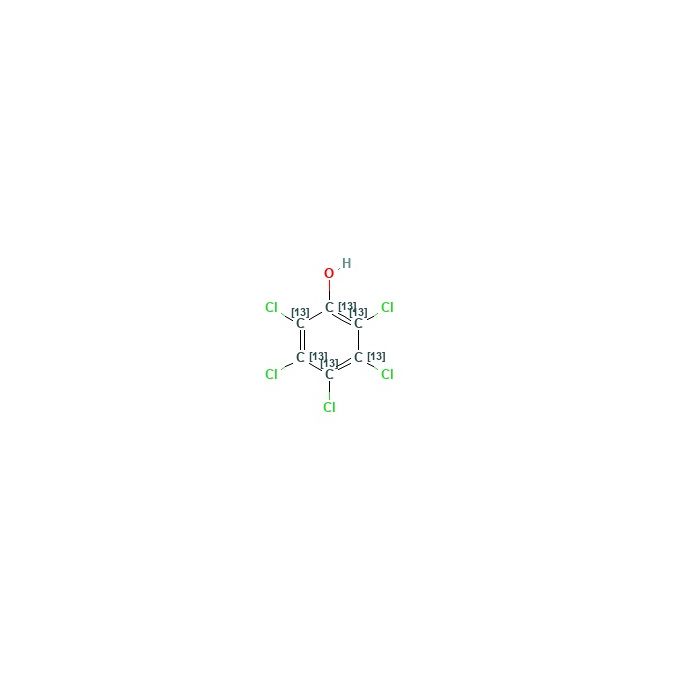
Pentachlorophenol-¹³C6 is the uniformly 13C-labeled isotopologue of pentachlorophenol (PCP), useful as an internal standard and tracer in analytical and environmental chemistry.
Item-specific identifiers (from Product Data):
SKU: P346942
CAS: 85380-74-1 (13C6 isotopologue)
CID: 12273179
InChIKey: Not specified for this item; refer to CoA/Spec Sheet.
SMILES: Not specified for this item; refer to CoA/Spec Sheet.
Structural description (literature/general):
Core scaffold: Phenyl ring bearing five chloro substituents and one phenolic hydroxyl group (pentasubstituted phenol).
Isotopic labeling: All six ring carbons are 13C; the molecule is otherwise chemically identical to native PCP.
Functional groups: Phenolic OH (weakly acidic), five aryl chlorides (strongly deactivating, ortho/para-directing in electrophilic reactions on less chlorinated analogs; here the ring is fully substituted).
2D structure (in words): A benzene ring with an OH and five Cl atoms occupying all six ring positions (no unsubstituted ring positions remain); oxygen is directly bonded to an aromatic carbon.
Empirical composition (literature/computed for isotopologue):
Molecular formula: ¹³C6HCl5O (literature)
Average molecular weight: ~272.34 g/mol for ¹³C6 isotopologue (native PCP ≈ 266.34 g/mol; +6.02 for six 13C, literature).
Note: Exact structure strings (SMILES/InChI) and any stereochemical annotations are not specified for this item; consult the CoA/Spec Sheet for definitive identity documentation.
Synthetic Utility
While the uniformly 13C-labeled material is most often used as an internal standard, pentachlorophenol itself can serve as a reagent or leaving group in organic synthesis.
Key functional features (literature):
Phenolic OH (weak acid): Can be deprotonated to form pentachlorophenolate, a moderately good nucleophile and excellent leaving group in acyl transfer reactions when converted to the corresponding ester.
Aryl chlorides: The ring is fully substituted, limiting further electrophilic aromatic substitution; however, the strong electron-withdrawing effect activates the phenolic oxygen for acylation and enables SNAr on suitably activated partners in some cases.
Typical transformations:
Activated esters: Formation of pentachlorophenyl (PCP) esters from carboxylic acids (via DCC/EDC or acid chloride + base) to enable subsequent coupling to nucleophiles (alcohols, amines). PCP esters are less common than PFP (pentafluorophenyl) analogs but are competent acylating agents.
Phase-transfer applications: Pentachlorophenolate salts can facilitate certain nucleophilic substitutions under biphasic conditions.
Isotopic considerations:
Using 13C6-labeled PCP in synthesis embeds the label into the phenolic fragment or the pentachlorophenyl moiety of intermediates; avoid conditions that would remove or scramble the aromatic carbons if label integrity is required.
For routine coupling chemistry where label retention is unnecessary, unlabeled PCP or alternative activating groups may be more economical.
Target Specificity
Not applicable. This product is a small-molecule chemical standard, not a biological targeting reagent (e.g., antibody, ligand with defined receptor specificity). No antigen, epitope, species reactivity, clone, or isotype information applies.
We use cookies to ensure the website functions properly and, where permitted, to improve your experience. You can manage your preferences at any time in Settings. Learn more in our Cookie Policy.
Shall we send you a message when we have discounts available?
Remind me later
Thank you! Please check your email inbox to confirm.
Products are supplied to verified businesses, institutions, and qualified professionals for research and development use only. Not for use in humans, animals, diagnosis, or therapy.

 H2218725