
Determine the necessary mass, volume, or concentration for preparing a solution.
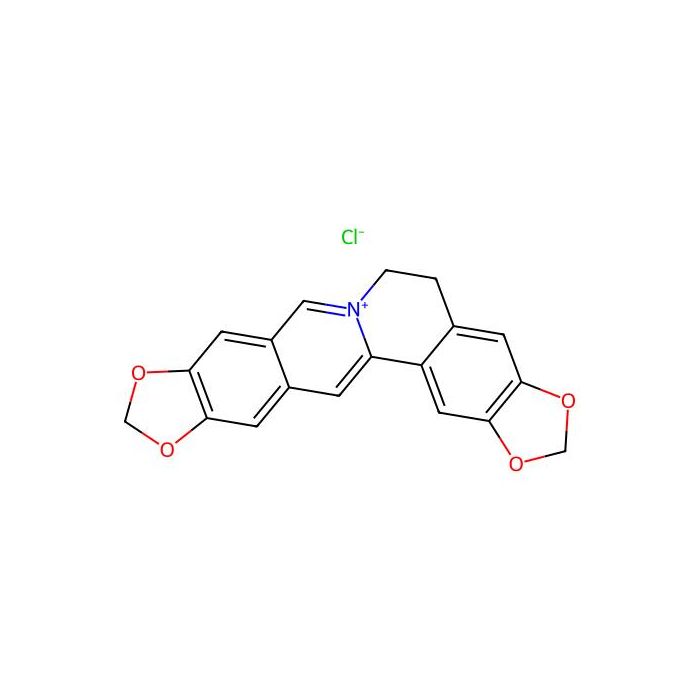
Pseudocoptisine chloride - ≥99% , CAS No.30044-78-1
AVAILABLE TO ORDER
GRADE & PURITY ≥99%
Storage
Store at 2-8°C,Desiccated
Shipped In
Wet ice
≥99% for sensitive chromatographic and analytical workflows requiring minimal baseline interference.
Store at 2-8°C,Desiccated Ships Wet ice Check lot-specific COA for exact specifications.
SDS, COA, datasheet, and spec sheet available for download. Lot-specific COA accessible via lot number lookup.
Cited in 0 peer-reviewed publications across chromatography, organic synthesis, and cross-coupling reactions.
Pseudocoptisine (Isocoptisine) chloride is a quaternary alkaloid with benzylisoquinoline skeleton, was isolated from Corydalis Tuber. Pseudocoptisine chloride inhibits acetylcholinesterase (AChE) activity with an IC 50 of 12.8 μM. Anti-inflammatory and anti-amnestic effects.
In Vitro
Pseudocoptisine (0, 60, 90 μM; 1 hour) dose-dependently inhibited LPS-induced NO production in RAW264.7 cells. Pseudocoptisine (30-90 μM; 1 hour; RAW264.7 cells) significantly reduces the LPS-induced TNF-α and IL-6 production and their mRNA expressions. Pseudocoptisine acetate reduces levels of the pro-inflammatory mediators, such as, iNOS, COX-2, TNF-alpha, and IL-6 through the inhibition of NF-kappaB activation via the suppression of ERK and p38 phosphorylation in RAW 264.7 cells. MCE has not independently confirmed the accuracy of these methods. They are for reference only.
In Vivo
The anti-amnesic activities of Pseudocoptisine in mice on the learning and memory impairments induced by scopolamine (1.0 mg/kg, i.p.) are examined. Pseudocoptisine (2.0 mg/kg, p.o.) significantly reverses cognitive impairments in mice by passive avoidance test . MCE has not independently confirmed the accuracy of these methods. They are for reference only.
Form:Solid
| Canonical Smiles | C1C[N+]2=CC3=CC4=C(C=C3C=C2C5=CC6=C(C=C51)OCO6)OCO4.[Cl-] |
|---|---|
| IUPAC Name | 5,7,18,20-tetraoxa-13-azoniahexacyclo[11.11.0.02,10.04,8.015,23.017,21]tetracosa-1(24),2,4(8),9,13,15,17(21),22-octaene;chloride |
| InChIKey | QBOVLUUBUAZWIN-UHFFFAOYSA-M |
| INCHI | 1S/C19H14NO4.ClH/c1-2-20-8-13-6-18-17(22-9-23-18)5-12(13)3-15(20)14-7-19-16(4-11(1)14)21-10-24-19;/h3-8H,1-2,9-10H2;1H/q+1;/p-1 |
| Isomeric SMILES | C1C[N+]2=CC3=CC4=C(C=C3C=C2C5=CC6=C(C=C51)OCO6)OCO4.[Cl-] |
| PubChem CID | 85777785 |
| Molecular Weight | 355.77 |
Comprehensive hazard, handling, storage, and regulatory compliance document.
Download SDS →Lot-specific quality data. Enter your lot number to retrieve the exact COA.
Look up COA →Full quality attributes and acceptance criteria for this grade.
View spec sheet →Taxonomy Tree
| Kingdom | Organic compounds |
|---|---|
| Superclass | Organoheterocyclic compounds |
| Class | Pyridines and derivatives |
| Subclass | Phenylpyridines |
| Intermediate Tree Nodes | Not available |
| Direct Parent | Phenylpyridines |
| Alternative Parents | Isoquinolines and derivatives Benzodioxoles Tetrahydropyridines Benzenoids Secondary ketimines Heteroaromatic compounds 1,3-dioxoles 1,3-dioxolanes Propargyl-type 1,3-dipolar organic compounds Oxacyclic compounds Azacyclic compounds Acetals Organopnictogen compounds Organic chloride salts Hydrocarbon derivatives |
| Molecular Framework | Aromatic heteropolycyclic compounds |
| Substituents | 2-phenylpyridine - Isoquinoline - Benzodioxole - Tetrahydropyridine - Benzenoid - Heteroaromatic compound - Secondary ketimine - Meta-dioxole - Meta-dioxolane - Oxacycle - Azacycle - Organic 1,3-dipolar compound - Propargyl-type 1,3-dipolar organic compound - Acetal - Organic nitrogen compound - Organic oxygen compound - Organopnictogen compound - Hydrocarbon derivative - Organic chloride salt - Organic salt - Organooxygen compound - Organonitrogen compound - Aromatic heteropolycyclic compound |
| Description | This compound belongs to the class of organic compounds known as phenylpyridines. These are polycyclic aromatic compounds containing a benzene ring linked to a pyridine ring through a CC or CN bond. |
| External Descriptors | Not available |
| Solubility | DMSO : 1 mg/mL (2.81 mM; ultrasonic and warming and heat to 60°C) |
|---|