The BCA (Bicinchoninic acid) method is currently a widely used method for protein concentration determination. Based on the diazotization reaction, that is, in an alkaline environment, proteins will reduce Cu2+ to Cu+ and produce a purple-blue complex, with a high absorbance value at 562nm. The amount of the reaction product is proportional to the protein concentration. The BCA protein concentration determination method achieves the simplicity, sensitivity, rapidity and stability of protein concentration determination. The protein standard substances provided in the kit facilitate users to create a standard curve. This BCA protein concentration determination kit can be used for colorimetric method detection or microplate method detection. The former requires a relatively large amount (100μL) of protein samples, but since the ratio of protein samples to BCA working solution used in the detection is 1:20 (v/v), it reduces the influence of interfering substances. The latter is simple and convenient to operate, only requiring a small amount (10-25μL) of protein samples. However, due to the ratio of protein samples to BCA working solution used in the detection being 1:10 (v/v), it to some extent limits the tolerance concentration of interfering substances and reduces the minimum detection level.
Product features
1. High sensitivity, detection range: 20-2000 μg/mL.
2. Suitable for microplate readers and spectrophotometers.
3. High accuracy, the coefficient of variation is much lower than that of the Coomassie Brilliant Blue staining method.
4. Not affected by most chemical substances in the samples. The greatest advantage of the BCA method for protein concentration determination is that it can tolerate high concentrations of detergents, and can be compatible with up to 1% SDS, 1% Triton X-100, 1% Tween 20, 60, 80 in the samples. However, it is affected by chelating agents and slightly higher concentrations of reducing agents. It is necessary to ensure that EDTA is below 10 mM, without EGTA, DTT is below 1 mM; β-mercaptoethanol is below 0.01%. Details can be found in Table 1.
5. This kit contains a series of protein standard solutions (BSA solutions) at a range of concentrations, which are ready to use without dilution, providing convenience and efficiency.

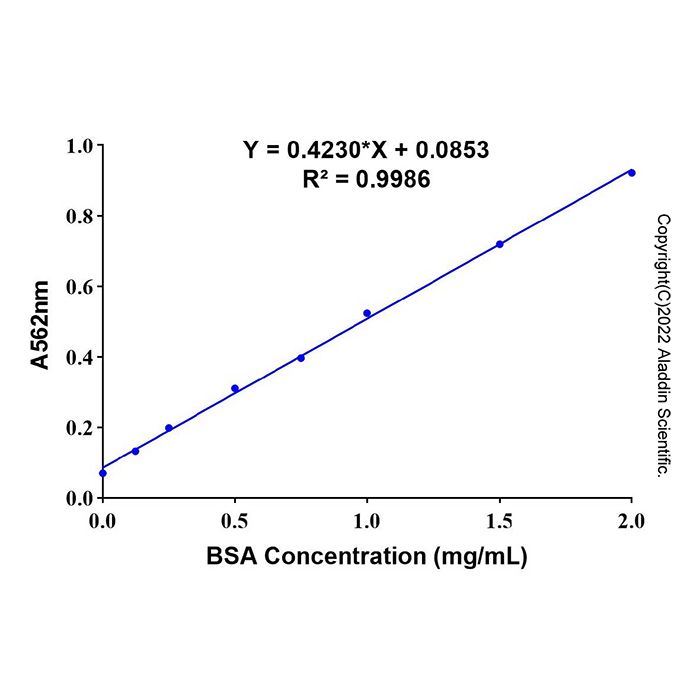
Figure 1. The actual measurement result of the protein standard curve of this kit. The data shown in the figure are for reference only; the actual detection outcome may vary slightly.
Usage Method
1. Preparation of BCA working solution:
Based on the number of samples, prepare an appropriate amount of BCA working solution by mixing reagent A and reagent B in a volume ratio of 50:1, and mix thoroughly. When the two are mixed, a precipitate will form, but it will disappear after thorough mixing. Note: Shake reagent A well before preparing the BCA working solution. The newly prepared BCA working solution can be stably stored at room temperature for 24 hours under sealed conditions.
2. Microplate Assay Method
(1) Take 10 μL of the standard sample and the unknown sample and add them to the corresponding labeled microplates.
(2) Add 100 μL of BCA working solution to each well and mix well and shake for 30 seconds.
(3) Stop the shaking. For most cases, place at 37 ℃ for 30 minutes; Note: It can also be placed at room temperature for 2 hours or at 60 ℃ for 30 minutes. When using the BCA method to determine protein concentration, the color will deepen over time, and the color development reaction will accelerate due to the increase in temperature. If the concentration is low, it is suitable to incubate at a higher temperature or extend the incubation time appropriately.
(4) Measure the absorbance at 562 nm in the reading instrument.
(5) Draw a standard curve and calculate the protein concentration in the sample. If the protein concentration is not within the range of the standard curve, please dilute the sample and measure it again.
Notes:
1. During the BCA protein determination process, the color will gradually deepen over time. The speed of the color development reaction is related to the temperature. It is necessary to ensure that the reaction is carried out at a fixed time and temperature to achieve precise quantification.
2. For long-term storage, if you find that reagent A or reagent B of BCA has precipitation. Please incubate at 37ºC with stirring to facilitate its complete dissolution. If bacterial contamination is detected, it should be discarded.
3. Follow the experimental operation procedures strictly to improve the accuracy of the sample loading volume.
4. For each determination, a corresponding standard curve should be made because the color development reaction is related to changes in temperature and time. Precise protein quantification should be done with a standard curve every time.
5. If the protein sample is precious or in small quantity, 5 μL of the sample and the standard can be taken to the corresponding labeled microplate wells, and 95 μL of BCA working solution can be added. This will not affect the determination of concentration.
6. All products of our company are only for research use. Professional personnel must operate and wear masks, gloves, and laboratory coats, and follow the safety operation procedures of the biological laboratory.
Interferon Substance List 1
.png)

 ZJ26F0434245