
Determine the necessary mass, volume, or concentration for preparing a solution.
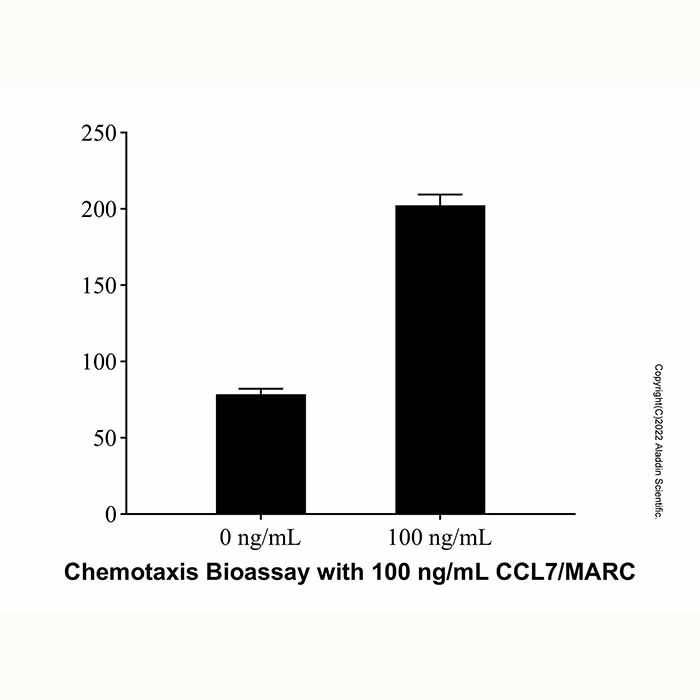
Recombinant Mouse CCL7/MARC Protein (rp186590) - Bioactivity
Determined by its ability to chemoattract human monocytes using a concentration range of 10.0-100.0 ng/mL.
Carrier Free, Bioactive, ActiBioPure™, High Performance, ≥90%(SDS-PAGE), See COA ActiBioPure™,Bioactive,Carrier Free,High Performance for sensitive chromatographic and analytical workflows requiring minimal baseline interference.
Store at -20°C,Avoid repeated freezing and thawing Ships Ice chest + Ice pads Check lot-specific COA for exact specifications.
SDS, COA, datasheet, and spec sheet available for download. Lot-specific COA accessible via lot number lookup.
Cited in 0 peer-reviewed publications across chromatography, organic synthesis, and cross-coupling reactions.
Mouse MARC, a member of the beta subfamily of chemokines, was initially identified as a transcript that is induced in a mouse mast cell line after Fc epsilon RI triggering by IgE plus antigen. Sequence comparisons suggest that MARC may be the mouse homologue of the human MCP-3 gene. Mouse MARC/MCP-3 expression has also been detected during murine experimental allergic encephalomyelitis in the spinal cord, and in LPS-stimulated murine WEHI -3 cells and Swiss 3T3 cells where MARC expression is glucocorticoid-attenuated. Except for one amino acid subsititution, mouse MARC is identical to mouse FIC, the product of a growth factor-activated gene. The mouse MARC cDNA encodes a 97 amino acid residue precursor protein with a 23 amino acid residue signal peptide that is cleaved to yield a 74 amino acid residue mature protein. Mouse CCR2, a mouse chemokine receptor, has been shown to bind JE/MCP-1 with high affinity and MARC/MCP-3 with lower affinity. The E. coli-expressed mouse MARC/MCP-3 produced at R&D Systems has been shown to be a monocyte and T-lymphocyte chemoattractant.
Recombinant Mouse CCL7/MARC Protein (rp186590) - Bioactivity
Determined by its ability to chemoattract human monocytes using a concentration range of 10.0-100.0 ng/mL.
Recombinant Mouse CCL7/MARC Protein (rp186590) - SDS-PAGE
3 μg/lane of Recombinant Mouse CCL7/MARC Protein was resolved with SDS-PAGE under reducing (R) and non-reducing (N) conditions and visualized by Coomassie® Blue staining, showing a band at 12.2 kDa under reducing conditions and 12.9 kDa under non-reducing conditions.
Comprehensive hazard, handling, storage, and regulatory compliance document.
Download SDS →Lot-specific quality data. Enter your lot number to retrieve the exact COA.
Look up COA →Full quality attributes and acceptance criteria for this grade.
View spec sheet →Find and download the COA for your product by matching the lot number on the packaging.
| Lot Number | Certificate Type | Date | Item |
|---|---|---|---|
 ZJ25F0218261 ZJ25F0218261 | Certificate of Analysis | Dec 15, 2025 | rp186590 |
| ZJ25F0218262 | Certificate of Analysis | Dec 15, 2025 | rp186590 |
| ZJ25F0218263 | Certificate of Analysis | Dec 15, 2025 | rp186590 |
| ZJ25F0218264 | Certificate of Analysis | Dec 15, 2025 | rp186590 |
Our grade selection guide covers purity, stabilizer status, and application suitability for all variants in our catalog.
View Carrier Free grade guide → View Bioactive grade guide → View ActiBioPure™ grade guide → View High Performance grade guide →