
Determine the necessary mass, volume, or concentration for preparing a solution.
| Activity Type | Activity Value -log(M) | Mechanism of Action | Activity Reference | Publications (PubMed IDs) |
|---|
Moligand™, 10mM in DMSO Moligand™ for sensitive chromatographic and analytical workflows requiring minimal baseline interference.
Store at -80°C Ships Dry ice packs + Cold packs Check lot-specific COA for exact specifications.
SDS, COA, datasheet, and spec sheet available for download. Lot-specific COA accessible via lot number lookup.
Cited in 0 peer-reviewed publications across chromatography, organic synthesis, and cross-coupling reactions.
Information
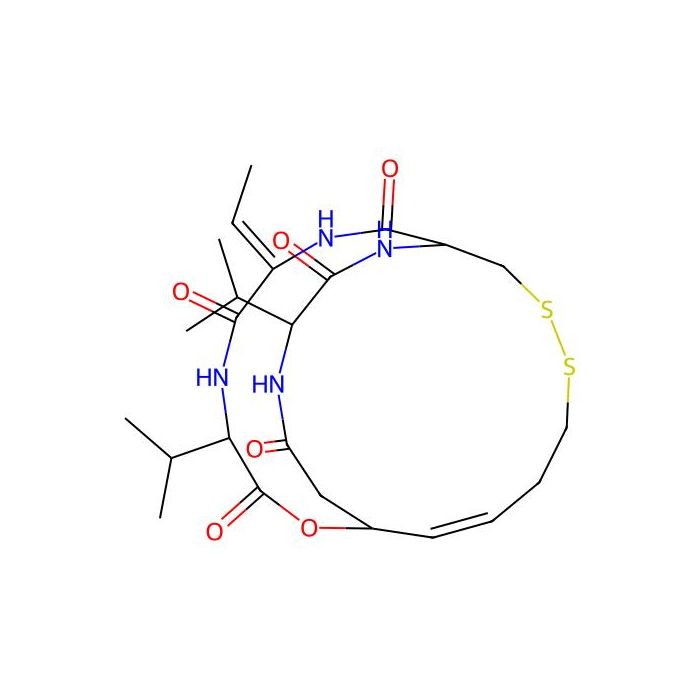
Romidepsin (FK228, Depsipeptide, FR 901228, NSC 630176) is a potentHDAC1andHDAC2inhibitor withIC50of 36 nM and 47 nM in cell-free assays, respectively. Romidepsin (FK228/depsipeptide) controls growth and inducesapoptosisin neuroblastoma tumor cells.
In vitro
Unlike TSA, the active form redFK of Romidepsin strongly inhibits HDAC1 and HDAC2 with IC50 of 1.6 nM and 3.9 nM, respectively, but is relatively weak in inhibiting HDAC4 and HDAC6 with IC50 25 nM and 790 nM, respectively. Romidepsin is 17-23 times weaker than redFK in inhibiting these HDACs with IC50 of 36 nM, 47 nM, 510 nM, and 14 μM, respectively. Romidepsin treatment in HeLa cells induces histone acetylation and p21 expression with EC50 of 3.0 nM, more strongly than redFK with EC50 of 11 nM due to the instability of redFK. In addition to G2/M arrest, Romidepsin treatment causes cyclin D1 downregulation and a p53-independent p21 induction, leading to inhibition of CDK and dephosphorylation of Rb resulting in growth arrest in the early G1 phase. Romidepsin is 100 times more potent than TSA and 1,000,000 times more potent than butyrate in inhibiting the proliferation of the A549 cells. Romidepsin inhibits the growth of U-937, K562, and CCRF-CEM cells with IC50 of 5.92 nM, 8.36 nM, and 6.95 nM, respectively. Romidepsin promotes apoptosis in chronic lymphocytic leukemia (CLL) cells at a concentration corresponding to that at which H3 and H4 acetylation and HDAC inhibition occurs, selectively involving activation of caspase 8 and effector caspase 3, as well as down-regulation of c-FLIP protein. In 11 of 13 (85%) renal cell carcinoma cell lines and in 16 of 37 (43%) other cancer cell lines, Romidepsin treatment up-regulates tumor death receptors, and potentiates natural killer (NK)-mediated tumor killing. Romidepsin exhibits concentration-dependent cytotoxicity against a panel of mantle cell lymphoma (MCL) cell lines.
In vivo
Romidepsin treatment potently inhibits the neovascularization of chick embryo and that of adult mice in the Matrigel plug assay. Administration of Romidepsin at 0.1-1 mg/kg twice a week significantly prolongs the survival of mice bearing U-937 lymphoma, with median survival times of 30.5 (0.56 mg/kg) and 33 days (0.32 mg/kg), respectively (vs. 20 days in control mice).
Cell Data
cell lines:IGF-1R-Sal, RH41 and Geo cell lines
Concentrations:Dissolved in DMSO, final concentrations ~10 μM
Incubation Time:72 hours
Powder Purity:≥99%
| ALogP | 2.2 |
|---|
| Isomeric SMILES | C/C=C\1/C(=O)N[C@H](C(=O)O[C@H]\2CC(=O)N[C@@H](C(=O)N[C@H](CSSCC/C=C2)C(=O)N1)C(C)C)C(C)C |
|---|---|
| RTECS | YV9399000 |
| PubChem CID | 5352062 |
| Molecular Weight | 540.7 |
Comprehensive hazard, handling, storage, and regulatory compliance document.
Download SDS →Lot-specific quality data. Enter your lot number to retrieve the exact COA.
Look up COA →Full quality attributes and acceptance criteria for this grade.
View spec sheet →| Activity Type | Activity Value -log(M) | Mechanism of Action | Activity Reference | Publications (PubMed IDs) |
|---|
| Activity Type | Activity Value -log(M) | Mechanism of Action | Activity Reference | Publications (PubMed IDs) |
|---|
| Activity Type | Activity Value -log(M) | Mechanism of Action | Activity Reference | Publications (PubMed IDs) |
|---|
| Activity Type | Activity Value -log(M) | Mechanism of Action | Activity Reference | Publications (PubMed IDs) |
|---|
| Activity Type | Activity Value -log(M) | Mechanism of Action | Activity Reference | Publications (PubMed IDs) |
|---|
| Activity Type | Activity Value -log(M) | Mechanism of Action | Activity Reference | Publications (PubMed IDs) |
|---|
| Activity Type | Activity Value -log(M) | Mechanism of Action | Activity Reference | Publications (PubMed IDs) |
|---|
| Activity Type | Activity Value -log(M) | Mechanism of Action | Activity Reference | Publications (PubMed IDs) |
|---|
| Activity Type | Activity Value -log(M) | Mechanism of Action | Activity Reference | Publications (PubMed IDs) |
|---|
| Activity Type | Activity Value -log(M) | Mechanism of Action | Activity Reference | Publications (PubMed IDs) |
|---|
| Activity Type | Activity Value -log(M) | Mechanism of Action | Activity Reference | Publications (PubMed IDs) |
|---|
| Activity Type | Activity Value -log(M) | Mechanism of Action | Activity Reference | Publications (PubMed IDs) |
|---|
| Solubility | Solubility (25°C) In vitro DMSO: 69 mg/mL (200.95 mM); Ethanol: 69 mg/mL (200.95 mM); Water: Insoluble; |
|---|
Our grade selection guide covers purity, stabilizer status, and application suitability for all variants in our catalog.
View Moligand™ grade guide →